Loretta on the Line
On Halloween night in Kettle Bend, radio host Rudy takes a call from Loretta, a singer missing for sixty years, and joins his mentor Joan in a race to uncover the truth before dawn silences her forever. Amid bickering ghosts and a town reluctant to admit its mistakes, they discover Loretta’s accidental death and expose the theft falsely blamed on her—only for Rudy to learn that Joan, too, has been a ghost throughout the night. As the reunited friends depart together, Rudy begins learning to care without supplying comforting answers, finding solace in the living company still beside him.
By MyAudioBooks.ai ·
Listen free: Loretta on the Line
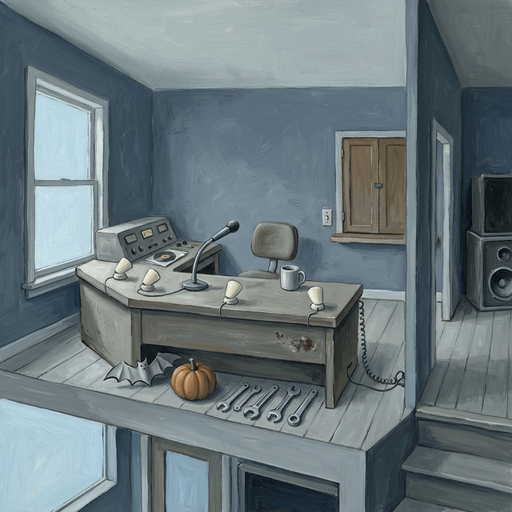
Rudy slid a second mug beside the empty chair while Beryl accused him, live on air, of frightening customers away from the hardware store.
"That cannot be right. My window display has a ghost, a tasteful pumpkin, and a very reasonably priced adjustable wrench."
"The ghost is wearing your face."
"An unfortunate manufacturing error."
Beryl had retired from the shop downstairs, but still decorated its window and volunteered at the little station above it. She also called Rudy’s overnight program whenever his standards required correction. On Halloween, this generally happened before midnight.
He turned the empty mug so its handle faced the chair. Joan preferred it that way. There were other things he knew about the station’s founder, mentor, and most exacting listener, but he still had not discovered how to invite her to breakfast.
Sunday. His kitchen. Eggs, if he could manage them without commentary from the smoke alarm. At eighty-three, Joan had plenty of invitations to official breakfasts. Rudy wanted her at an ordinary one.
Beryl came back down the telephone line.
"You have stopped answering."
"I was respecting your contribution. Joan says I should try that."
"Try it while I am speaking."
Rudy lowered his microphone a fraction. The room smelled of warm dust from the console and the peppermint tea he had made too strong. Through the floor, the hardware store’s old pipes knocked twice.
"It is eleven forty, on October thirty-first, two thousand and twenty-four, and Kettle Bend has once again entrusted its Halloween broadcasting to a man whose employment was supposed to last one summer."
"Five summers ago."
"I am twenty-eight. I require a generous definition of temporary."
He had come to the mountain town for cheap rent and a job. Somewhere between Joan teaching him to replace a microphone cable and trusting him with the overnight hours, leaving had become something he mentioned less often.
He nudged the borrowed record back into its sleeve.
"That was Loretta, singing with the Halloween dance band sixty years ago tonight. Joan lent us the record, which she described as scratched, overrated, and absolutely not to be left near my tea."
Beryl’s line rustled.
"You talked over the beginning."
"Only the bit before the singing."
"The music."
That deserved a pause. He allowed her nearly a whole one.
The anniversary feature had sounded straightforward when he proposed it: play the record, take memories of the old Grange Hall dance, let Joan complain about his taste. Everyone in Kettle Bend knew the ending. Loretta, the singer with an audition bag packed, had taken the dance takings and left town during the Halloween festivities of nineteen sixty-four.
Rudy had repeated that account in his introduction. He had also invited anyone who remembered differently to call.
Another caller lamp lit. He brought the line up while Beryl was drawing breath for a further improvement.
A woman’s voice entered the studio, low and amused.
"The bit before the singing cost us three rehearsals, darling. You might have let them play it."
Rudy grinned at the console.
"An excellent point from a caller with excellent timing. Who have we got?"
"Loretta. And I would like my ending corrected."
He moved his tea away from the borrowed record.
"That is a very good voice. Beryl, did you arrange this?"
"No."
Loretta continued.
"You asked whether anybody remembered. I remember being accused of running off with money I never had."
"So tonight we are rehabilitating an unfairly maligned—"
"You are letting me finish a sentence."
His smile stayed in place a little too long. He lowered her volume, then raised it again. The voice matched the record, though the singer on the record had never sounded this impatient with him.
"All right. Tell us what you remember."
"I never left Kettle Bend."
Beryl, unusually, supplied no correction.
A third lamp lit, then another. Rudy answered one and heard the old hall caretaker telling him that Loretta’s bag had been waiting behind the stage. Rudy knew that dry cough. He had helped stack chairs after the man’s funeral the previous winter.
He checked the caller display, which supplied no useful explanation.
"We have somebody doing a whole cast tonight."
The next voice belonged to a retired drummer who had died in the spring. He objected to the caretaker’s description of where the chairs had stood. Another caller demanded to know why the band had been blamed for a missing coat.
The argument drew more calls, and each caller had a correction. By the time Rudy had sorted out who was answering whom, his console’s date had rolled into November first.
Beryl spoke over the growing argument.
"Rudy. Keep one line open at a time."
He obeyed. The drummer vanished into a waiting light. The caretaker’s cough stopped. Loretta remained.
"We seem to agree that you had made plans to go somewhere, which perhaps became confused with—"
"My bag had a clean blouse in it. That does not make it a confession."
"No. Fair enough. You say you stayed in town. Where did you go after the dance?"
Her answer came without the teasing cadence.
"Down. I fell. There was water inside the hall."
Rudy’s fingers stopped over the controls. Loretta continued.
"Cold water. I tried to get my face up. There was something above me, and I could not get high enough."
He had a joke ready about the hall’s plumbing. It would have been a good small joke ten seconds earlier. He swallowed it.
"Are you saying you died there?"
"I am saying I never caught my breath again."
The needle on the sound meter settled between her words. Rudy could hear his own tongue pulling away from the roof of his mouth.
Beryl broke in, brisker than usual.
"I am coming upstairs. Do not give everybody a microphone while I am on the way."
"I can manage a telephone."
"Then surprise me."
Her line went quiet. Rudy kept Loretta’s open.
He wanted the impersonation to become obvious. He wanted a laugh from somebody waiting downstairs, or a confession that Joan had hired a theatre group. Instead, Loretta asked him whether Joan had kept the record all these years.
"She brought it in herself."
"She said she could not bear my voice."
He nearly supplied an affectionate interpretation. His mouth had already begun the first word.
Then Joan’s voice came from behind him.
"I said I could not bear the way you were using it."
Joan stood just inside the studio in her brown coat and house slippers. Rudy had heard none of the stairs’ customary complaints. He had been concentrating on the callers, but usually the fifth step announced visitors to the whole street.
"Joan. You are just in time to explain whatever Beryl has not done."
Joan advanced to the empty chair without sitting.
"Turn this off."
Loretta answered from the speaker.
"Good evening to you, too."
"Whoever you are, this is an unpleasant performance."
Rudy reached toward the mute control. He could make this useful: a short break, some music, a private apology before Joan decided the whole program had been his idea.
Loretta spoke first.
"You said my dress made me look like a hotel lampshade."
Joan’s mouth tightened.
"The fringe did."
"Then you said I had packed everything except a conscience."
"After you told me to spend the rest of my life arranging chairs for people who had somewhere better to go."
Rudy took his hand away from the mute control.
Joan stared at the speaker above the console. Usually she would already have settled into the chair, but she seemed to have forgotten it entirely.
Loretta’s voice lost its ease.
"Yes. I said that."
"You were very pleased with yourself."
"No. I wanted to win."
Nothing in the borrowed record could have furnished that exchange. Rudy knew Joan well enough to recognize the particular stillness that came when somebody had struck the exact place she protected.
He poured tea into her mug. It gave his hands a useful task.
"Here. Peppermint. Aggressively peppermint. I have apparently brewed a hedge."
Joan left the mug where he set it.
"I had meant to put the kettle on at home. Then I heard this."
She indicated the second fader with a bent forefinger.
"That one is too high. You are letting the waiting callers through."
Rudy moved it himself. A mutter of objection disappeared.
He turned back to the microphone.
"Loretta, when you say you fell inside the hall, do you mean through a door, or through the floor?"
"I remember walking. Then the edge gave way under my foot. I cannot tell you what it was made of. I had a face full of water to attend to."
"Could you see a way out?"
"No."
He waited this time. Loretta added:
"Thank you for not improving that answer."
The stairs creaked all the way up under Beryl. She entered carrying her spectacles and immediately went through to the station’s other room, a narrow workroom where the telephone connections could be managed without elbowing the host.
"I have the callers. You have the questions."
Through the open doorway, Rudy watched her settle on the workroom stool, put on the spare headphones, and separate Loretta’s line from the others. She had covered enough Sunday programs to know every switch.
"Recording is running. One speaker at a time."
Loretta answered from the studio speaker.
"You may keep the sound. You cannot keep me in it."
Rudy pressed his palms against his knees.
"What does that mean?"
"You played my record. You asked us to answer. I heard you, and then I could. That has never happened before."
"We can play it again."
"It is not a doorbell."
Joan drew closer to the console.
"How long can you stay?"
"Until seven in the morning. His dawn sign-off."
Rudy leaned toward the microphone.
"Then I will not sign off."
"You can leave every little lamp shining. Seven is still the end."
Her certainty frightened him more than a crackle or a shriek would have done.
"How do you know?"
"The same way I knew I could answer you. I do not know who took the money. I do not know what happened upstairs after I fell. I know this is my last chance to speak."
Rudy tried a more practical question.
"Can you come here?"
"I can hear you here. Sometimes I am back at the hall. I have tried reaching for things there. My hand goes through. I cannot lift a latch or take somebody by the sleeve."
"But could you show us—"
"I cannot do an encore on request."
Joan’s correction came quietly.
"He is trying to help."
"Then let him ask me what help I want."
He had been thinking how extraordinary the program would sound in daylight. That thought now embarrassed him.
"What do you want us to do?"
"Find what happened. Say it while I can answer. All of it, Rudy. Not just a nicer version."
He glanced at Joan. She remained beside the untouched tea.
"If we leave it as it stands, you fall silent for good. Joan loses her chance to settle this with you. And tomorrow people still call you a thief who ran away."
"Yes."
He drew the microphone closer.
"Then we are changing the program. If you call, I will ask what you saw, not what everybody knows. That includes people I like."
Joan turned her head toward him.
He kept his hand on the microphone stand until it stopped trembling.
Beryl brought in a caller who wanted it understood that Otis had been a dependable man. The caller’s next point concerned the packed audition bag. Dependable men, apparently, were entitled to one another’s supporting evidence.
Rudy asked whether the caller had seen Loretta leave.
“No, but Otis did.”
Beryl switched to Otis.
His reedy voice had a careful warmth. Rudy remembered it from town suppers, where Otis had introduced every speaker with the same lengthy apology about keeping introductions short. He also remembered attending Otis’s funeral three years earlier.
"I would prefer that this discussion be conducted with a degree of consideration for everyone concerned."
"You were the dance treasurer that night?"
"I undertook that responsibility, yes. A number of responsibilities were undertaken."
"And you saw Loretta leave through the rear door?"
"She was observed going towards the rear, carrying her bag."
Joan spoke before Rudy could form the next question.
"The rear approach was blocked."
He turned in his chair as she continued.
"The borrowed loudspeaker cabinets were there, with the spare platform sections. They had been piled between the service passage and the outer door. You could not see that door from the dance floor."
"There was equipment, certainly."
"There was a great deal of equipment. I had to leave my coat at the front."
Rudy pulled a blank pad toward him, then pushed it aside. Otis was here. He could answer.
"Where were you standing?"
"Near the refreshment table, at that particular point."
"Could you see the rear door?"
"One was familiar with where it led."
Loretta gave a small, unamused laugh.
"So was I. I was still inside when I fell."
He had water and a blocked sightline. Two things to test, rather than a whole town’s confidence.
The callers did not appreciate the distinction.
Over the next stretch of the program, Beryl admitted them individually. One remembered the bag. Another remembered Otis returning lost raffle money on a different occasion. Someone objected that Rudy had arrived in town too recently to know the people he was questioning.
He started to say that he was only trying to give everybody a fair hearing. It sounded like a request to be liked.
Instead, he asked that caller whether they had attended the dance.
They had not.
Beryl cut off a man who wanted to discuss the station’s declining tone, then leaned through the workroom doorway.
"Otis is still waiting. The others can wait harder."
Rudy rubbed the warm indentation left by his headphones. Time had gone into identifying voices, separating arguments, and asking people to return to the question. He had stopped making jokes about the queue.
Joan’s tea had cooled.
When Beryl restored Otis’s line, Rudy tried again.
"I want to go back to where you were standing. The refreshment table faced the dance floor?"
"It occupied the same position for years."
"And the loudspeaker cabinets blocked the view of the outside door?"
"To some extent. I would not wish to contradict Joan’s memory of her coat."
"I am asking about the door."
Joan moved away from the empty chair and stood beside the speaker.
"Otis. You said you saw her go."
"At the time, the distinction hardly seemed necessary."
Rudy kept his question plain.
"It is necessary now. Did you see Loretta open an outside door?"
The waiting lines murmured until Beryl silenced them. At last Otis answered.
"No."
"Did you see her on the street?"
"No. Her departure was inferred from the circumstances. She had her bag. The money could not be found. Nor could she."
Rudy let the admission stand. He resisted the urge to soften it into a misunderstanding.
"Then we have nobody on this program who saw her leave the building."
Otis began a qualification. Beryl held his line.
Loretta spoke with unexpected weariness.
"There. That only took sixty years."
"It does not tell us about the money."
"I know. I would be delighted if being right about one thing did the whole evening’s work."
He allowed himself a brief smile. She had earned it.
Joan folded her arms.
"The audition was real. That part has not changed."
"Nobody said it had."
"You had decided that everything here was beneath you."
"I had decided I wanted to sing somewhere with a dressing room that did not contain turnip prizes."
"It was a vegetable competition. They were not all turnips."
Rudy almost rescued the exchange with a joke about professional standards. Joan’s arms were held too tightly for it.
"What did she actually say to you about leaving?"
Joan addressed the console rather than him.
"She said she would be on the morning bus. She had an audition on Monday. She had packed."
"And that she was leaving you behind?"
"That was perfectly clear."
Loretta interrupted.
"I asked you to come."
Rudy turned toward Joan. Her lips parted, then pressed together as Loretta went on.
"Not to carry my suitcase. Not to clap from the back. I said there would be work for you, too. You knew more about microphones than the man running the audition."
"You did not know that."
"Neither did you. We could have gone and found out."
Rudy rested his hands flat on the console. Joan’s approval mattered enough that he wanted to ask a different question.
He asked the one he had.
"Did she invite you?"
Joan answered with exact, reluctant care.
"Yes. She invited me."
"Then why have you always said—"
"I heard that she would go whether I came or not."
Loretta’s voice softened, but only slightly.
"I would have. I was allowed to want it."
"Yes."
She drew herself up.
"And you were needlessly cruel when I refused."
"Yes. I was."
Rudy had no tidy version to offer. An invitation could be real. A quarrel could be ugly. Neither proved that Loretta had taken anything, or crossed the town boundary, or stopped caring about the friend she had insulted.
He wanted Joan to sit down. He wanted to leave both women out of the callers’ reach. Yet Loretta’s time would run out just as surely in a private conversation.
"I am going to the hall."
Joan’s attention sharpened.
"Now?"
"I have the key you authorized for the equipment checks. I know the sound floor. If there is something unsafe, I stop. But we have spent long enough asking people which story they prefer."
Loretta answered him from the speaker.
"Do not expect me to know where to point."
"Tell me what you remember. I will do the pointing."
Beryl was already checking the telephone connection.
"Call the studio from your mobile. I will connect it so the listeners and the callers can hear you away from here. Keep it near your mouth. No pocket commentary."
Rudy took his charged telephone from beside the console. He fetched the ordinary torch from the equipment shelf, checked its beam, and passed his right hand through the wrist loop. The hall key went into his coat pocket.
Joan waited at the stair entrance.
"I am coming."
He had hoped she would.
At two twelve in the morning, Beryl tested his voice through the live connection and told him to stop breathing directly into it. He obeyed. Behind her, Otis was requesting an opportunity to clarify his clarification.
Rudy took the stairs with his free hand on the rail. Joan followed. His own footsteps made so much noise that he concentrated on keeping them out of the telephone.
Outside the hardware store, he paused under Beryl’s Halloween decorations.
A paper bat hung sideways against the window. One wing had folded behind its body, leaving it in a position of considerable private embarrassment. Beryl had spent the afternoon cutting those bats at the shop counter. He remembered her keeping the smallest scraps out of the lock.
Joan waited on the pavement while callers murmured from the telephone in his left hand. Rudy lifted the loose wing with one finger and straightened the bat beneath its strip of tape. He pressed the corner flat. Nobody inside the studio could see him, and he offered no explanation to the microphone.
Then he turned toward the hall.
The walk took eight minutes. Rudy knew it from carrying station equipment there, and from returning for whatever cable he had forgotten. Tonight he had checked both coat pockets before leaving.
Joan kept beside him as they passed the closed bakery. He adjusted the telephone so she could speak without leaning toward it.
"Loretta, Otis saw you head toward the rear. You said you were still inside. Were you trying to leave?"
"I was in the service passage. That is not the rear exit."
Joan added:
"It leads behind the stage."
"Yes. And the outer door was farther along, past all that stacked equipment. I never reached it."
Rudy stepped around a raised paving stone. The torch knocked lightly against his cuff.
"Did you fall before you got behind the stage, or after?"
"I cannot put it in that order. There was less light. I remember my shoe slipping, then the water."
"All right. We will start with what we can see."
He could hear Beryl adjusting the callers at the other end. Otis remained among them, audible in a brief request that the hall be treated respectfully.
A woman who had called earlier about Otis’s good character returned to the line.
“Surely an accident would be enough. Give the poor girl a dignified ending. Nobody wants a quarrel at this hour.”
Rudy drew the telephone nearer.
"An accident may explain the fall. We have not found it yet. It would not explain the missing money."
“Must it all be dragged up together?”
Loretta answered before he could.
"It was put on me together."
Joan walked with her face turned toward the hall. He wished he could offer her the easy assurance he usually supplied: that she had done her best, that everyone understood, that this would come right.
He could still offer breakfast on Sunday. The thought steadied him. He could ask difficult questions tonight and ask her to his kitchen afterward. One need not cancel the other.
At the hall’s front steps, Joan stopped beside him.
"I did keep the record."
Loretta let a little time pass.
"I heard."
Rudy climbed the last step. His watch showed two twenty in the morning, November first. The telephone stayed live in his left hand; the torch hung from its loop at his right wrist, and the authorized key remained in his coat pocket.
The caller was still speaking about a dignified accident. Joan stood close beside him, her hands at her sides.
Rudy wanted a dry floor under his feet and something true to tell them. He closed his right hand around the stubborn front-door handle and began to test it.
The handle gave a little, then stopped. Rudy let it return without another wrench. Through the telephone in his left hand, the caller was still arranging Loretta’s dignified ending.
He brought the telephone to his mouth.
"I am putting you in my pocket while I unlock the door. Any remarks about the quality of the lining will be ignored."
He slipped it into his coat, steadied the dangling torch against his wrist, and fetched the key with his right hand. The lock turned cleanly. Once the door stood open, he returned the key to his pocket, took up the torch, and retrieved the telephone with his left.
Joan followed him into the Grange Hall. Their voices acquired the flat echo Rudy knew from equipment checks. He pulled the door shut himself.
"Front entry. Clear floor to the stage. I am staying on the route we use for the sound equipment."
His beam crossed the dance floor and found the shallow stage apron. Beside it, a glass-fronted notice cabinet marked the entrance to the service passage.
Joan stopped near the place where the refreshment table had stood.
"The platform sections were across that opening."
Loretta answered through the telephone.
"Some of them. I could get into the passage."
"I said the outer door was blocked."
"You pointed at the passage."
Rudy held the telephone between them.
"For the benefit of listeners, there has been pointing. It has not produced agreement."
That earned no reply. He crossed the floor slowly, checking the boards ahead rather than letting either woman’s remembered certainty choose his footing.
The notice cabinet contained a faded notice about keeping the passage clear. Rudy had encountered several varieties of municipal optimism, but this one had endured particularly well.
He stopped beside it.
"Loretta, did you pass this cabinet?"
"I remember glass. I checked my hair."
Joan turned toward the telephone.
"During a quarrel?"
"My hair had work to do afterward."
Rudy lifted the torch. His reflection brightened in the cabinet glass.
A woman’s wet face rose behind his shoulder. Water lay across her open eyes. A dark curl clung to her cheek, and her lips moved before the telephone carried the words.
"There. I remember standing there."
He turned too quickly. A damp outline stood between him and the passage, indistinct at the edges. He could see the cabinet’s lower corner through her dress.
His right hand went out to steady her.
It passed through her shoulder and struck the cabinet catch. A sharp edge dragged across his palm.
"Damn!"
The torch swung on its loop, throwing the beam over the ceiling. He caught it against his coat. A thin red smear crossed the heel of his hand.
Joan stood where he had left her.
"Put your hand against something clean."
Rudy tucked the telephone into his pocket long enough to pull out his handkerchief. His fingers wanted to shake; he gave them the simpler job of folding the cloth.
"Well, that is one way to—"
The rest of the joke failed to arrive. He left it there.
Loretta’s outline thinned. The passage showed through her face, then she was gone from everything except the telephone.
"I told you I could not be caught."
He retrieved the telephone and held the handkerchief against his palm with the torch handle.
"You did. I heard it rather late."
Beryl came onto the connection.
"Are you hurt?"
"Scraped palm. Small. I am staying here until I have it sorted."
"Good. The callers can also stay where they are."
Joan examined the cabinet without approaching the catch.
"That fitting should have been replaced years ago."
He would usually have supplied a remark about the hall’s maintenance budget. Instead, he pressed the cloth more firmly against the sting and waited until he could hold the torch without slipping.
He had wanted something true. The small spot of blood on his handkerchief was more truth than he had expected from a notice cabinet.
Rudy tucked the stained handkerchief away and moved onto the stage apron when his hand had stopped bleeding. From there he could see down the service passage, but he kept his feet on the boards he knew.
The rear of the hall had changed since the dance. A partition had disappeared; a store cupboard had gained a door; callers disagreed about whether an old opening had ever been a doorway at all. Beryl admitted them separately. Rudy asked each to describe where they had stood, and reported what his beam actually found.
The dead caretaker remembered the water supply being shut off, not the tank being filled in. Another caller insisted there had been a washroom behind the stage. Joan placed that washroom on the opposite side.
An hour went into separating the building people remembered from the building beneath Rudy’s feet.
Then Otis requested time to explain that many old halls contained water.
Rudy drew the telephone nearer.
"Did you know of a tank behind this stage?"
"There were former arrangements for washing and fire precautions. One cannot be expected to recall every alteration."
"Then we will ask someone who does."
The answer came in pieces, through corrections and impatient repetitions. Rudy stayed at the apron while Beryl sorted them. He made one cautious journey down the clear passage, stopping at the turn where his familiar flooring ended, then returned rather than testing a dark patch with his weight.
Joan grew increasingly exact about distances. Loretta grew quieter.
By the time the callers agreed that the old water store had been a covered cistern beneath the rear stage, Rudy’s legs ached from standing. He had heard the audition bag mentioned so often that he could have described it more confidently than the shoes on his own feet.
He brought Loretta back to the last thing she remembered before the fall.
"You were in the passage. What were you going there to do?"
"Get out of Joan’s way."
Joan folded her arms.
"You had made that clear."
"And then I stopped being pleased with what I had said."
Rudy waited. The telephone pressed a warm rectangle against his left ear.
Loretta continued in an ordinary voice.
"I had another song to do. I was going back toward the stage. I meant to say I was sorry before I sang it."
Joan’s arms loosened.
"You turned back?"
"Yes. I could want the audition and still want you to speak to me."
Joan turned toward the passage.
"There was a cover. Beyond the old scenery recess. We used to be told to keep off it."
"The cistern cover?"
"Yes. I had forgotten it was under that part of the stage."
He asked Beryl to return the caretaker’s line. The man remembered an inspection opening in the side of the raised rear stage, reached from the passage. It had fixed iron bars, and a wooden shutter outside them.
Rudy had passed that shutter during equipment checks. He had assumed it covered ventilation.
He made the route slowly, checking the clear boards in his torch beam. Joan came beside him without offering to carry anything. At the recess, he stopped on solid flooring and described the shutter aloud.
Before he opened it, Joan spoke.
"Her shoes had oval buckles. Little brass leaves around the edge. One leaf was missing from the right buckle. She caught it in a bus step."
Loretta answered with a trace of her old annoyance.
"They were expensive shoes."
"You told me that while I was trying to mend it."
Rudy pocketed the telephone again. He transferred the torch to his left hand, released the shutter’s simple hook with his sore right, and pulled the wood aside.
The bars remained firmly set in the frame.
Beyond them, the beam found stone, old timber and a low collar around the cistern. Part of its cover had fallen inward. Through the gap, water reflected a pale piece of the torch beam.
He changed the angle.
A shoe lay below the broken edge, partly submerged. Its oval buckle had a border of tiny leaves. One space interrupted them.
Farther along were the remnants of cloth and the pale, unmistakable shape of human bones.
Rudy planted both feet, shifted the torch into his right hand and retrieved the telephone with his left. He rested the torch against a bar, taking its weight off the scrape.
"There is a shoe. Oval buckle. A leaf missing from the edge. There are remains in the cistern."
His voice sounded too loud in the passage. He lowered it.
"I am outside the bars. I am going no farther."
Loretta appeared on the other side of the opening.
This time he saw all of her. The fringed dance dress clung darkly to her legs. Water ran from her hair to her jaw without reaching the floor. Her left arm rested across her body, held wrong at the elbow, and her shoes stood beneath her skirt with their little brass buckles.
She raised her face toward the broken cover.
"I kept trying to get back to that edge."
The words came with effort. Rudy could hear the remembered water in them.
"It broke farther each time I reached."
He wanted to step toward her. His palm supplied a quick, useful warning.
"You can stop reaching now. We have found you."
Loretta lowered her gaze to him.
"You have."
Joan stood close to the bars. Her mouth moved once before she spoke.
"I thought you were on the bus."
"I know."
For several breaths, Rudy heard only the telephone connection and the faint rustle of his coat.
Then Beryl brought forward the caller who had wanted a dignified ending. The woman proposed a small memorial in the hall. No mention of scandal was necessary. They could acknowledge that Loretta had died tragically before she could put matters right.
Rudy’s ready-made introduction arrived almost complete: a young singer, a terrible accident, a community remembering with compassion.
He could have delivered it warmly. People would have thanked him.
He kept the microphone end of the telephone near his mouth.
"What matters did she need to put right?"
The caller referred to the money.
Loretta’s face lost the relief Rudy had just seen.
"You would put flowers over it and leave me underneath."
Joan turned from the opening.
"We can at least announce the accident. It would give people something decent to say."
"Yes. And they would still be saying she stole the takings."
"You have found her, Rudy."
"That answers where she went. It does not answer what we have said she did."
Joan held herself very straight. He wanted her approval so badly that the next words took more effort than opening the shutter.
"Beryl, notify the authorities on the other connection. Tell them exactly where the opening is. Nobody should enter the cistern. We are coming back."
He described the access once more, then pocketed the telephone long enough to close the shutter and check its hook with his left hand. He took the torch back from the bar and slipped his wrist through its loop. Loretta’s voice remained on the telephone after her figure disappeared.
At five fifty-five in the morning, with the torch hanging from its loop, Rudy locked the hall’s front door. He returned the key to his coat, retrieved the telephone and took the eight-minute route to the station, Joan beside him.
Otis was asking Beryl for a private conversation.
Rudy reached the studio at six oh three. The warmth made his scraped palm sting again. He ended the mobile patch and set the telephone beside the console, then left the torch on the equipment shelf. At the workroom sink, he washed the scrape and let Beryl fasten a simple dressing over it while a caller explained that the program had become unpleasant.
Through the open doorway, Rudy heard his own name coupled with ingratitude.
Beryl smoothed the last strip of tape.
"You can bend your fingers?"
He did.
"Yes. Not elegantly."
"A familiar condition."
She returned to the caller controls. Rudy took his place at the console. Joan stood beside the second chair, her cold tea still untouched.
The next caller had listened to him for years and would not again. Another demanded an apology to Otis. Beryl kept each contribution short, but the objections were real and the minutes went with them.
Rudy asked each caller the same question: had they seen Loretta take the money?
None had.
Joan waited until he lowered the live microphone.
"There are people listening who trusted him."
"I know."
"You sound as though that is nothing."
He turned toward her.
"It is why the question matters."
She faced the speaker instead. He had never felt the distance between her and his chair so plainly.
Beryl leaned into the doorway.
"Otis wants you off air. I can put him in your headphones. Loretta will stay separate."
Rudy started a quiet instrumental record from the station shelf, lowered the studio microphone and selected the private talkback.
"This conversation is private. What do you want to tell me?"
Otis’s careful warmth had become thin.
"There may be an accommodation. You have established the unfortunate accident. I could clarify the financial aspect for your own understanding, provided the broadcast respected the good work undertaken by others."
"You want me to know what happened and leave everyone else believing she took the money?"
"I would not put it in those terms. One could say the discrepancy was unrelated."
"Who would say it?"
"You have considerable skill with words."
Rudy rested his dressed hand beside the faders.
"Yes. That has been part of the trouble."
Otis began describing years of service. Rudy let him finish. It was a long account, and the console clock moved while he listened.
Then Rudy answered.
"I will not broadcast this private conversation. I will also not make that bargain. If you agree to return to the live line, I will ask you directly about the money."
"You have no proof that I took it."
"The cistern does not prove that. Neither does the blocked door. I am asking you to answer."
Otis remained silent long enough for Rudy to hear a chair creak in the workroom.
"I will answer, if the questions are fairly put."
Rudy told Beryl to restore the line. He faded the music, brought up his microphone and stated that Otis had agreed to further public questions.
No accidental switch would do this for him.
"Otis, you told people you saw Loretta leave. You have acknowledged tonight that you never saw her reach the outside door or the street. Why did you say you had?"
"It seemed the reasonable conclusion. Her bag was gone. She was gone."
"A conclusion is what you thought. A sighting is what you told people."
"People were demanding an explanation."
Joan moved closer to the console.
"I was demanding one."
Otis’s voice steadied.
"Quite. Joan understood the circumstances. She knew how the girl had spoken, what plans had been made—"
Joan interrupted him.
"I knew we had quarrelled. I knew she had packed for an audition. I knew nothing about the money."
Rudy gave her room to continue. She drew nearer to the microphone without touching it.
"You cannot use me to establish that she stole it."
Otis began again with the missing bag.
Rudy stopped him.
"Did you take the dance takings?"
"There was an amount which I intended to replace."
"Whose money was it?"
"The dance money."
Rudy kept his sore hand flat.
"Did you take it for yourself?"
"Temporarily. I had spent more than I could meet. I expected to manage it before anyone required the full sum."
"And when Loretta could not be found?"
"The explanation presented itself."
"You presented it."
Otis made a small sound of objection, then stopped.
"Yes. I said I had seen her leave. I thought she had gone. I thought she could start again somewhere else."
Loretta’s voice came from the studio speaker.
"With what name?"
Otis offered no answer.
She continued without raising her voice.
"You knew I needed people to trust me enough to give me work."
Otis answered her.
"I did not know you were beneath the stage."
"That is true. It is also a different answer."
The caller lamps shone in a row. Beryl admitted none of them.
Joan waited until Otis’s line had been lowered.
"There is something I must correct as well."
Rudy turned the microphone toward her, moving it himself.
"I told people that Loretta had taken the receipts and run away. I repeated it as something I knew. I had seen neither thing."
Her voice became slower, more exact.
"I was angry that she would go without me. It was easier to be angry with a thief than to wonder whether she had wanted me there. When people asked, I supplied the accusation again. I did that for years. I should not have done it."
Loretta let the silence last.
"You should not."
Joan bowed her head.
"No."
"And I should not have said you would spend your life arranging chairs. I wanted you hurt enough to change your mind. That was a rotten thing to do."
Rudy felt the impulse to tell them that they had both done their best. He took a sip of cold tea instead.
Loretta continued.
"I was coming back to apologize for that. Not for wanting to sing."
"I understand the distinction."
"At last."
Joan gave a short, reluctant nod.
At six forty-three, Rudy stated the account plainly.
"Otis took the dance receipts. He invented the claim that he had seen Loretta leave. Loretta took no money. She turned back toward the stage intending to apologize to Joan, and died when the old cistern cover failed beneath her. Joan repeated an accusation she did not know to be true. Their quarrel did not cause the cover to fail. Wanting an audition did not make Loretta a thief."
Loretta broke in.
"I had already put the bag down when I turned. I remember that now. Beside the scenery."
Rudy accepted the correction.
"She had put the bag down. She was going back."
Joan faced the speaker.
"I wish you had reached me."
Loretta answered quietly.
"So do I."
Beryl came out of the workroom at six forty-four with her coat over one arm. Rudy had the caller controls now; the last questions had been answered, and he had told the listeners that the remaining minutes belonged to the women.
He lowered the microphone.
"Would you go round to Joan’s? Check the house and fetch her shoes. She came out without stopping for anything."
Joan glanced down at her slippers.
"I had meant to make tea."
Beryl paused at the stair entrance.
"Was the door locked?"
"I do not lock it while I am up."
Beryl put on her coat.
"Five minutes there. I will call you privately."
Her steps complained all the way down. Rudy settled his headphones more comfortably, reopened the studio microphone and put on the instrumental record again, quietly beneath their voices.
Joan remained beside the chair.
He wanted to tell her that the callers would forgive him. He wanted her to say she was proud of the broadcast. Instead, he asked whether the microphone was close enough.
"Yes. Leave it."
He did.
At six forty-nine, Beryl’s private line lit. Rudy lowered the studio microphones before answering in his headphones.
Her voice was very plain.
"Rudy, I could see Joan in her armchair through the window. She did not answer. The door was unlatched. I went in."
He turned toward the workroom, away from Joan.
"What do you mean?"
"She is unresponsive. I have called for an ambulance. I am following their instructions."
His right hand closed on the edge of the desk. The dressing pulled.
"Could she have fainted? Is she warm?"
"I will tell you when help gets here."
He disconnected Beryl’s private channel and left the record playing. He put Loretta on the studio’s private talkback. The public microphone stayed down.
Joan stood near the untouched mug.
Rudy remembered the stairs. Her finger indicating the fader. The key, the telephone, the torch, all carried by him. He had crossed a town with her and never heard her shoes.
He pulled off the headphones.
"Beryl says you are at home."
Joan’s expression sharpened in familiar objection.
"I came here."
"She found you in your chair."
Joan looked down at her hands.
"I sat down to hear the anniversary introduction. I was going to make tea afterward."
Rudy waited.
"Then Loretta spoke. I came by the usual way. I remember deciding to come."
Loretta’s voice reached them from the speaker.
"Joan?"
Joan turned toward it.
"I thought I had walked."
Rudy pressed his good hand over his mouth. There were things to check, people to telephone, a house that would need securing. He could name a dozen tasks. None would get her into the chair beside him.
The private line lit again before seven.
He put the headphones on.
"The paramedics are here. Joan is dead, Rudy. They say she has been gone for hours."
He bent toward the console, keeping his face away from the studio microphone.
"There is nothing they can do?"
"No."
He thanked her. She said she would return when the responders no longer needed her.
After the line closed, he sat with the headphones in his lap.
Joan waited. For once, she had no correction ready.
Rudy turned to her.
"I was going to ask you to breakfast."
His voice sounded young to him. He disliked that and let it sound young.
"Sunday. At my place. Eggs and toast. I kept waiting until I could make it sound casual."
Joan’s mouth trembled once.
"You could have asked directly."
"I know that now."
"I would have come."
He nodded, though there was nowhere useful to put that answer.
She drew closer.
"And I would have eaten what you made. You need not have passed an examination."
"The toast might have."
A little of her usual severity returned.
"Then you would have made more toast."
He managed a breath that hurt less than the previous one.
Loretta became visible beside her, still in the wet fringed dress, her injured arm held close. Rudy had no impression of an entrance. She was simply there when Joan turned.
The women faced one another across sixty years of difference. Loretta offered her good hand. Joan took it.
Their fingers held.
Rudy kept his hands in his lap. Joan spoke first.
"I did keep the record."
"Yes. And you let him talk over it."
"I had not arrived yet."
Loretta studied the brown coat.
"You used to have a green one."
"Blue."
"A very green blue."
Rudy let them have it.
When he returned Loretta’s line to the broadcast and raised his microphone again, he checked the level with his left hand. There was still time for a farewell, though no longer enough to mistake it for anything else.
"Joan and Loretta are here with me. The account we gave you tonight is corrected. The authorities have been told where Loretta lies. They will see to her safely."
He paused until he could continue.
"I am glad we heard her answer."
Loretta faced the microphone.
"So am I. Next time you listen to somebody sing, give the band their beginning."
Joan’s hand remained in hers.
"And let people finish."
Rudy nodded.
At seven in the morning, he gave the station’s name and the date, November first. He thanked the listeners, Beryl, Loretta and Joan. He said goodbye to both women without disguising it as a promise.
Then he lowered the microphone.
Joan held his gaze. Loretta drew a little closer to her, and the two women vanished together.
The console remained lit. The record turned. Rudy stopped it and sat in the ordinary room until he could stand.
He put the hall key back on its hook. He left the telephone charging and made a short list of people he would need to call about Joan, then turned the paper facedown. Those calls would be private. He rinsed the mugs and filled the kettle.
Beryl returned while it heated. Her steps sounded from the bottom stair, heavy and familiar.
She hung her coat by the door.
"They have taken over at the house. It is secure."
Rudy nodded and set tea to steep.
"Will you stay a bit?"
Beryl pulled out the second chair.
"I thought I might. I was going to say—"
She stopped. He brought her the second mug and waited without offering her the end of the sentence.
At seven fifteen, the hardware store’s shutters rattled open below, and Beryl sat with both hands around her tea while Rudy let her pause remain unfilled.