Letters of Marque and Fortune: Prize Courts and the Forbes Family Myth
Privateering turned merchant ships into state-sanctioned weapons, but only prize courts could transform a violent seizure into lawful profit—testing every capture through manifests, testimony, and competing claims of ownership. Though a War of 1812 privateer named Cleaveland Alexander Forbes existed, archival evidence shows the famed Boston Forbes fortune arose instead from China trade, opium, and railroads, exposing how easily romantic legends collapse under the scrutiny of ledgers and court records.
By MyAudioBooks.ai ·
Listen free: Letters of Marque and Fortune: Prize Courts and the Forbes Family Myth
A government slip of paper turns an act of armed robbery into legitimate warfare, yet the ship that takes the prize cannot touch a penny until a judge reads through the cargo manifest. During centuries of Atlantic naval conflict, a letter of marque permitted privately owned merchant vessels to hunt enemy shipping for private profit. Captors dreamed of sudden, transformational fortunes, dividing captured gold, rum, and textiles among backers and crew. Yet the legal machinery of the prize court stood between a seizure on open water and the wealth it promised. That lucrative gamble sparked persistent historical legends, none more enduring than the claim that early American dynasties, including the wealthy Boston Forbes family, built their empires on the plunder of wartime privateers. To test whether privateering could truly build generational wealth, we have to look past the romance of sea battles. The answer lies in the paper trail, running from the quarterdeck to the courtroom, the ledger, and the archives.
At My Audio Books dot A I, you can create your own audiobooks from prompts, turn your documents into audio, all with one subscription, and store your items in your own personal library.
The legal architecture of privateering rested on a single instrument: the letter of marque and reprisal. This official commission authorized a privately owned, privately armed vessel to wage war against the commerce of a designated foreign power. In the early modern Atlantic, recurring imperial conflicts constantly threatened commercial shipping. The American Revolution, the naval Quasi-War with France in the late seventeen nineties, and the War of eighteen twelve forced nations to project force across thousands of miles of ocean. Maintaining a massive standing navy strained national treasuries. Governments solved this problem by delegating violence to private enterprise. By issuing letters of marque, a state enlisted commercial ships, paid for by private syndicates, to disrupt enemy trade routes at zero cost to the public purse.
In the United States, the founders wrote this power directly into the Constitution. Article One, Section Eight grants Congress the express authority to declare war and issue letters of marque. When tensions with France escalated into undeclared maritime skirmishes, Congress passed legislation in seventeen ninety-eight authorizing American merchantmen to defend themselves and seize armed French vessels. The privateer was neither an outlaw nor a standard naval vessel. The legal distinction between a privateer and a pirate rested entirely on the state commission. Without a valid letter of marque, attacking a ship on the high seas constituted piracy, an offense punishable by death under admiralty law. With that commission, the captor acted as an instrument of state policy.
That commission imposed strict legal boundaries. A letter of marque identified the specific sovereign power whose vessels could be targeted. It required the ship's owners to post substantial financial bonds guaranteeing adherence to the law of nations. If a privateer attacked a neutral vessel or raided outside authorized waters, the captain faced civil liability, forfeiture of bonds, or criminal charges. For investors, privateering was a calculated financial speculation. Merchants fitted out swift schooners or brigs, purchased cannon, and hired large crews willing to forgo standard wages in exchange for contractual shares of captured property. But capturing a ship at gunpoint was merely an opening move. The real contest occurred months later, inside a court of law.
A privateer captain who boarded an enemy merchantman could not simply sell the cargo at the nearest wharf. The law of prize required the captor to bring the seized vessel, intact, into an authorized port for adjudication. Once the prize arrived, jurisdiction shifted to an admiralty court, or in British colonies, a vice-admiralty court. The judicial inquiry was rigorous. Prize commissioners boarded the vessel, secured its hatches, and seized every piece of paper aboard: bills of lading, ship registers, customs clearances, merchant correspondence, and logbooks. They separated the captured crew and deposed the captain and officers under oath.
The admiralty judge examined a series of precise legal questions. Did the capturing vessel hold a valid commission at the moment of the strike? What was the true nationality of the seized ship? Who owned the cargo? During wartime, merchant shipping adapted rapidly to avoid capture. British owners frequently disguised their vessels under neutral flags, creating fraudulent ownership papers in places like Sweden, Denmark, or Spain. The prize court tested these documents against the sworn depositions of the sailors to uncover the commercial reality of the voyage.
Neutrality added dense layers of legal friction. Neutral goods carried on an enemy ship, or enemy property transported aboard a neutral vessel, triggered competing claims. Admiralty doctrine also scrutinized whether the capture occurred in blockaded waters or involved contraband of war, such as munitions, naval timber, or provisions bound for an enemy military installation. If the judge determined the capture was unlawful, the court ordered the vessel restored to its original owners, sometimes assessing heavy damages against the privateer captain for wrongful detention.
Only when the court entered a formal decree of condemnation did title to the ship and cargo transfer to the captors. Condemnation transformed captured goods into lawful prize, enabling public auction. Yet auction proceeds rarely translated into pure profit. Before any dividend reached an investor, the court subtracted maritime custody fees, appraiser costs, wharfage, and customs duties. The remaining sum was split according to the terms of the privateering syndicate. Shipowners and primary investors, who had financed the vessel, powder, and provisions, took the lion's share, often half or more. The remainder was distributed among the captain, officers, and crew based on fractional shares outlined in the ship's articles. A single seaman might earn years of ordinary merchant wages from one rich capture, or walk away with nothing if a target was ruled neutral and released.
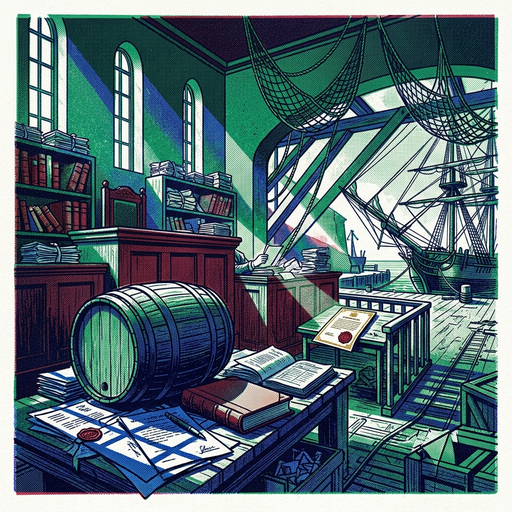
The tangible reality of prize adjudication is captured vividly in the case of Thirty Hogsheads of Sugar versus Boyle, argued before the United States Supreme Court in eighteen fifteen. A hogshead was an immense wooden barrel used across the Atlantic to transport cured sugar, tobacco, and molasses. Thirty hogsheads represented thousands of pounds of high-value refined commodity, capable of commanding substantial sums at auction.
The dispute began during the War of eighteen twelve, when an American privateer commanded by Captain Thomas Boyle intercepted a shipment of sugar originating from the island of Santa Cruz. The island had previously belonged to Denmark, a neutral nation, but British forces had captured and occupied it during the broader Napoleonic Wars. The sugar had been harvested from an estate owned by Adrian Benjamin Bentzon, an officer in the Danish government who maintained an agricultural plantation on the island. Bentzon argued that because he was a neutral Danish citizen residing outside British dominions, his private property should remain immune from seizure under international law.
Delivering the opinion of the court, Chief Justice John Marshall rejected Bentzon's defense. Marshall established that the legal character of agricultural produce depends on the territory where it is grown. Because Santa Cruz was under British military dominion at the time the sugar was harvested and shipped, the produce of the soil was inextricably tied to enemy territory. Marshall ruled that the owner of an estate in hostile territory must accept the belligerent status of that estate's output, regardless of personal neutrality. The Supreme Court affirmed the sugar's condemnation as lawful enemy prize.
Decisions like Thirty Hogsheads of Sugar demonstrate how wartime prize disputes established foundational American property and maritime doctrine. For the captors, winning condemnation meant liquidity. Yet the broader economic question remained: could windfalls from individual captures, obtained through violent maritime speculation, be converted into durable, multi-generational commercial fortunes?
In popular historical imagination, early American fortunes are frequently linked to illicit maritime exploits. Seductive lore suggests that the prominent Boston Forbes family—celebrated diplomats, railroad builders, and China-trade merchants—traced their massive wealth back to prize money gathered by privateers during the War of eighteen twelve. Investigating this claim requires separating three distinct historical questions: Did an individual named Forbes sail as a privateer? Was he part of the specific family that built the dynasty? And did identifiable prize proceeds fund their later commercial empire?
Archival records preserve clear evidence of a privateer named Forbes. The manuscript collections at Mystic Seaport document the maritime career of Captain Cleaveland Alexander Forbes. During the War of eighteen twelve, Forbes served as an active American privateer, commanding vessels authorized to disrupt British commercial lanes. Following the peace in eighteen fifteen, Cleaveland Forbes transitioned into the commercial merchant marine. For decades, he served as a skilled packet shipmaster, carrying passengers and southern cotton across the transatlantic run between New York and European ports.
However, establishing that a man named Forbes operated as a privateer does not prove that his wartime returns founded the Boston Brahmin fortune. When we turn to the Forbes Family Papers preserved at the Massachusetts Historical Society and the archives of the Forbes House Museum in Milton, Massachusetts, an entirely different commercial picture emerges. The dynasty that produced John Murray Forbes and his brother Robert Bennet Forbes did not emerge from privateering windfalls. Their commercial capital arose through the maternal patronage of the Perkins family.
In the eighteen twenties and eighteen thirties, young John Murray Forbes and Robert Bennet Forbes traveled to Canton, China, under the auspices of their uncles, James and Thomas Handasyd Perkins. They joined the merchant firm Russell and Company, which dominated the American trade in Chinese tea, silks, and Indian opium. John Murray Forbes managed massive accounts for Chinese merchant prince Houqua and accumulated his fortune directly through mercantile commissions and the lucrative, devastating opium traffic. When Forbes returned to Boston in the late eighteen thirties, he reinvested that Asian trade capital into nascent midwestern infrastructure, underwriting the Michigan Central Railroad and the Chicago, Burlington and Quincy Railroad.
The paper trail reveals no transfer of funds from Captain Cleaveland Alexander Forbes's wartime captures into the China-trade partnerships or railroad treasuries of John Murray Forbes. The two men represent separate branches of the wider Forbes surname, occupying entirely different commercial spheres. The myth of a privateering origin for the Forbes dynasty compresses disparate historical figures into a single romantic narrative. One man sailed under a wartime commission, while another family amassed wealth through colonial commodity markets, the opium trade, and continental railroads. In historical research, establishing a documented occupation or a shared surname cannot substitute for a documented balance sheet.
As global commerce expanded across the nineteenth century, the disruptive costs of privateering grew increasingly intolerable to industrializing empires. While a letter of marque maintained a legal barrier against piracy, it never eliminated the predatory character of commerce raiding. Privateers routinely harassed neutral vessels, tied up merchant capital in protracted litigation, and risked drawing uninvolved nations into armed conflict. Vice-admiralty and prize courts often operated as instruments of imperial coercion, subordinating neutral commercial freedom to the tactical needs of naval powers.
The formal turning point arrived in the aftermath of the Crimean War. On April sixteenth, eighteen fifty-six, seven major European powers gathered to sign the Declaration of Paris. The treaty's opening article declared simply: "Privateering is and remains abolished." The declaration established a new international consensus protecting neutral flags and non-contraband goods from maritime seizure.
The United States, however, refused to sign the eighteen fifty-six declaration. American diplomats argued that the country maintained only a modest standing navy. Washington refused to surrender the right to mobilize private merchantmen unless European powers agreed to exempt all non-contraband private property from capture at sea. Yet even without signing, American practice rapidly aligned with the international ban. During the American Civil War in the eighteen sixties, the federal government declined to commission privateers, relying instead on an expanding industrial navy to blockade southern ports.
While classic privateering vanished, prize law itself survived. In eighteen sixty-three, the United States Supreme Court decided the historic Prize Cases. Shipowners challenged the Union navy's capture of vessels attempting to run the southern blockade, arguing that because Congress had never formally declared war on the Confederacy, the captures were unconstitutional. The Supreme Court upheld the captures. The justices ruled that a state of war existed as a factual reality, empowering the executive to enforce a blockade and invoke the full authority of prize law.
Decades later, in eighteen ninety-nine, Congress formally repealed statutory provisions granting prize money to naval officers and crews, extinguishing the direct profit motive from modern American warfare at sea. Yet the constitutional power granting Congress the authority to issue letters of marque remains embedded in Article One. Legal scholars periodically debate whether the clause could ever be repurposed for modern conflicts, but international treaty obligations, universal naval conventions, and the practical realities of modern warfare render a revival of privateering virtually unthinkable.
Looking back across the era of Atlantic commerce raiding, the letter of marque and the prize court reveal how early modern states balanced military necessity against the rule of law. A government commission granted private citizens the terrifying authority to project violent maritime force. Yet the state never yielded its monopoly over property rights. A captain could capture a ship at gunpoint, but only a judicial decree could convert that prize into lawful wealth.
The case of the Forbes family demonstrates why historians must examine balance sheets rather than legends. The historical record documents Captain Cleaveland Alexander Forbes as a legitimate War of eighteen twelve privateer and packet master. Yet his career existed entirely outside the Perkins and Russell China-trade networks that enriched John Murray Forbes. The true foundation of that dynasty lay in Canton tea, Turkish and Indian opium, and American rail lines, not in privateering prize money.
Origin stories that trace great family fortunes to swashbuckling privateers are seductive because they turn complex, systemic economic histories into daring individual exploits. But when we dismantle the myth, a deeper historical question remains. Did the legal architecture of prize courts truly restrain violence at sea, or did it merely provide an organized, respectable mechanism to legitimize the spoils of war?
If this investigation shifted how you think about wartime wealth and maritime history, consider what other fortune legends might dissolve under the light of court records and commercial ledgers. Keep exploring the archives, and stay curious about the paper trails that shape our world.