Lake Nyos and the Invisible Cloud: Limnic Eruptions and Degassing in Cameroon
On a night in 1986, Lake Nyos released an invisible cloud of carbon dioxide that swept through Cameroonian valleys, killing roughly 1,700 people and thousands of animals. The gas had accumulated for years in the lake’s deep waters before erupting in a runaway burst of bubbles. Degassing pipes now reduce the danger, but the lake’s underground gas supply makes monitoring and maintenance essential.
By MyAudioBooks.ai ·
Listen free: Lake Nyos and the Invisible Cloud: Limnic Eruptions and Degassing in Cameroon
On the night of August twenty-first, nineteen eighty-six, an invisible cloud surged silently from the waters of Lake Nyos in northwestern Cameroon. By morning, roughly seventeen hundred people and thousands of animals were dead across the surrounding valleys. There was no glowing lava, no falling ash, and no scorched earth from a fiery volcanic explosion. The village houses stood completely undamaged, yet whole families had perished in their sleep within a few hours. Understanding how a quiet mountain lake could produce such sudden catastrophe requires looking deep beneath its surface, where a rare geological trap turns physics into a lethal hazard.
At My Audio Books dot A I, you can create your own audiobooks from prompts, turn your documents into audio, all with one subscription, and store your items in your own personal library.
Lake Nyos occupies a deep volcanic crater in the Oku volcanic field, situated along the Cameroon Volcanic Line. This tectonic zone stretches from the Gulf of Guinea northeast into central Africa. In August nineteen eighty-six, the surrounding slopes and river valleys supported farming communities, including the villages of Nyos, Cha, and Subum. Life in these settlements followed the rhythms of livestock herding and agriculture, with little warning that the water high above them posed any danger.
Late that evening, a massive volume of gas broke through the lake surface and swept down the terrain. Detailed scientific reconstructions place the human death toll at approximately one thousand seven hundred forty-six, with broader regional estimates recording between seventeen hundred and nearly eighteen hundred lives lost. In addition to the human toll, approximately three thousand five hundred cattle died in their pastures, accompanied by hundreds of sheep, goats, birds, and wild animals. Survivors awoke to profound isolation, having lost their households, their neighbors, and their livestock overnight.
The timing of the event played a decisive role in the casualty rate. The gas escaped around nine in the evening, when most families were inside their homes and preparing for sleep. Because the released gas was predominantly carbon dioxide, it arrived with neither color nor a distinct odor at ordinary levels. Carbon dioxide is roughly one and a half times denser than surrounding air under typical conditions, which meant the cloud did not rise into the atmosphere. Instead, it hugged the ground, flowing like water out of the crater mouth and spilling down into the valley floors.
The pattern of casualties matched the geography of the landscape. Settlements located directly in the path of the low-lying drainage channels suffered almost total mortality. In contrast, people situated on elevated ridges or several kilometers farther away experienced lesser symptoms or escaped harm entirely. Local wind currents, physical barriers, and elevation determined who lived and who died.
When scientific teams arrived, they found no evidence of a conventional volcanic eruption. The lake bed remained intact, no fresh magma had reached the surface, and no layer of volcanic ash covered the surrounding vegetation. Chemical analysis of surviving water samples and survivor medical records revealed that the lethal agent was carbon dioxide released from the lake itself.
This was not Cameroon's first encounter with the phenomenon. Just two years earlier, on August fifteenth, nineteen eighty-four, Lake Monoun had suddenly released a lethal gas cloud. Located roughly one hundred kilometers to the southeast, that crater lake claimed thirty-seven lives along a nearby road. At the time, that event was treated as an isolated, puzzling anomaly. The disaster at Lake Nyos demonstrated that Lake Monoun was not an exception, but an earlier warning of a systemic hazard shared by certain deep volcanic lakes. The urgent question facing scientists was how millions of tons of gas could quietly accumulate in open water, and what physical process could trigger such a violent release.
The accumulation of carbon dioxide at Lake Nyos begins deep in the earth. Beneath the Cameroon Volcanic Line, cooling magma bodies continue to off-gas vast amounts of volatile compounds. Rather than venting through an open crater or volcanic fumarole, this carbon dioxide migrates upward through fault networks and fractured rock. Entering subterranean aquifers, it seeps into the lake through springs at the very bottom.
Isotopic testing of the carbon atoms in the dissolved gas provided critical proof of its provenance. The isotopic signature matched carbon from mantle magma rather than biological decay or atmospheric sources. This confirmed that the gas was continuously supplied by deep volcanic activity far below the lake floor, even while the volcano itself remained dormant.
Water has a remarkable capacity to store gas under pressure, a relationship described by Henry's law. The deeper you go in a body of water, the greater the hydrostatic pressure exerted by the weight of the water column above. At Lake Nyos, the lake reaches depths exceeding two hundred meters. At that depth, the water experiences pressure greater than twenty times atmospheric pressure at sea level. Under that intense compression, a single liter of water can hold multiple times its own volume in dissolved carbon dioxide.
A common carbonated soft drink provides a direct comparison. Inside an unopened bottle, high pressure forces carbon dioxide to stay dissolved in the liquid, keeping the fluid clear and still. As long as the cap remains sealed, no gas bubbles form. At Lake Nyos, there was no physical cap; the sheer weight of the overlying water column served as the lid, locking enormous volumes of dissolved gas into solution.
This storage mechanism worked because Lake Nyos is permanently stratified, a condition geologists call meromictic. In many temperate lakes, seasonal changes in air temperature cause surface waters to cool, sink, and mix thoroughly with deeper layers. In the tropical climate of northwestern Cameroon, seasonal temperature variations are modest. Furthermore, the deep water at Lake Nyos was heavily laden with dissolved iron, bicarbonate, and other minerals, which significantly increased its density.
The result was a dense, heavy layer of cold, mineral-rich water resting undisturbed at the bottom of the lake, completely isolated beneath a lighter layer of warm surface water. This density barrier prevented vertical circulation. For decades, volcanic springs pumped carbon dioxide into the bottom layer without letting it touch the atmosphere. The timescales of accumulation and discharge were completely out of balance: geological recharge accumulated over many years, while the physical conditions set the stage for an instantaneous release.
The disaster that unfolded at Lake Nyos is known in geology as a limnic eruption. Unlike an ordinary volcanic explosion driven by expanding steam and molten rock, a limnic eruption is driven entirely by the rapid exsolution of dissolved gas from water. The immediate mechanical energy comes from the lake itself.
The process depends on a self-reinforcing physical feedback loop. Imagine a parcel of gas-saturated water near the lake bottom that gets nudged upward. As that water rises toward the surface, the water column above it shrinks, and the surrounding hydrostatic pressure drops. Eventually, the water reaches a depth where the pressure is no longer high enough to keep all the carbon dioxide dissolved. The gas begins to precipitate out of the liquid, forming microscopic bubbles.
The formation of those bubbles fundamentally alters the physics of the water. Bubbles displace water and dramatically lower the average density of the fluid mixture. Because this water-and-gas mixture is now significantly lighter than the undisturbed water around it, it becomes buoyant and surges toward the surface at high speed.
That rapid ascent accelerates the process. Faster upward movement brings even faster decompression, which causes bubbles to multiply and expand exponentially. Rising water causes bubbling, and bubbling causes the water to rise faster. Within seconds, a localized disturbance transforms into a self-sustaining column of rising fluid, pulling more gas-saturated deep water upward in its wake. At Lake Nyos, this runaway reaction created a massive effervescent eruption that shot a fountain of water and foam dozens of meters into the air.
Scientists still debate the exact disturbance that triggered the initial movement on the night of August twenty-first. Several hypotheses have been proposed. One theory points to a small rockfall or landslide along the steep crater rim, which could have plunged into the lake and pushed deep water upward. Another suggests a localized tremor or subterranean gas pulse entering the lake bed. A third proposes that seasonal rains or surface cooling altered the upper water density, weakening the stratification. If the bottom layers had reached full saturation, they could have destabilized spontaneously.
Regardless of the initial trigger, the physical consequences across the landscape were devastating. As the eruption emptied the dissolved gas from the lake, an estimated one hundred thousand to three hundred thousand tons of carbon dioxide broke out into the night air. Overlying water was thrust outward, stripping shores down to bare rock, while the dense cloud spilled over the crater rim.
As the cloud poured into the valleys, it behaved like an invisible, heavy fluid. At concentrations above ten percent, carbon dioxide does not simply starve the body of oxygen; it acts as an active toxin. It causes rapid hypercapnia, lowering the p H of the blood, impairing the nervous system, and triggering immediate loss of consciousness. Many victims perished where they slept, without time to react or flee. The pattern of mortality traced the contours of the valley floors, stopping precisely where the gas cloud diluted into the open atmosphere or failed to crest higher terrain.
Recognizing that a limnic eruption is driven by bubble buoyancy gave engineers a path toward prevention. If the runaway decompression that devastated the valleys could be contained inside a vertical pipe, the same physics could safely drain the gas. Controlled discharge would prevent pressure from building toward another catastrophic pulse.
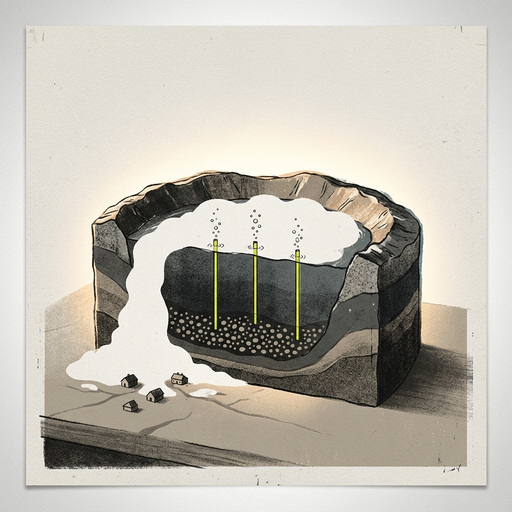
Beginning in the late nineteen nineties, an international team of scientists and engineers designed a system of vertical degassing columns. The design is elegant because it relies on the lake's own energy to function. A long, flexible polyethylene pipe is suspended from a floating platform, with its lower intake anchored in the gas-rich layers near the lake floor.
To start the system, operators use a mechanical pump at the surface to lift a column of deep water up through the pipe. As that water approaches the surface, falling hydrostatic pressure causes carbon dioxide bubbles to nucleate inside the conduit. Just as during the natural disaster, the bubbles lower the density of the water inside the pipe, creating an upward suction known as a gas-lift or auto-siphon. Once the flow begins, the pump is shut off. The pipe runs on its own, continuously drawing gas-saturated water from the lake floor. It ejects a steady fountain of water and spray tens of meters into the air, allowing the carbon dioxide to disperse harmlessly into the atmosphere.
Artificial degassing at Lake Nyos officially began with the installation of a single pipe in early two thousand one. While the concept worked as designed, the scale of the lake presented a major operational challenge. A scientific evaluation conducted in two thousand five concluded that a single column was insufficient. It projected that the pipe would remove only about one-quarter of the remaining excess gas by two thousand fifteen.
By two thousand eight, surveys from the United States Geological Survey revealed that roughly eighty percent of the gas inventory recorded in January two thousand one remained trapped in the depths. That baseline measurement had peaked at nearly fifteen gigamoles, or fifteen billion moles of dissolved gas. The single pipe was making progress, but the continuous influx from subterranean springs meant that extraction was barely outpacing natural recharge.
To address the deficit, engineers installed two additional degassing columns at Lake Nyos in two thousand eleven, bringing the total to three active pipes. A subsequent analysis published in two thousand twenty-one documented a significant surge in gas removal rates after the expansion. The data showed that multi-column extraction could effectively lower the saturation level of the deep water.
A parallel effort at Lake Monoun confirmed the viability of the approach. Degassing operations began there in two thousand three with a single column. Because Lake Monoun is smaller and shallower than Nyos, the results were more immediate. Between two thousand three and two thousand seven, the inventory of dissolved carbon dioxide fell from roughly point six gigamoles to point two five gigamoles. This drop of more than half substantially lowered the risk of another release.
The success of engineered degassing does not mean the hazard has been permanently eliminated. The pipes do not plug the subterranean magma chamber; they merely drain the reservoir that the magma continues to fill.
A comprehensive assessment published in two thousand twenty estimated that natural recharge delivers roughly nine to eleven million cubic meters of carbon dioxide into Lake Nyos every year. The same study noted that the three active degassing columns collectively circulate approximately seven to eight million cubic meters of water annually. Because water volume and gas volume are distinct measurements, total gas discharge depends directly on concentration. Over time, as deep water becomes less saturated, each cubic meter of water lifted by the columns carries less gas with it.
Today, Lake Nyos operates in a delicate state approaching dynamic equilibrium, where engineered removal roughly balances incoming geological recharge. If that mechanical discharge slows or stops, the deep water will inevitably begin to reaccumulate dissolved gas.
This reality makes rigorous, continuous monitoring essential. Research teams from Cameroon, the United States, France, and Japan have collaborated to measure water chemistry, temperature profiles, and dissolved gas concentrations across multiple depths. Alongside the degassing columns, technical teams deployed electronic gas sensors and acoustic warning stations along the perimeter of the lake. These detectors watch the drainage pathways to alert downstream communities if dangerous gas levels emerge.
Yet significant operational questions remain. Monitoring instruments and automated sirens are vulnerable to tropical weathering, battery depletion, lightning strikes, and funding interruptions. The physical pipes themselves face corrosion, biological fouling, and mechanical stress from ongoing operation. Historical success in installing the system does not guarantee its current operational status without regular, independently verified maintenance reports.
The lake also faces compounding geological risks. The northern rim of Lake Nyos is held back by a natural dam composed of fragile volcanic pyroclastic rock. Geologists have long cautioned that structural weakening, severe erosion from heavy rainfall, or an earthquake could cause this natural barrier to collapse. Such a collapse would release a catastrophic wall of water into the valleys below. At the same time, the sudden loss of upper lake water would decompress the gas-rich layers underneath, potentially triggering another limnic release.
For the farming families who have gradually returned to the fertile soils around Lake Nyos, true safety relies on human infrastructure as much as mechanical hardware. Protection requires clear evacuation routes, community education, operational warning sirens, and disaster response plans that account for how fast a dense gas cloud travels.
Three lasting principles emerge from the study of Lake Nyos. First, a limnic eruption is driven by dissolved gas stored under pressure in lake water rather than by a conventional volcanic blast. Second, Lake Nyos combined extraordinary depth, stable density stratification, and continuous magmatic recharge to create an invisible, high-pressure gas reservoir. Third, while engineered degassing has significantly reduced the risk, it manages the symptom without removing the geological engine beneath it.
Natural hazards do not always announce themselves with rising plumes of smoke, tremors, or glowing ash. Some of the most dangerous geological systems develop quietly under the surface, governed by the silent laws of fluid dynamics and pressure. Maintaining safety at Lake Nyos depends on ongoing scientific observation, continuous maintenance, and the humility to remember that an engineered solution must constantly match the persistent forces of the earth below.
If this investigation changed how you think about the hidden forces within our natural landscapes, take a moment to reflect on the unseen processes at work beneath seemingly quiet terrain. Join us again as we continue exploring the complex mechanisms that shape our world.