Kyoto in Late Autumn: Temples, Seasonal Food, and Neighborhood Walks With a Nara Day Trip
Explore Kyoto in November 2026 through crimson temple gardens, Fushimi Inari’s vermilion gates, Arashiyama’s bamboo, and the historic lanes and seasonal kitchens of Gion and Nishiki Market, then journey to Nara’s sacred deer and monumental Great Buddha. Along the way, learn to follow autumn’s shifting colors, navigate crowds and transport, dine confidently, and respect local life and sacred traditions—discovering why seeing thoughtfully matters more than seeing everything.
By MyAudioBooks.ai ·
Introduction
You pause on Shijo Bridge with the Kamo River moving beneath you and the eastern hills rising beyond the rooftops. The November air catches your cheeks. Behind you, downtown Kyoto is gathering pace; ahead, the streets lead toward wooden storefronts, shrine grounds, and paths that climb into the trees. Before you choose a direction, you notice how close the mountains seem. They frame the city, and over the coming days, they help you find your way.
It is November, twenty twenty-six, and you have come to Kyoto for temples, gardens, neighborhood walks, and the pleasures of a seasonal table. You are also arriving when many other travelers hope to see the same autumn leaves. The question is not simply which famous places deserve a visit. It is how to give them enough time and attention that your days become more than a succession of entrances, queues, and photographs.
Autumn offers a useful lesson from the beginning: there is no single moment when all of Kyoto changes color. The Japanese word koyo describes the seasonal turning of leaves, a transformation that moves unevenly through this mountain-ringed basin. A sheltered garden may still hold green while a higher hillside has deepened toward red. Rather than chasing one promised peak, you learn to read the landscape and leave room for a change of plan. The season becomes something to follow, not an appointment to keep.
For more than a thousand years, Kyoto served as Japan's imperial capital. Yet its history is not confined to grand monuments. It remains visible in the proportions of a shopfront, the arrangement of a garden, and the ingredients chosen for a meal. Along the older streets, you encounter machiya, traditional wooden townhouses that often combined a family's business with its home. Their narrow fronts remind you that these picturesque neighborhoods are also places of work and ordinary life. Appreciating them means noticing what continues behind the scenery.
Your bearings begin with the river and the surrounding hills. Eastward lies Higashiyama, where temple approaches descend into the lanes near Gion. Westward, Arashiyama brings you toward riverside landscapes and wooded slopes. To the south, Fushimi Inari's shrine paths draw you onto a sacred mountain. These places belong to the same city, but they reward separate stretches of attention. You do not need to cross the entire basin each day to feel that you have traveled well.
Between those larger destinations, there is room for another kind of discovery. Around Nishiki Market, ingredients offer an introduction to Kyoto's kitchens. At a dining counter, choosing a bowl of vegetables or a warming tofu dish can become easier than deciphering an unfamiliar menu suggests. In Gion, understanding the work of geiko and maiko, Kyoto's traditional performing artists and their apprentices, helps you approach the district with curiosity and respect. You are visiting a living culture, not a performance arranged around your arrival.
A train journey south extends that perspective to Nara, an imperial capital before Kyoto, where temple grounds and parkland invite a different walking rhythm. Throughout the journey, practical knowledge gives you more freedom: knowing when rail is useful, how nearby streets connect, and how customs differ between a Buddhist temple and a Shinto shrine. You need not master everything before setting out. Begin here, above the river, with the hills in view. What might you notice if seeing Kyoto well matters more than seeing it all?
End of Introduction
Welcome to Kyoto in late autumn. If you are standing in this city in November of twenty twenty-six, you have arrived during one of the most visually stunning seasons in Japan. The summer humidity has long since broken, replaced by crisp mountain-basin air that sharpens every sensation. Morning mist may cling to the forested ridges around the city, and across temple courtyards and mountain slopes, the famous Japanese maples turn vivid shades of scarlet, copper, and burnished gold.
Kyoto rests inside a natural bowl, framed on three sides by highlands. To the east rise the ridges of Higashiyama. To the north stands the darker crest of Kitayama. To the west, the wooded slopes of Arashiyama descend toward the riverbanks. Two main waterways define the lowlands: the Kamo River flowing through the eastern districts, and the Katsura River sweeping through the western plains. This basin geography creates distinct microclimates, meaning small areas with different local conditions, and understanding shifts in elevation and temperature can help you make the most of the season.
The Japanese word for this autumn phenomenon is kōyō, the seasonal changing of broadleaf foliage. One tree announces itself immediately. Along broad boulevards and inside temple courtyards, the fan-shaped leaves of the maidenhair ginkgo turn a brilliant buttery yellow.
The undisputed star of Kyoto's autumn, though, is the irohamomiji, the delicate Japanese mountain maple. As nighttime temperatures fall, the green chlorophyll in the leaves fades, unveiling bright yellow carotenoids and helping bring out deep red anthocyanins. Because cold air drains down from the surrounding mountain passes, the northern reaches of Takao, Mount Hiei, and Ōhara often show their deepest crimson earlier than central Kyoto. Central valley temples, shaded cloister gardens, and the southern approaches usually reach peak color from the middle of November into early December.
A common traveler mistake is treating the autumn peak as a single fixed date on the calendar. The exact window shifts from year to year with temperature and weather patterns. The Kyoto City Tourism Association begins updating its official foliage calendar in late October of twenty twenty-six, following individual temple gardens from first color through peak to falling leaves. Treat your trip as a sequence of micro-peaks rather than a hunt for one mythical day. If the central city gardens are still partly green, you might head north toward higher ground. If the northern maples have started dropping their leaves, turn to the sheltered courtyards of the southern and eastern hills. Either way, you are likely to find beautiful scenery.
November also brings shorter days and cool evenings. The sun slips behind the western mountains well before five o'clock in the afternoon, casting long blue shadows across stone gardens and bringing a sudden chill to the air. As dusk settles, Kyoto reveals a second personality through yakan haikan, special evening temple viewings. During these limited seasonal sessions, historic Buddhist precincts and formal stroll gardens illuminate their grounds. Brilliant leaves glow against the night, reflecting in carp ponds, while pagoda eaves cast dramatic silhouettes into the sky.
These evening sessions are special events with their own rhythm. At many temples hosting an illumination, the grounds close around the transition from daytime to evening visits. Staff prepare the paths, switch on the lighting, and reopen the gates later in the evening. You may need a separate evening admission ticket; you cannot assume you can linger through sunset on a daytime pass. Check each temple's arrangements before setting out. Knowing the distinction saves you from being turned away at dusk, and lets you build a pause into your afternoon, perhaps with a warm cup of roasted green tea in a neighborhood cafe before the gates open again under the stars.
Balancing this extraordinary beauty with autumn crowds takes a clear tactical mindset. November brings travelers from across Japan and around the world, and the headline landmarks can become congested from midmorning through the afternoon. Rather than fighting that wave, use time of day and topography, the shape and elevation of the land, to your advantage. Pair dawn visits at open-air sites with evening illuminations, and give the middle of the day to quieter cloisters or neighborhood wandering. You can experience Kyoto's contemplative spirit without feeling overwhelmed.
To help you adjust, the city provides congestion tools such as Kyoto Smart Navi and the municipal travel congestion forecast. These services draw on information such as live camera feeds and historical patterns to estimate crowd levels around popular sightseeing corridors and suggest quieter alternatives. Check current information before setting out, and be ready to shift your plans.
Begin in the eastern hills, with Kiyomizu-dera, the Temple of Pure Water, anchored high on the slopes of Mount Otowa in the district of Higashiyama. Founded in seven hundred seventy-eight by the Buddhist monk Enchin and rebuilt in sixteen thirty-three under the Tokugawa shogunate, this UNESCO World Heritage site is one of the world's most recognizable cultural landscapes. The approach winds upward through narrow stone-paved lanes lined with traditional wooden merchant houses, and the aroma of baking cinnamon biscuits and roasting tea drifts from open shopfronts.
Passing through the towering two-story Deva Gate, painted in brilliant cinnabar lacquer, you step into a sprawling hillside complex that culminates in the Hondō, the monumental main hall. The hall's most striking feature is its massive wooden stage, the butai, which juts out over the steep gorge below. Built with interlocking zelkova pillars and joined without metal nails, the stage seems to float above a sea of roughly one thousand mountain maples filling the ravine beneath it.
By day, standing on the broad cypress planks of the stage gives you an extraordinary panorama. Beneath your feet, the tree canopy billows in waves of deep carmine, burnt orange, and pale amber. Beyond the pagodas and temple roofs, the modern grid of Kyoto stretches across the valley floor toward the western hills. Below, clear mountain water cascades from Mount Otowa into three stone channels at the Otowa Waterfall, where visitors catch the streams with long-handled tin cups. Traditionally, the water is believed to confer health, academic success, or fortunate relationships. The scent of burning cedar incense drifts from bronze urns, mingling with the earthy fragrance of fallen leaves and damp mountain stone.
For late autumn twenty twenty-six, Kiyomizu-dera has confirmed an autumn evening illumination in late November. During the event, the temple stays open into the evening, with a final entry time. Check the temple's current information for exact dates and hours. The transformation is striking. Concealed spotlights rake the canopy from below, turning the ravine into a glowing sea of fire. A single concentrated beam of blue light rises from beside the main hall into the night sky. It symbolizes the compassion of Kannon, the bodhisattva of mercy enshrined within the temple's sanctuary. During the same period, the secluded Jōjuin garden inside the complex opens for special public viewings by day and evening, offering a quieter pond garden within the busy grounds.
Experiencing Kiyomizu-dera at its best means choosing deliberately between two distinct visits. The temple opens early in the morning, before many tour groups arrive and before the surrounding commercial lanes stir to life. Entering near opening time offers a chance for a quieter atmosphere. The stage may be less crowded, and the morning light can fall softly on the maple canopy. If you also want the spectacle of the night illumination, treat it as a separate evening outing later in your stay. A midday visit during peak foliage can mean shuffling shoulder to shoulder across the stage. Splitting your experience between morning light and evening illumination lets you see two distinct sides of the temple.
From the eastern hills, turn south to the foot of Mount Inari and Fushimi Inari Taisha. This ancient Shinto shrine, established in seven hundred eleven, long before Kyoto became the imperial capital, serves as the spiritual headquarters for Inari shrines across Japan. In Shinto tradition, Inari is a kami, or sacred spirit, associated with rice cultivation, agricultural abundance, and commercial prosperity.
Across the shrine grounds, you will encounter stone foxes, known as kitsune, who act as Inari's sacred messengers. These stone guardians sit atop their pedestals, clutching symbolic items in their teeth: keys to traditional rice granaries, sheaves of grain, or jewels representing spiritual wealth.
Fushimi Inari is world-famous for its senbon torii, a winding pathway of thousands of closely spaced wooden shrine gates painted in brilliant vermilion and black. In traditional Japanese belief, vermilion pigment, originally derived from cinnabar, represents vital life force and wards off malicious energies. Inside the tunnels, natural light filters through the wooden uprights, bathing the stone path in a warm amber glow. On the reverse side of each gate, black calligraphy records the names of companies, guilds, and individual devotees who dedicated the gate in thanksgiving for prosperity, alongside its installation date. The crunch of gravel beneath your shoes, the scent of wet cedarwood, and the cool mountain breeze create a steady rhythm as you walk.
Fushimi Inari Taisha is among the country's most heavily visited cultural sites, so its crowd patterns deserve your attention. The lower shrine complex and the initial torii tunnels tend to grow busier from the morning into the afternoon. Tour groups funnel into the narrow passages, creating a slow-moving crowd where quiet contemplation and photography can be difficult.
Your escape route is vertical. Fushimi Inari is a sacred mountain, crisscrossed by stone hiking trails that climb to a summit two hundred thirty-three meters above the valley. Many day visitors walk only a short distance into the lower gates, take photographs, and turn back toward the train station. Continue up the main stone staircase, and in roughly thirty to forty-five minutes you can reach the Yotsutsuji intersection, an open mountain terrace with views over southern Kyoto, wooden benches, and a hillside teahouse serving hot amazake, a sweet, warming fermented rice drink.
Above Yotsutsuji, the crowd often thins. The path splits into a circular loop around the upper peak, passing through cedar groves, stone springs, and secluded sub-shrines known as otsuka. These clearings hold miniature red gates, personal stone altars, and small moss-covered fox figurines left by local worshippers. The air up here is cool and quiet, punctuated by the calls of mountain crows and the rustle of wind through bamboo. The full summit circuit can take about two hours at an easy, steady pace, rewarding the climb with a more secluded experience.
The grounds of Fushimi Inari Taisha are generally accessible around the clock, though staffed facilities keep separate hours. That continuous access gives you scheduling flexibility. An ascent that starts early in the morning can offer a quieter walk through the lower tunnels, while an evening visit may bring a different atmosphere under the lanterns. If you choose to walk after dark, wear sturdy footwear with reliable traction, since the stone stairs can be slick with dew. Bring a small flashlight or a charged phone, because lighting on the higher paths may be limited.
Now head to the far western edge of the city, where urban neighborhoods give way to natural scenery at Saga-Arashiyama. Straddling the waters of the Katsura and Ōi rivers, this district has been celebrated for over a millennium. During the Heian period, court nobles traveled here from the imperial palace to escape court politics, composing classical waka poems from pleasure boats as they admired the seasonal foliage on the mountain slopes. Today, the district remains anchored by Togetsukyō, the Moon Crossing Bridge, whose wooden balustrades frame a view of the forested hillside of Arashiyama rising from the water's edge. In late November, the mountain face can become a rich tapestry of crimson, amber, and evergreen pine.
A short walk north of the riverbank sits Tenryū-ji, the Temple of the Heavenly Dragon, founded in thirteen thirty-nine by the warrior shogun Ashikaga Takauji to appease the spirit of Emperor Go-Daigo. Tenryū-ji is celebrated for its Sōgenchi garden, designed by the Zen monk Musō Soseki and preserved in much of its historic form. Soseki worked in the technique of shakkei, or borrowed scenery, incorporating the distant Arashiyama mountains into the composition of the central pond, the rock arrangements, and the weeping maples. From the wooden veranda of the main hall, you can watch scarlet reflections ripple across the pond surface while koi glide through the water.
Exit through the northern gate of Tenryū-ji and you step directly into the Arashiyama Bamboo Grove, known locally as Chikurin no Michi. The narrow pathway cuts between stands of moso bamboo that rise high overhead, their thick green culms forming a canopy that filters the sunlight into a pale, ethereal jade glow.
The grove is as famous for its sound as for its sight. Japan's Ministry of the Environment has included it on the country's official list of one hundred soundscapes to preserve. When mountain breezes sweep down from the Ōi River gorge, the tall stalks creak gently against one another, and their long leaves produce a soft, whispering rustle. Walking the packed-earth path, flanked by rustic fences woven from dried bamboo branches, you enter a natural setting that feels removed from the modern city.
For travelers visiting in late autumn twenty twenty-six, one seasonal detail reshapes the evenings here. The Arashiyama Bamboo Light-up, also known as Arashiyama Tsukitōro, is scheduled to run earlier in the autumn, ending before the main late-November foliage period. Check event information for current dates, hours, and ticket arrangements. Visitors arriving later in November should expect the bamboo path to be unilluminated after dark.
During late November, then, the bamboo grove is generally a daylight experience. Because it connects directly to popular shopping streets and riverside walkways, the central path can become exceptionally crowded during the day. To hear the wind in the stalks and experience the delicate green light with fewer people around, aim to arrive early. At that hour, the path is quieter, the air may carry the scent of morning dew and bamboo leaves, and you can stroll at a more unhurried pace.
Preserving this fragile natural environment has become a focus for the local community. Visitors have carved names and dates into living stalks, leaving scars that can threaten the plants. The city maintains protective woven bamboo railings and signage asking guests to stay on the designated path and leave the living culms untouched. Respecting those boundaries helps the grove continue to thrive.
Continue walking west and north past the end of the bamboo path, and you leave the primary tourist corridor for the pastoral lanes of Saga. Here, the landscape feels like a quiet rural village tucked against the foot of the hills. Scattered through these residential streets are some of Kyoto's lesser-known spots for autumn foliage, including Jōjakkō-ji, Nison-in, and Giō-ji.
Jōjakkō-ji, clinging to the steep slopes of Mount Ogura, is particularly striking in late autumn. Its grounds hold a two-story tahōtō pagoda surrounded by mountain maples. Because the hillside is terraced, you can look up through layers of red foliage toward the thatched temple gates, or down over carpets of green moss dusted with fallen leaves. Climb the stone steps to the upper terrace and the view opens across the rural rooftops of Saga toward the city center, with a tranquility that feels far removed from the busy riverbanks below.
You now hold a mental map of Kyoto's three great anchors: Kiyomizu-dera in the eastern hills, Fushimi Inari Taisha in the south, and Saga-Arashiyama in the west. Together they form a broad triangle around the outer edges of the city basin. Attempting all three on the same calendar day is a common mistake for first-time visitors. Crossing between Arashiyama on the western perimeter and Kiyomizu-dera on the eastern slopes means traversing the city center, which can consume substantial sightseeing time on crowded public buses or require multiple subway and private rail transfers.
The most rewarding approach is to treat each geographical quadrant as the anchor of its own day. One morning, give yourself to the eastern hills of Higashiyama: start near dawn at the wooden stage of Kiyomizu-dera, wander down through the historic stone lanes, and return after sunset for an illuminated temple garden.
On another day, head west to Arashiyama. Arrive early to hear the bamboo grove in relative peace, explore the Zen landscape of Tenryū-ji, and spend a quiet afternoon wandering the hillside retreats of Saga.
On a third morning, rise early for the vermilion torii paths of Fushimi Inari Taisha, continuing high onto the forested slopes where the sacred mountain offers a more secluded walk.
Anchor your days around these geographic hubs and work with Kyoto's morning and evening rhythms, and the city opens to you even at the height of foliage season. You can bypass some midday congestion, meet the temples in their most evocative light, and discover that November offers quiet wonder, profound history, and striking beauty. In the next part, we leave the outer mountain fringes and step into the historic heart of the city: the lanes of Gion and Higashiyama, the food stalls of Nishiki Market, and the culinary traditions of Kyoto.
Now that you have explored the mountain fringe that cradles Kyoto, it is time to step into the preserved urban heart of the city. Here, the grand landscapes of hillside temples and bamboo groves give way to intimate, human-scale streetscapes: narrow flagstone lanes, weather-darkened timber facades, paper lanterns glowing at twilight, and the aroma of roasting green tea and simmering broth. This part of our journey builds a spoken mental map, linking the historic districts of Higashiyama and Gion on the east bank of the Kamo River to the culinary corridors around Nishiki Market on the west. As we walk, we will see how these neighborhoods fit together, learn the etiquette that protects their living heritage, and discover how to move through Kyoto's dining traditions with ease and confidence.
To hold this central corridor in mind without consulting a map, picture a natural spine running north to south: the Kamo River. This wide, shallow waterway divides central Kyoto into two worlds. On the eastern bank, the land rises gradually toward the forested ridges of Higashiyama, cradling historic merchant lanes and the wooden teahouse quarters of Gion. On the western bank, the terrain flattens into the downtown commercial grid, where modern avenues shelter glass-roofed shopping arcades and the covered lanes of a historic food market.
Connecting these two worlds is Shijo Street, a major east-west avenue that crosses the river over Shijo Bridge. At the far eastern end stands the bright cinnabar gate of Yasaka Shrine, a visual beacon against the mountain slope. At the western end of the crossing lies the commercial district of Kawaramachi, with Karasuma just beyond. One block north of Shijo Street, beneath a sheltered canopy, sits Nishiki Market. Hold onto this simple anchor: the river in the center, the historic slopes to the east, and the covered food lanes to the west. It will help you keep your orientation in the heart of Kyoto.
Begin on the eastern slopes of southern Higashiyama, descending from the mountain ridge toward the river plain. Few neighborhoods in Japan preserve their historic streetscape as completely; many of the buildings here retain the character of the Edo period. Leaving the entrance paths of Kiyomizu-dera, you step onto a descending network of pedestrian stone alleys known as Sannenzaka and Ninenzaka. Sannenzaka, meaning the three-year slope, and Ninenzaka, the two-year slope, curve down the hillside, paved with granite flagstones that gleam softly after an autumn rain.
Lining these sloped pathways are traditional wooden townhouses known as machiya. These two-story merchant dwellings, built from dark cedar and cypress, feature delicate wooden lattice screens called koshi over their lower windows, deep eaves hung with clay roof tiles, and paper lanterns beside sliding entryways. Today the buildings house craft workshops, incense merchants, and confectionery shops. As you stroll downward, the warm, nutty aroma of hojicha, or roasted green tea, drifts from open roasting drums. Sandalwood and agarwood incense may waft from quiet courtyards, and somewhere ahead the wooden geta sandals of a passerby clack against the stones.
Midway down the slope, look westward through the narrow gap between timber roofs and you may catch sight of the Yasaka Pagoda, the five-story wooden tower of Hokan-ji temple. Rising above the tiled eaves, its weathered, charcoal-gray cedar creates one of Kyoto's defining silhouettes, especially in late afternoon, when the setting sun can bathe the wooden balconies in warm amber light.
Continuing northward along the foot of the hills, the stone path winds into Ishibei-koji, a lane of stone walls and cobblestones where private ryokan inns and dining rooms hide behind bamboo blinds and rustic stone fences. Even a short passage through this corner of the old city can slow your footsteps to match the neighborhood's pace.
Follow the stone alleys north and you emerge into the southern precincts of Yasaka Shrine. Founded in the seventh century, long before Kyoto became the imperial capital, this Shinto sanctuary honors Susanoo-no-Mikoto, the deity of storms and the sea. Its grounds serve as a threshold between the temple slopes of Higashiyama and the entertainment quarters below. At the center of the complex sits a wooden dance stage hung with paper lanterns, donated by local businesses and traditional teahouses. At dusk, when the lanterns flicker to life, they cast a warm glow over the gravel courtyards. Walk through the shrine's cinnabar-lacquered western gate, descend the broad stone staircase, and you step onto the eastern edge of Gion.
Gion is Kyoto's most famous hanamachi, a traditional entertainment district where professional artists known as geiko and maiko preserve classical Japanese performing arts. In Kyoto, fully trained artists are called geiko, or women of art, while their apprentices are known as maiko, or dancing girls. They train in classical dance, the shamisen, a three-stringed lute, traditional vocal accompaniment, calligraphy, and the tea ceremony, entertaining guests at private banquets held in teahouses known as ochaya.
Shijo Street divides Gion into two distinct sections. To the south lies Gion Kobu, centered along the stone-paved promenade of Hanami-koji, a name that translates as blossom-viewing lane. Wooden teahouses with bamboo eaves and slatted screens line the street, their entryways marked by nameplates and red lanterns. To the north lies the Shirakawa area, bordering the willow-lined Shirakawa canal. Here, wooden verandas extend over the stream, stone bridges span the water, and stone lanterns illuminate mossy banks beneath weeping willows and crimson maples.
Because Gion is both an active cultural quarter and a residential neighborhood where people live and work, moving through it calls for thoughtfulness and care. Local guidelines aim to protect the dignity of residents and artists alike. The most important rules concern the residential alleys. Public thoroughfares like Hanami-koji remain open to respectful visitors, but narrow lanes branching off them may be private property.
Tourists are prohibited from entering certain private side alleys in southern Gion. Signs mark restricted entrances, and trespassing may incur a fine. The visual guideline is straightforward. If a street is wide, stone-paved, and marked as public, you are welcome to walk along it. If a narrow alley carries private-property warnings, admire the architecture from the main corner and let residents keep their privacy.
Meeting a geiko or maiko on the street calls for the same restraint. If you see an artist walking along Hanami-koji in the early evening, she may be on her way to an appointment at an ochaya. Her hand-painted silk represents the work of skilled artisans, and her hair ornaments, called kanzashi, may change with the calendar month. She may also be balancing on wooden sandals known as okobo. Do not chase her, touch her garments, or block her path to pose for a photograph. The respectful response is to step aside, keep a dignified distance, and quietly admire her elegance as she passes.
Leaving Gion behind, stroll westward along Shijo Street and step onto Shijo Bridge to cross the Kamo River. Pause midway across, and the geography of the city falls into place. To your east, the wooded ridges of Higashiyama rise against the sky, speckled with autumn maples and the tiered roofs of temples. Below you, residents and travelers sit along the grassy riverbanks, listening to the water. To your west, the historic wooden skyline gives way to department stores, train concourses, and the neon of downtown.
Crossing to the west bank brings you into Kawaramachi, the commercial heart of the city. Walk north from Shijo Street, past the storefronts of the Teramachi shopping arcade, and you arrive at the eastern entrance of Nishiki Market. Locals affectionately call it Kyoto no Daidokoro, or Kyoto's Kitchen. This covered, pedestrian market runs for about five city blocks, roughly four hundred meters from Teramachi Street in the east to Takakura Street in the west.
Nishiki's culinary history stretches back some seven centuries. It began as an open-air fish market using the cold groundwater bubbling up through the valley floor, then grew during the Edo period into a wholesale hub supplying the imperial court, aristocratic estates, and Buddhist temples. Today, beneath an arched stained-glass ceiling of red, green, and yellow panels, more than one hundred family stalls display ingredients and foods associated with traditional Kyoto gastronomy.
Walking into Nishiki is an immersion for the senses. Warm bulbs illuminate wooden stalls overflowing with seasonal produce, while damp stone pavers underfoot reflect the warmth of simmering pots. The air carries layers of aroma: the briny tang of cedar pickling barrels, soy sauce caramelizing over grilled skewers, shaved bonito flakes, and freshly grated wasabi root.
Kyoto's prized heirloom vegetables, known collectively as kyo-yasai, take center stage. These heritage cultivars, developed over centuries in the basin's soil, offer shapes and flavors you may rarely find elsewhere. In late autumn, wooden crates display kamo nasu, a large, dense, round eggplant with glossy, near-black skin. There is shogoin daikon, a large sweet white root prized for slow braising, and ebi-imo, a knobby taro yam whose layered markings resemble a shrimp's tail.
Nearby, pickling masters tend cedar tubs of tsukemono, preserved vegetables cured in salted rice bran, sake lees, or sweet vinegar. You may see samples of brilliant purple shibazuke, crisp pickles scented with red perilla leaves. Fishmongers display fillets of seasonal seafood brought inland from the Sea of Japan and Wakasa Bay. Dry-goods shops sell sheets of dark, sun-dried kombu kelp from the cold waters off Hokkaido, the foundation of Kyoto's delicate dashi stocks. Artisans may use hand planes to shave katsuobushi, cured and smoked skipjack tuna, into thin, pink-tinted ribbons, while nearby knife shops display hand-forged blades.
Understanding market etiquette keeps this abundance enjoyable for everyone. The market association has adopted policies to manage congestion along its narrow corridor. One guideline concerns tabearuki, or eating while walking. Moving through a dense crowd with a dripping skewer or a cup of hot broth risks staining someone's clothing or causing accidental burns, so visitors are asked to finish food where they bought it. When you purchase a hot snack, perhaps a skewer of tamagoyaki, the layered rolled omelet seasoned with sweet dashi, a freshly fried fish cake, or roasted chestnuts, step into the small designated area beside the stall or stand quietly in front of the counter to finish. Then return the skewer and wrapper directly to the vendor's bin, since public trash receptacles can be scarce on Japanese streets.
With your appetite awakened, let us step into the broader world of Kyoto's dining culture. Food here is a refined cultural expression, shaped by the changing seasons, Buddhist philosophies of mindfulness, and centuries of imperial refinement. Many first-time visitors worry about unfamiliar customs, specialized restaurant types, or language barriers. Once you know the basic categories of dining and a few common ordering conventions, eating out in Kyoto becomes one of the pleasures of your journey.
To choose where to eat with ease, think in styles of eating rather than specific addresses. Kyoto's dining landscape offers distinct environments, each suited to a different mood, budget, and time of day.
The first style you will encounter is obanzai, the home-style cooking of Kyoto. Traditionally prepared in local merchant households, obanzai relies on seasonal, unpretentious ingredients, making use of vegetables, tofu, and preserved pantry staples. An obanzai dining room is typically warm, cozy, and informal. When you step inside, you may find a wooden counter displaying large ceramic serving bowls, known as o-bachi, each holding a different freshly prepared dish.
The joy of obanzai is its visual accessibility. Even if the handwritten wall menu is entirely in Japanese calligraphy, you can sit at the counter and point to the bowls that look most enticing. You might choose tender eggplant simmered in sweet dashi and mirin until soft, hijiki seaweed braised with slivers of fried tofu and sweet carrot, or small mountain potatoes glazed with soy and white sesame. Add a bowl of freshly steamed rice and warm miso soup, and you have a window into everyday Kyoto domestic life.
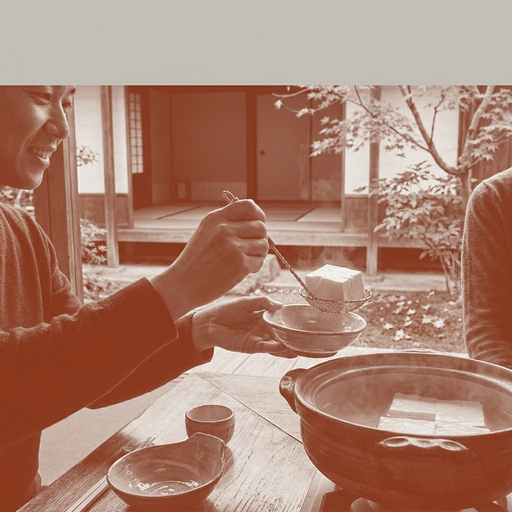
A second tradition, tied closely to the city's Zen Buddhist heritage, is yudofu, or simmered hot-pot tofu. Because Buddhist monks practiced shojin ryori, a strictly vegetarian monastic cuisine, Kyoto became a center of artisanal tofu production, supported by soft, pure well water that yields delicate silken tofu. Yudofu is a comforting meal on a crisp November afternoon.
In a traditional yudofu restaurant, often set in a garden pavilion near the temple precincts of Nanzen-ji or Arashiyama, a heavy earthenware pot of water sits over a small burner at your table. A piece of dried kombu flavors the water as it heats, and cubes of fresh, silken tofu simmer gently in the broth. Using a small wire ladle, you lift a steaming cube from the water and transfer it to your bowl, then dress it with ponzu, a citrus-infused soy sauce, and finish it with sliced scallions, grated ginger, and flakes of dried bonito. The tofu is velvety, creamy, and clean, warming you from the inside out.
For a celebratory or formal evening, Kyoto offers kaiseki ryori, a highly refined style of Japanese culinary artistry. Developed alongside the traditional tea ceremony, a kaiseki meal is a multi-course feast in which each dish reflects the season. In late autumn, the menu may celebrate the harvest. Earthenware teapots can arrive holding dobin mushi, a clear broth of wild matsutake mushrooms, chicken, and ginkgo nuts. Seasonal mackerel or sea bream may come garnished with sweet persimmon, and small dishes may be decorated with crimson maple leaves. Courses are served in lacquerware or ceramics chosen to suit the meal, and the experience can unfold over an unhurried evening.
For everyday lunches and casual dinners, welcoming options abound across the central neighborhoods. Teishoku establishments serve complete set meals on a lacquer tray, pairing a main dish, perhaps grilled salted salmon, crispy chicken karaage, or panko-crusted pork tonkatsu, with white rice, pickles, and miso soup at a modest, predictable price. Soba and udon shops offer comforting bowls of hot buckwheat or wheat noodles in smoky dashi broth, topped with the sweet fried tofu that gives kitsune udon its name, or with crispy seasonal tempura.
In the evenings, the social heart of Japanese dining beats inside the izakaya, a casual Japanese tavern. Look for the glowing red paper lanterns called akachochin and the short cloth door curtains known as noren that mark the entrance. Inside, colleagues, friends, and travelers gather over small savory plates and local drinks. The menu spans charcoal-grilled yakitori skewers, crispy gyoza dumplings, fresh sashimi, and seasonal vegetable tempura. Kyoto's proximity to the historic brewing district of Fushimi means the sake on offer, known formally as nihonshu, is exceptional. Brewed with soft, iron-free spring water, Fushimi sake is famously smooth, aromatic, and gentle on the palate, a natural companion to seasonal dishes.
Navigating these settings with poise is easier when you know a few common customs of a Japanese meal. At a traditional restaurant, you will often push aside the hanging noren and slide open a slatted wooden door called a hiki-do, rather than pull it toward you. Upon entering, the staff greets you with a warm, energetic chorus of irasshaimase, meaning welcome. Hold up your fingers to indicate how many people are in your party, and you will be guided to a seat.
If the restaurant has traditional raised tatami flooring, you will remove your shoes at the entrance threshold, known as the genkan. Step out of your shoes without letting your socks touch the lower stone floor. Move directly up onto the polished, raised wooden platform, and slip your feet into the guest slippers provided. Place your outdoor shoes neatly into the wooden cubbies, or let your host store them for you.
Once you are seated, whether at a wooden counter or a low dining table, your host will present an oshibori, a small, rolled damp towel. In late autumn, it may arrive hot, ready for wiping your hands before you begin eating. On the table you will find a small ceramic rest holding your chopsticks, often a disposable wooden pair called waribashi. To separate them cleanly, pull the two pieces apart horizontally, close to your lap, rather than vertically, so the soft wood does not splinter.
In izakaya and casual evening dining rooms, a small, unannounced appetizer usually arrives alongside your first drink. This is the otoushi, an established custom that serves as both a culinary greeting from the kitchen and a modest cover charge for your seat, typically a small additional cost. It might be marinated seasonal greens, a braised quail egg, or a cube of sesame tofu. Accept it as part of the hospitality of the evening.
When you are ready to order, take the initiative. In many Japanese restaurants, staff may give guests privacy until summoned. To call your server, raise your hand slightly and say clearly, sumimasen, which translates as excuse me. It is polite, widely understood, and a straightforward way to bring a server to your table. In many modern casual spots you will also find a small wireless call button on the table; pressing it chimes a gentle bell at the service counter.
If you encounter a menu without English translations or photographs, stay relaxed. Ask the server for the kitchen's daily recommendation with a polite osusume wa arimasu ka, meaning what do you recommend. In obanzai or counter-service shops, pointing to the ceramic display bowls or to seasonal items in the refrigerated case is generally accepted.
When your food arrives, it is customary to express quiet gratitude before the first bite. Place your hands together in front of your chest and say softly, itadakimasu, which translates poetically to I humbly receive. As you eat, it is proper to lift small rice bowls and soup bowls toward your chest with one hand, rather than hunching over the table. And when your hot soba or udon arrives, do not hesitate to slurp. In Japanese culinary tradition, slurping draws air across the hot noodles, cooling them and aerating the aromatic broth. It can also signal to the chef that you are enjoying the meal.
At the conclusion of your meal, place your chopsticks neatly back across the ceramic rest, or slip them back inside their paper sleeve. Avoid sticking chopsticks upright into a bowl of rice, because that gesture mirrors a solemn ritual performed at Buddhist funeral services. As you finish, you can offer gochisosama deshita, meaning thank you for the wonderful meal.
Paying follows a clear routine in many Japanese restaurants. You usually settle the bill at the register near the front exit rather than at your table. Look for a small slip of paper left face down on the corner of your table, and take it with you as you rise. If no slip appears, form a small X with your index fingers toward your server and say, okaikei onegaishimasu, meaning the bill, please.
At the register you may notice a small rectangular tray on the counter, the tsurisen tray. Place your payment, whether cash, a credit card, or a digital transit card, into the tray rather than handing it directly to the cashier. If you pay with cash, your change may be counted back into the tray or returned by the cashier. Japan’s service customs generally do not call for tipping. Leaving extra coins on the table can cause confusion, and staff may try to return money they believe you forgot.
As evening deepens across central Kyoto, make your way back toward the river and take a quiet stroll along the illuminated banks of the Shirakawa canal in northern Gion. The daytime crowds have eased, leaving the flagstones glistening under the soft glow of amber lanterns. Willow branches sway over the flowing water, and the dark wood of centuries-old machiya frames a scene of timeless serenity. By now you hold the geography that connects the eastern hills to the downtown riverbanks, you know how to honor the privacy of local neighborhoods, and you have met the warmth and grace of Kyoto's living culinary traditions.
In the final part of our journey, we expand our horizon beyond the city limits. We embark on an easy day trip to ancient Nara, choosing between the direct express rail lines, walking among the free-roaming sacred deer of Nara Park, and standing in awe before the monumental Great Buddha of Todai-ji. From there, we connect that outing to Kyoto's broader transit network, exploring when buses, trains, and walking serve you best, how to avoid unnecessary transfers and backtracking, and which payment and ticketing details are worth checking. We will also walk calmly through the rituals and visiting etiquette of Japan's shrines and temples, so that your time inside these sacred spaces feels as meaningful as it is smooth.
Having traced the mountain rim of Kyoto and wandered the lantern-lit lanes and covered markets of its historic heart, you are ready to broaden your journey. In this part of Japan, a train ride can carry you across prefectural lines and backward through time. Today, that journey leads south into the rolling basin of Nara, the eighth-century imperial capital whose ancient timber halls and free-roaming sacred deer predate the city of Kyoto itself. From that excursion, we will connect the threads of your entire stay: the transit choices that keep your days manageable during autumn foliage season, the simple, beautiful etiquette that welcomes you into Shinto shrines and Buddhist temples, and the practical habits that let you travel through Japan with poise and peace of mind.
Nara makes the most sense when you set it beside Kyoto in time. Before Kyoto became the imperial seat known as Heian-kyo in seven ninety-four, Japan's first permanent capital flourished forty kilometers to the south at Heijo-kyo, modern-day Nara, from seven ten until seven eighty-four. Here, at the far eastern end of the ancient Silk Road, continental culture, Buddhist philosophy, and monumental architecture arrived from China and Korea, blossoming into an era of artistic ambition. The contrast between the two cities is immediate. Where Kyoto is refined, intimate, and shaped by centuries of aristocratic and samurai patronage, Nara feels open, archaic, and monumental. Gentle hills cradle it, and ancient forests that have remained undisturbed for over a millennium shade its edges.
Reaching Nara from Kyoto is one of the easiest and most rewarding day trips in Japan, and the train you choose shapes the convenience of your entire day. Two distinct rail options depart from Kyoto Station. Your decision hinges on where each one drops you in relation to the historic sights.
The first option is the private Kintetsu Railway, which runs along the Kintetsu-Kyoto Line straight to Kintetsu-Nara Station. It is generally the most convenient choice for independent travelers. The Kintetsu Limited Express completes the journey in roughly thirty-five to forty minutes, offering reserved seating for an additional express surcharge. The Kintetsu Express, alternatively, takes about forty-five to fifty minutes, requires no seat reservation, and runs on the standard fare. Crucially, Kintetsu-Nara Station sits right at the foot of the historic district. Walk out of the station exits, and you are already within a short stroll of the open lawns of Nara Park and the five-story pagoda of Kofuku-ji.
The second option is the Japan Railways line, known as the JR Nara Line, which departs from the main JR platforms of Kyoto Station. The Miyakoji Rapid Service takes roughly forty-five minutes to reach JR Nara Station. If you are traveling with an active Japan Rail Pass that covers JR routes, you can make the journey without buying an additional ticket. The trade-off is geographic. JR Nara Station sits about one kilometer west of Kintetsu-Nara, so stepping off a JR train means adding a walk along Sanjo-dori, a pleasant pedestrian shopping street, or catching a local loop bus before you reach the edge of the park. Unless you are relying strictly on a rail pass, the Kintetsu line can save your walking energy for the expansive temple grounds ahead.
Whichever train you select, your arrival in Nara brings an immediate encounter with the city's most famous residents: the shika, or sika deer, that roam freely through Nara Park. More than one thousand of these animals wander across the lawns, under the maple trees, and around the temple gates. In Shinto belief, the deer are regarded as sacred messengers of the gods. Legend holds that when the powerful Fujiwara clan established Kasuga Grand Shrine in the eighth century, the deity Takemikazuchi-no-mikoto arrived from the east riding upon a white deer to guard the new capital. Shielded by law for centuries, the animals are officially designated as natural monuments of Japan.
Throughout the park, small wooden carts operated by local vendors sell shika-senbei, deer crackers made of wheat bran and rice flour. These crackers are the food to offer the animals. As you hold one in your fingers, you may notice a delightful habit. Many deer will pause, lower their heads, and bow to you in greeting, mimicking the traditional Japanese gesture of respect in expectation of a treat.
Interacting with the deer is charming, but a few wildlife guidelines keep the experience safe and comfortable. In late autumn, male deer can become competitive during the mating season. Even calm animals may nudge your pockets, nibble at paper park maps, or tug at the edges of your coat if they smell crackers. Offer the crackers one by one with a flat, open hand. Once your supply is exhausted, hold both hands up at chest level, spreading your empty palms toward the deer. They may recognize this visual signal and turn away to graze.
Wander eastward through the park beneath canopies of golden ginkgo and scarlet maple, and the great roofline of Todai-ji rises above the treetops. Founded in the eighth century by Emperor Shomu, Todai-ji, the Eastern Great Temple, was established as the administrative and spiritual head of Buddhist temples across Japan. It was built to protect the realm against disease, famine, and political upheaval, and its scale still announces that ambition.
The approach leads through the Nandaimon, the monumental Great South Gate, reconstructed in the late twelfth century in the bold Daibutsu-yo architectural style. Look upward into the cavernous wooden pavilion, and you will see two fierce guardian figures towering more than eight meters high. These are the Kongo Rikishi, carved from multiple blocks of solid wood by the master sculptors Unkei and Kaikei. With swirling drapery, bulging sinews, and dramatic expressions of focused wrath, they stand vigil to banish negative spirits from the sacred precinct. The figure on the right holds an open mouth, sounding the cosmic beginning, while the figure on the left keeps his lips tightly closed, representing the cosmic end.
Passing through the inner gate brings you into the grand courtyard of the Daibutsuden, the Great Buddha Hall. Even after two disastrous fires and subsequent reconstructions, this remains one of the largest wooden buildings in the world. The current structure, dating to the Edo period in the early eighteenth century, is awe-inspiring in its scale. Architectural records reveal that it is about one-third smaller than the eighth-century original. Its massive tiled roof, crowned by golden shibi ornaments shaped like stylized fish tails to ward off fire, sweeps upward against the autumn sky.
Step over the high threshold into the cool, shadowed interior of the Daibutsuden, and the air smells of aged cedar beams and centuries of burning incense. Dominating the hall is the Daibutsu, the Great Buddha of Nara. Formally known as Rushana Butsu, or Vairocana Buddha, this monumental seated bronze figure represents the cosmic Buddha whose light illuminates the universe. Consecrated in seven fifty-two, the statue stands nearly fifteen meters tall and contains hundreds of tons of cast bronze, copper, and tin. The Buddha's right hand is raised in the abhaya mudra, a universal gesture of reassurance that calms fear. The open left palm rests gently on the knee, a gesture of welcome. Standing before this towering bronze presence, looking up into its serene, downcast eyes, you feel the willpower of an ancient empire. That empire mobilized its population to cast an enduring monument to peace.
After leaving the Daibutsuden, resist the impulse to turn straight back to the train station. Instead, take the stone path winding upward along the hillside behind the main hall, following the forested slopes toward Nigatsu-do, the Second Month Hall. This sub-temple, clinging to the ridge of Mount Wakakusa, is famous across Japan as the site of Omizutori, the sacred water-drawing and fire ceremony performed every March since the eighth century.
Nigatsu-do feels worlds apart from the busy crowds below. Climb the covered stone stairway, and you step out onto a magnificent wooden balcony supported by massive timber scaffolding jutting over the slope. Hanging bronze lanterns line the eaves, swaying gently in the cool breeze that rolls down from the mountains. From this high veranda, the entire Nara basin unfolds below you. The sweeping tiled roofs of Todai-ji rise out of the forested park, the golden slopes of Mount Wakakusa stretch away to your left, and the distant mountain ranges fade into late-afternoon mist. There is no admission fee here, and a quiet rest house nearby offers hot roasted green tea to weary walkers, inviting you to sit in contemplative silence before you descend.
From Nigatsu-do, a stone-paved trail leads south into the primeval forest toward Kasuga Taisha, Nara's grand Shinto sanctuary. The walk itself is enchanting. Centuries-old cedar trees rise straight toward the canopy, while more than two thousand moss-covered stone lanterns line the winding forest paths. In late afternoon, shafts of golden autumn sunlight pierce the foliage, illuminating the lanterns, the drifting autumn leaves, and the occasional deer stepping quietly through the undergrowth.
At the end of the forest trail stands the main shrine complex, its brilliant cinnabar-lacquered pillars, white plaster walls, and sweeping cypress-bark roofs contrasting vividly with the deep green of the ancient woods. Suspended along the open wooden corridors are roughly one thousand ornate bronze lanterns, each etched with delicate geometric patterns, cloud forms, or running deer. During lantern festivals in February and August, the lanterns are lit with candle flames, turning the shrine into a constellation of amber light. Even in daylight, the quiet reverence of the forest sanctuary creates an unforgettable harmony between spiritual architecture and the living natural world.
Returning to Kyoto in the late afternoon, your thoughts will naturally turn to navigating the city during the rest of your stay. Autumn in Kyoto is intoxicating, but it also places tremendous demand on the local transportation network. To move through the city efficiently, look beyond the obvious choices and adopt a transit mindset suited to autumn crowds.
The classic trap for first-time travelers is relying exclusively on Kyoto City buses. On paper, the bus network looks wonderfully comprehensive, linking Kyoto Station directly to famous temples and historic districts. In practice, during peak foliage weeks, roads in central Kyoto and eastern Higashiyama can become heavily congested with regional tour coaches, delivery vans, and local traffic. Long lines at the Kyoto Station bus terminals, followed by stop-and-go traffic along Higashioji Street, can consume valuable sightseeing time.
The solution is to use the rail networks as your rapid, congestion-free spine, reserving buses and walking for the final, short connection. Think of Kyoto's transit as a layered grid. Running underground are two municipal subway lines. The north-south Karasuma Line connects Kyoto Station directly to downtown shopping avenues and northern residential districts, while the east-west Tozai Line cuts across the city beneath the Sanjo corridor toward the eastern hills. The two lines cross at Karasuma Oike Station, providing an underground transfer between the four cardinal directions.
Layered alongside the subway are several private and regional railway lines that bypass road traffic. Running along the eastern bank of the Kamo River is the Keihan Main Line, a useful option for the eastern corridor. Keihan trains carry you swiftly from Fushimi Inari in the south, through Gion-Shijo in the historic center, and up to Demachiyanagi in the north. From there, you can connect into the northern mountains without sitting in city traffic.
Heading west, the private Hankyu Railway runs beneath Shijo Street from Kyoto-Kawaramachi and connects onward to Katsura Station. There, a cross-platform transfer onto the Hankyu Arashiyama Line takes you into the heart of Arashiyama. For travelers visiting the western temples from Kyoto Station, the JR Sagano Line offers a rapid ride to JR Saga-Arashiyama Station, avoiding traffic jams on the western river bridges. By anchoring your movements around subway and train stations, and walking the remaining distance through atmospheric neighborhood streets, you can save time and see more of everyday residential Kyoto.
Navigating this multi-operator network is simple once you understand the ticketing system. Pass options can change, so check the current choices before you travel. The city offers combined subway and bus passes, which may be useful if your plans include several rides on eligible routes. Check the current price, coverage, and conditions before buying, and compare them with the fares for the rides you expect to take.
For flexibility across many public and private operators, consider a rechargeable contactless IC card. Whether you use an ICOCA card purchased locally in the Kansai region, a Suica or Pasmo card bought in Tokyo, or a digital IC card loaded into your smartphone wallet, these transit cards work across much of Japan. You tap your card or phone against the reader at train and subway ticket gates when entering and exiting, and the fare is deducted from your stored balance.
When riding a Kyoto City bus, understanding the boarding procedure keeps everything moving smoothly. Most Kyoto buses board through the rear door and exit through the front door beside the driver. Within the flat-fare zone, which encompasses the central city basin, you can usually step aboard at the rear without tapping a card. When your stop approaches, press one of the illuminated stop buttons along the walls or ceiling. Then walk forward to the driver's booth and tap your IC card on the reader beside the fare box, or pay with cash as directed.
If you board a bus that travels beyond the flat-fare zone into suburban areas such as Takao, Ohara, or Kurama, look for a reader inside the rear entrance door. On these routes, you may need to tap your IC card upon entering to record your boarding stop, then tap again at the front door when exiting so the computer calculates the distance-based fare. If paying cash, check whether you need to pull a small numbered paper slip, known as a seiriken, from the dispenser inside the rear door. When you exit, check the electronic board above the driver for the fare corresponding to your number.
One policy shaping travel in twenty twenty-six involves luggage aboard public transit. Kyoto's buses feature narrow aisles designed for local commuting, and large wheeled suitcases can create bottlenecks and safety hazards during the crowded foliage season. City transit authorities discourage passengers from bringing oversized luggage onto municipal buses.
Travelers have several practical alternatives. For day excursions, luggage lockers and staffed baggage counters are available at major stations, including Kyoto Station, Karasuma Station, and Kawaramachi Station. Check current availability and payment options. If you are changing hotels or moving between Kyoto and other cities, consider takuhaibin, Japan's nationwide luggage delivery service. Companies like Yamato Transport, known for their black cat logo, may pick up large bags from your hotel and deliver them to your next accommodation. Confirm the service area, delivery timing, and fee with the provider. Traveling light with only a daypack can transform your transit experience from a stressful chore into a breezy stroll.
With the mechanics of movement firmly in hand, let us turn to the spiritual landscape of Kyoto and Nara. Over the course of your days, you will step inside sacred precincts. Learning to distinguish between Shinto shrines and Buddhist temples, while practicing the simple rituals of reverence within each, deepens your journey with cultural meaning.
Shinto and Buddhism have lived side by side in Japan for nearly fifteen hundred years, often blending their art and practices in a syncretic harmony known as shinbutsu-shugo. Even so, they remain distinct spiritual traditions, with different origins, architectural forms, and devotional etiquette.
Shinto is Japan's indigenous spirituality, rooted in deep reverence for nature and the vital life forces of the universe. It recognizes kami, sacred spirits or divine essences that dwell within natural phenomena: ancient trees, rushing waterfalls, forested mountains, weather, and ancestral lineages. A Shinto shrine is a space of purification, renewal, and celebration of life.
You can often identify a Shinto shrine by its entrance, which may be marked by a torii gate. This simple, elegant post-and-lintel gateway is often painted in bright cinnabar red or left as bare, weathered cedar. The torii symbolizes the boundary between the ordinary world and the sacred dwelling of the kami. Inside the grounds, you may see sacred ropes of twisted rice straw, known as shimenawa, hung with white zigzag paper streamers and marking ancient trees or sacred boulders where kami are believed to reside.
Buddhism, in contrast, arrived in Japan from mainland Asia in the sixth century, offering philosophical teachings on the nature of suffering, impermanence, compassion, and enlightenment, alongside rituals for honoring ancestors and guiding souls through the afterlife. Buddhist temples, known as o-tera or ji, are built around monastic communities and devotional halls.
Temples often have a different appearance. Their entrances may be marked by monumental multi-story wooden gatehouses called sanmon, representing the three gateways to liberation. Inside a temple complex, you may encounter pagodas housing sacred relics, stone incense burners wafting fragrant smoke, and spacious worship halls holding gilded bronze or lacquered wooden statues of Buddhas and Bodhisattvas.
Visiting a Shinto shrine often follows a graceful choreography of purification and greeting. When you reach the torii gate at the shrine entrance, pause before stepping through. Turn toward the inner sanctuary, bow your head slightly in respect, and step across the threshold. As you walk along the approach path, known as the sando, keep to the left or right side of the gravel trail. Shinto tradition holds that the exact center of the path is reserved for the passage of the kami.
Before you approach the main prayer hall, stop at the chozuya, an open-air stone water pavilion. It may be fed by flowing water from the mouth of a sculpted bronze dragon. Here, you can perform a brief ritual purification, cleansing your hands and mouth before greeting the spirits. The sequence uses a single wooden ladle filled with water.
Begin by taking the long-handled ladle in your right hand and scooping a measure of clean water from the basin. Pour a portion over your left hand to rinse it. Switch the ladle to your left hand, and pour water over your right hand. Switch the ladle back to your right hand, pour a small amount of water into your cupped left palm, and bring that water to your lips to rinse your mouth discreetly. Spit the water quietly into the stone drainage trough beside the basin, and avoid drinking directly from the ladle. Finally, tilt the ladle upright with the handle pointing down, allowing the remaining water to trickle down the wooden handle and cleanse it for the next visitor. Place the ladle face down across the wooden rests, and you are ready to proceed.
Approach the haiden, the shrine's main worship hall, and stand before the large wooden offering box with its slatted top. If a heavy braided rope hangs from a bronze bell above the box, grasp it and give a firm, crisp shake, ringing the bell to announce your presence to the kami.
Next, toss a coin gently through the slats into the offering box. Any coin is acceptable, but Japanese worshippers traditionally favor a five-yen brass coin. The Japanese word for five yen, go-en, is a homophone for good fortune, destiny, and meaningful personal connections.
Now comes the traditional Shinto prayer sequence, remembered by the cadence ni-rei, ni-hai, ichi-rei, meaning two bows, two claps, one bow. Stand tall, relax your shoulders, and bow deeply from the waist twice, bending your upper body to roughly ninety degrees. Straighten up and bring your hands together in front of your chest. Slide your right hand slightly back so its fingertips rest against the first joint of your left fingers, and clap your hands crisply twice. The sharp sound of the claps expresses joy and calls the attention of the spirit. Keep your hands pressed together at chest level, close your eyes, and offer a silent prayer of gratitude, hope, or personal reflection. When finished, slide your hands back to your sides and bow deeply one final time to conclude your greeting. Step backward a pace or two before turning away.
Approaching a Buddhist temple involves a different, equally contemplative rhythm. At the sanmon gate, bow slightly with your hands at your sides before stepping through. Notice the raised wooden doorsill, the shikii, running across the threshold. Step cleanly over this wooden beam rather than onto it, since stepping directly on the sill can damage the architecture and is considered disrespectful to the temple's founders.
In the temple courtyard, you may find a large bronze urn filled with sand and smoldering incense sticks, known as a jokoro. If you wish to make an offering, purchase a small bundle of incense, light the tips at the communal candle, and gently fan out any active flames with your hand. Avoid blowing out the flame with your breath, which is regarded as impure. Place the incense upright in the sand, and use both hands to waft the fragrant white smoke toward your head, your shoulders, or any part of your body where you seek mental clarity, physical healing, or spiritual blessing.
When you step before the main altar of the temple's central worship hall, toss your coin into the offering box and bow your head slightly. Bring your hands together flat against one another in front of your chest, fingers pointing upward, in the posture known as gassho. In Buddhist thought, the right hand represents the Buddha and the left hand represents yourself; bringing them together symbolizes the union of wisdom and compassion, the oneness of all living beings. Close your eyes and offer your silent contemplation. One crucial distinction: clapping belongs to Shinto shrine rituals, not Buddhist temple worship. At a temple, worship is conducted in peaceful, reverent silence, so conclude with a gentle bow of gratitude.
When exploring the inner halls, abbot's quarters, and tatami cloisters of historic temples, you may be asked to remove your outdoor footwear. Look for the genkan, the sunken stone entrance threshold. Step out of your shoes without letting your socks or bare feet touch the lower stone floor, moving directly onto the raised wooden platform. Turn your shoes around so the toes point outward toward the garden, and place them neatly into the wooden cubbies provided, or carry them in the plastic bags handed out by temple attendants. Wear clean, comfortable socks, since walking barefoot on sacred tatami rush mats or polished cypress verandas is generally considered improper.
Inside these historic halls, observe photography guidelines with care. Rules vary by site, so check posted signs before taking photographs, especially inside inner sanctuaries and near sacred altars, golden mandalas, and consecrated Buddhist statues known as hibutsu, or hidden Buddhas. Signs with a camera silhouette marked by a red slash indicate places where photography is prohibited. Avoid using flash, which can damage delicate pigments and antique gold leaf. Turn off your camera flash, switch your mobile phone to silent mode, and absorb the serene beauty of the art through your own eyes. Outdoor stroll gardens, stone courtyards, and external architecture may allow photography, but remain on designated flagstone paths and never step onto fragile moss carpets or climb over protective bamboo fences.
A wonderful way to commemorate your visits to both shrines and temples is the tradition of goshuin, sacred handwritten pilgrimage seals. Rather than accumulating plastic souvenirs, you can purchase an accordion-fold stamp book, known as a goshuin-cho, at many major temples or shrines. Present your book at the calligraphy counter and pay the requested offering. A monk or shrine maiden may brush exquisite black calligraphy recording the date of your visit and the sacred name of the deity, then stamp it with intricate red cinnabar seals. Watching the calligrapher grind the inkstone and stroke the wet ink across the handmade paper with practiced grace is a mesmerizing cultural encounter. It leaves you with an authentic, deeply personal artistic record of your journey.
As you plan the practical details of your days in Kyoto and Nara, keep a few everyday realities in mind. Japan is an ultra-modern society, but cash is still useful in many cultural spaces. Major hotels, department stores, and train ticket offices often accept international credit cards, while temple admission booths, traditional garden entrances, small food stalls, and goshuin counters may require cash. Keep some yen in your wallet, along with a coin purse for the five-hundred-, one-hundred-, and five-yen coins you will accumulate. ATMs that accept foreign debit cards can be found inside Seven-Eleven convenience stores, branded as Seven Bank, and at Japan Post offices. Check their hours and card compatibility when needed.
You will also notice that public rubbish bins can be hard to find on Japanese streets and in temple grounds, so carry a small plastic bag in your daypack for snack wrappers, used tissues, or empty drink bottles until you return to your hotel. Alternatively, look for the recycling receptacles beside outdoor drink vending machines, which are designed for empty aluminum cans and plastic bottles.
Japan is widely recognized as a safe and orderly travel destination, with well-maintained public infrastructure. Even so, carrying the basic emergency contacts provides quiet peace of mind. Dialing one one zero connects you to the police, while dialing one one nine reaches the fire department and ambulance services. Confirm emergency details with official sources before you travel. The Japan National Tourism Organization also operates a multilingual visitor hotline, offering support in English for medical inquiries, transit disruptions, and general travel safety. Check its current operating hours before relying on the service.
As your days in Kyoto and Nara draw to a close, take an hour on your final evening to step away from the itineraries and let the sensory tapestry of the region settle into your memory. Perhaps you return to the grassy banks of the Kamo River as twilight settles, watching the city lights begin to shimmer on the running water while the silhouette of the Higashiyama hills fades into deep indigo. Perhaps you find a quiet corner bench beneath the glowing lanterns of a neighborhood shrine, listening to the dry autumn leaves rustle in the evening breeze and the distant, resonant toll of a heavy bronze temple bell sounding across the valley floor.
You have walked the high wooden stage of Kiyomizu-dera above a sea of crimson maples, and climbed the winding vermilion mountain tunnels of Fushimi Inari into the cool silence of sacred cedar groves. You have heard the wind whisper through the soaring bamboo of Arashiyama, wandered the stone-paved lanes of Gion with respect and discretion, and tasted the deep nourishment of Kyoto's seasonal kitchens. You have crossed the plains to ancient Nara, bowing to sacred deer beneath golden ginkgo trees and standing in silent wonder before the Great Buddha. Armed with an understanding of the city's geography, the rhythm of its seasons, the efficiency of its rails, and the gentle grace of its sacred traditions, you are no longer an outsider looking through glass. You are an observant, welcomed guest, traveling through one of the world's great cultural landscapes with clarity, reverence, and lasting joy. Have a wonderful journey.
Sources
Kyoto City Tourism Association: Its official tourism pages supplied autumn foliage guidance, neighborhood context for Saga and Arashiyama, and advice on responsible visiting. The association’s foliage calendar, evening-event listings, and congestion tools informed planning around seasonal conditions, while its sightseeing guidelines explained respectful behavior in Gion and residential areas.
Kiyomizu-dera’s official visitor information: The temple’s own pages provided the reference for opening hours, autumn night viewing, and special garden access. Dated events and admission arrangements should be reconfirmed with the temple before a visit.
Kyoto Municipal Transportation Bureau: Its ticket information supported the overview of city buses, subway travel, and sightseeing passes. This is the official reference for checking pass coverage and purchase conditions.
Japan National Tourism Organization: Its introduction to Shinto shrine etiquette contributed context for worship customs and respectful conduct at sacred sites.
Kyoto Crowd Map and Kyoto Spirit: These supplementary sources contributed observations about quieter visiting times and crowd patterns at Fushimi Inari. Their advice is best understood as planning guidance, not a guarantee of crowd levels on any particular day.
Sources listed are for reference only and were compiled through automated research. Inclusion does not imply endorsement by, affiliation with, or sponsorship from any source listed.