Israel's Election: The 19 Seats That Decide Everything
October 27, 2026: Netanyahu's bloc takes 53 seats, Eisenkot's opposition 48, and the Arab parties a record 19 — and nobody has a majority. The three paths to a government (Netanyahu's narrow door, the unprecedented opposition-plus-Arab-parties majority of 67, and the unity deal both leaders are avoiding), what President Herzog does next, and why this election permanently changed Israeli coalition math.
By MyAudioBooks.ai ·
Listen free: Israel's Election: The 19 Seats That Decide Everything
On Wednesday afternoon, October twenty-eighth, twenty twenty-six, Israel's Central Election Committee updated its count from the night before. With eighty-nine point eight percent of the ballots in, the bloc led by Prime Minister Benjamin Netanyahu was on track for fifty-three seats in the one-hundred-and-twenty-member Knesset. The opposition bloc, led by Yashar chair Gadi Eisenkot, was on track for forty-eight. And the two predominantly Arab parties, on a record-high Arab voter turnout, were projected to win a historic nineteen seats between them. Both blocs, the committee noted, were far from the sixty-one seats a government requires. Then the machine that produces Israeli governments stopped, because there is no sixty-one anywhere in the picture — except through the nineteen. Our verdict, after reading the count and the coalition math, is that the election did not produce a government. It produced a question that only one group can answer. This is the story of the nineteen.
The results are real but not yet final: as of early Thursday the count stood at ninety point two percent, with the double-envelope ballots — soldiers, diplomats, the institutional votes counted separately — still to come. Every number in this book is the count as it stood on October twenty-eighth, and every implication is conditional on it holding. That is not a hedge; it is the honest state of the story.
At My Audio Books dot A I, you can create your own audiobooks from prompts, turn your documents into audio, all with one subscription, and store your items in your own personal library.
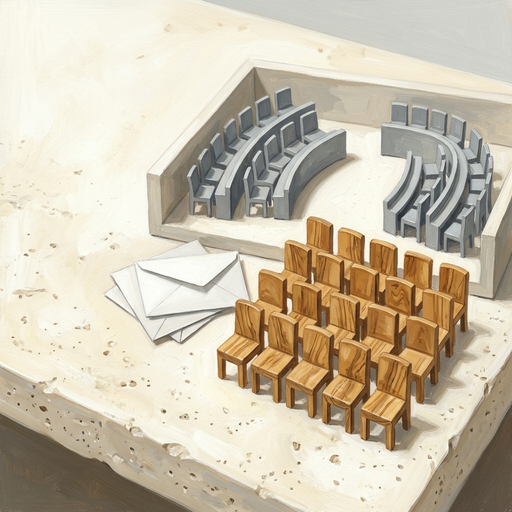
Start with the arithmetic, because it is the whole story. The Knesset has one hundred and twenty seats, so a governing coalition needs sixty-one. Netanyahu's bloc — his own Likud at twenty-six seats, United Torah Judaism, Shas, and Otzma Yehudit at seven, and the Religious Zionist Party at six — holds fifty-three. The opposition bloc — Yashar, B'Yachad, Yisrael Beytenu, and the Democrats — holds forty-eight. The two Arab parties, the Joint List and Ra'am, hold nineteen. Fifty-three plus forty-eight is one hundred and one, which means the last nineteen seats are not a footnote to this election; they are the only path through it. Whoever governs Israel next must either include the Arab parties, assemble a unity government across the two blocs, or fail and go back to the voters.
The first path is the incumbent's. Netanyahu gets the first attempt, because his bloc is the largest and his party is the largest party. To reach sixty-one he needs eight more seats, and the map to get them is narrow. He cannot take them from the Religious Zionist or Otzma parties; they are already inside his fifty-three. He cannot take them from the opposition's forty-eight without Eisenkot's consent, which is to say without a national-unity deal. And he cannot take them from the Arab parties without shattering the founding assumption of his own coalition: Otzma Yehudit and the Religious Zionist Party have built their politics on the exclusion of exactly those parties. A Netanyahu government with Ra'am in it would be, on its face, the most consequential coalition in Israeli history. A Netanyahu government with the Joint List in it is, on present form, unthinkable.
The second path is the one nobody in Israeli politics has ever had to take seriously until now: the opposition's forty-eight plus the Arab parties' nineteen equals sixty-seven. A government without Netanyahu, resting on Arab support. The Jerusalem Post reports that Golan has already called on the opposition bloc to form a government with Ra'am and the Joint List, on the strength of the record Arab turnout. This is not a fringe scenario anymore; it is arithmetic. It would also be the first coalition in Israeli history built with Arab parties as full partners from day one — Ra'am sat in the Bennett-Lapid government in twenty twenty-one, but as a junior partner in a broad anti-Netanyahu alliance, not as the indispensable bloc. Here, the nineteen are the majority-maker. That is a different animal entirely.
The third path is the one Israeli politics always retreats to when the math fails: national unity. Netanyahu and Eisenkot, the general and the incumbent, splitting the prime ministership or the ministries until a government exists. It requires Eisenkot to abandon the opposition's stated reason for existing — replacing Netanyahu — and it requires Netanyahu to share power with a man whose campaign was built on ending his own. The alternative for both is the other kind of deal: Eisenkot goes to the Arab parties instead, and Netanyahu watches the opposition take sixty-seven. The price of unity is now the price of survival for both men, which is why unity, despite everything, remains the most likely of the three. When the only alternative is the other guy winning, generals and incumbents discover common ground at remarkable speed.
But do not lose the actual news inside the coalition game. The nineteen is not just a number; it is a verdict on who Israeli politics is for. The Joint List and Ra'am did not sneak into the Knesset on a low-turnout technicality; they arrived on the highest Arab turnout in the country's history, which means the balance of power in Israel now runs through the ballot boxes of a fifth of its citizens. For decades, Arab parties were the bloc everyone needed and nobody would name as partners. The twenty twenty-six election has made that position untenable. You can exclude them, but you can no longer govern without counting them. We think that is a structural change, and it will outlast whatever coalition emerges from this week.
What happens next, on the documents' own timetable: the double-envelope count finishes, the CEC certifies the result, and President Isaac Herzog begins the consultations that decide who gets the mandate. Herzog has already said, in the Jerusalem Post's paraphrase, that Israel "must do everything possible to avoid another round of elections." That is not a ceremonial remark; it is the president of the state telling the parties that the public will not accept another year of this. The mandate will go first to the leader with the best chance of forming a government, which on present numbers is Netanyahu — but a mandate is not a government. If he cannot assemble sixty-one, the mandate moves to Eisenkot. And if Eisenkot cannot assemble it either, the state goes back to the polls, and the nineteen get bigger again.
So here is our read of the implications, all of them conditional on the count holding. A Netanyahu-led government is still the single most likely outcome, but only because he gets to try first and because unity is cheaper than the alternatives for his partners. An opposition-plus-Arab-parties government is the most consequential outcome now on the table, because it would normalize something Israeli politics has never done. And a unity government is the most Israeli outcome of all: two blocs that despise each other discovering that sixty-one is a bigger number than their differences. Every one of those roads runs through the nineteen. The election that was supposed to settle things has instead made one thing unavoidable: from now on, there is no Israeli government without the Arab parties in the room, whether they are welcome there or not.
At My Audio Books dot A I, you can listen to this story and thousands of others that explore the hidden science and mechanics behind the headlines.
What we would watch next, in order of importance. The double-envelope count: if it moves the blocs by even one or two seats, the kingmaker math changes again, and it was already a knife-edge. The first signals from Yashar and from Ra'am and the Joint List — whether the Arab parties will formally back an opposition government, and whether Eisenkot will take that deal rather than unity. Herzog's assignment of the mandate and the twenty-eight-day clock that follows it, because a failed attempt is a different government from no attempt at all. And finally the turnout number itself: if the record Arab turnout holds in the next election too, then the nineteen is not an anomaly but a new floor, and the coalition system has permanently changed. The election is over. The election that actually decides the government has just started.
At My Audio Books dot A I, you can create fiction, non-fiction, and turn your documents into audio, all stored in one place with a single subscription — plus get instant access to thousands of audiobooks and deep-dive investigations. Learn more today at My Audio Books dot A I.