Island of the Dolls: Separating History From Folklore in Xochimilco
For decades, Julián Santana Barrera hung discarded dolls across a Xochimilco island, reportedly to appease a girl who drowned nearby—though no record has confirmed her identity or death. After Santana died, his family preserved the eerie collection as a tourist destination, where a solitary man’s work and an unverified story continue to shape one another.
By MyAudioBooks.ai ·
Listen free: Island of the Dolls: Separating History From Folklore in Xochimilco
Deep within the southern wetlands of Mexico City, hundreds of weathered dolls hang suspended from the drooping branches of water willows and the eaves of wooden cabins. Some are missing eyes, their hollow sockets staring into the damp air. Others display cracked vinyl skin, severed limbs, and matted hair, transformed by decades of intense high-altitude sunlight, seasonal downpours, and rising canal humidity. For more than half a century, travelers from around the globe have navigated these labyrinthine waterways, drawn by a haunting central premise. According to local lore, a reclusive farmer gathered and displayed these discarded figures to appease the restless spirit of a young girl who drowned along his muddy shoreline.
Yet when researchers turn to the historical record to identify the child at the heart of this world-famous narrative, they find nothing. No civil registry confirms her birth, no police dispatch records her disappearance, and no municipal archive documents her recovery. The Island of the Dolls exists in plain sight, an undeniable physical reality shaped by fifty years of solitary human labor. Yet the foundational tragedy that supposedly summoned it into being remains entirely uncorroborated. In the minutes ahead, we will trace how an unverified event transformed an ordinary agricultural plot into an enduring international destination, carefully untangling documented history from repeated folklore.
At My Audio Books dot A I, you can create your own audiobooks from prompts, turn your documents into audio, all with one subscription, and store your items in your own personal library.
To comprehend the emergence of the island, one must first understand the remarkable hydrological world that cradles it. The southern borough of Xochimilco preserves the final living remnants of a vast pre-Hispanic lacustrine basin that once filled the Valley of Mexico. Long before the Spanish conquest altered the hydrology of the plateau, indigenous Mesoamerican communities transformed shallow, marshy lake beds into one of the most productive agricultural systems in human history through the creation of chinampas.
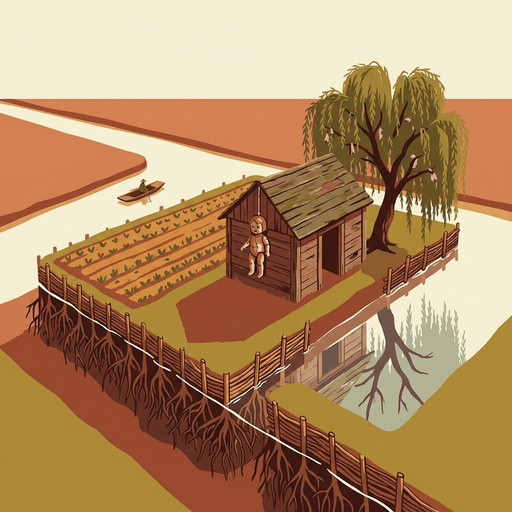
Popular travel literature often describes chinampas as floating gardens, but that description is physically misleading. Chinampas do not drift across the water. They are permanent, anchored artificial islands constructed through meticulous human engineering. Ancient farmers drove stakes of native ahuejote water willows into the shallow lake bed to outline rectangular plots. Between these vertical posts, they wove flexible branches to create retaining fences. Workers then dredged decomposing aquatic reeds, silt, and mineral-rich lake mud from the bottom of the basin, spreading alternating layers within the timber perimeter until the soil surface rose above the waterline.
As the ahuejote willows matured, their extensive, fibrous root networks anchored deep into the submerged lake bed, binding the accumulated soil and stabilizing the canal banks against erosion. The resulting network was a geometric grid of narrow, navigable channels separating fertile agricultural plots. This design permitted constant subsurface irrigation through capillary action, allowing farmers to cultivate up to seven harvests of vegetables and flowers each year without relying on rainfall alone.
In nineteen eighty-seven, the United Nations Educational, Scientific and Cultural Organization, known as UNESCO, inscribed the Historic Centre of Mexico City and Xochimilco on the World Heritage List. That international designation recognized the surviving canal network and chinampa zone as an invaluable cultural landscape. The inscription honors the continuity of pre-Hispanic engineering and centuries of agrarian tradition, rather than any individual eccentric property within the wetland.
Over the twentieth century, as the urban sprawl of Mexico City paved over the northern lakes, Xochimilco evolved into a cultural refuge and a recreational landscape. Visitors traveled along the principal waterways aboard trajineras, bright, flat-bottomed wooden boats propelled by boatmen using long wooden poles known as canaletes. This established passenger infrastructure created the commercial pathways that eventually carried outside observers into the more remote, quiet agricultural channels. Water in Xochimilco is both a source of life and an ever-present peril, establishing the physical backdrop for the tragedy that would soon define one quiet plot.
The human history of this particular chinampa belongs to Julián Santana Barrera. Born in the region, Santana relocated to the secluded island in the middle of the twentieth century, with local accounts placing his arrival around the nineteen fifties. Choosing a solitary life away from the growing urban bustle of the valley, he spent his days cultivating maize, chilacayote squash, vegetables, and ornamental plants, subsisting on what he could harvest and trade.
According to widely repeated oral tradition, an unexpected accident shattered the quiet rhythm of his homestead. The story relates that a young girl drowned in the canal water running directly alongside his chinampa. Santana reportedly discovered a doll drifting in the canal shortly after the child died. Convinced that the toy had belonged to the drowned girl, or perhaps perceiving it as an instrument to quiet her unsettled soul, he fastened the doll to the limb of a willow tree as an act of memorial appeasement.
What began as a singular gesture of remembrance gradually expanded into a five-decade obsession. Over the following fifty years, Santana gathered hundreds, and eventually thousands, of discarded dolls and synthetic fragments. He suspended them from tree branches with wire, hung them along clotheslines, and fastened them to the wooden planks of his modest cabin. Observers have offered various interpretations of his behavior. Some portray the installation as a protective perimeter designed to ward off malevolent spirits. Others view it as a continuous devotional offering, or simply the psychological coping mechanism of a man living in profound social isolation.
When viewed within the cultural context of central Mexico, Santana's actions mirror established vernacular practices. Throughout the region, rural communities frequently erect animitas and roadside shrines at sites of sudden or violent death. Families decorate these small shrines with personal belongings, toys, votive candles, and religious icons to offer comfort to the deceased and assist wandering souls in finding peace. Santana's display bears strong structural affinities with these informal folk practices, even though his personal theology was never formalized through church doctrine or written theological statements.
To examine the site with historical discipline, one must separate the narrative into three clear categories. First, there are documented physical realities: the existence of the chinampa, Santana's documented residence, and the physical collection hanging from the trees. Second, there is the oral tradition: the story of the drowned girl and Santana's spoken explanations. Third, there are the critical gaps where physical evidence and oral tradition fail to intersect.
When the drowning narrative is examined under historical scrutiny, significant structural fissures quickly become evident. The story survives not as a single, consistent historical account, but as a cluster of mutually incompatible oral versions. In one common variant, Santana hears frantic cries, runs to the water's edge, and watches helplessly as the girl is dragged beneath the surface by deep canal currents. In a second variant, he arrives long after the event, finding her lifeless body tangled among the submerged roots and reeds near his dock. In a third version, Santana never sees a body at all, learning of the tragedy through distant canal rumors and connecting the accident to a floating toy he retrieved days later.
These variations represent fundamentally different relationships to the event, yet modern retellings frequently blend them together. More critically, extensive archival research yields no corroborating primary records. Exhaustive investigations of civil death registries in Xochimilco, municipal police ledgers, hospital logs, and contemporaneous Mexico City newspapers from the mid-twentieth century reveal no report of a young girl drowning in that specific sector. Her legal name, her age, her family lineage, and the precise date of her death are missing entirely from the public record.
This lack of documentation does not automatically demonstrate that an accident never occurred. Accidental drownings were an unfortunate, recurring reality in the agricultural channels of Xochimilco, where deep waterways ran directly alongside residential plots without safety barriers. In mid-twentieth-century agrarian communities, where daily life was often detached from urban administrative bureaucracies, the deaths of rural children were sometimes handled through local religious customs without generating municipal records or newspaper coverage. A girl could have drowned in the canal without leaving an archival footprint.
However, historical plausibility must not be confused with positive factual proof. The modern confidence with which the drowning is recounted relies almost entirely on circular media repetition. International travel programs, lifestyle magazines, and digital publications routinely quote earlier coverage without consulting primary documentation. Over several decades, this uncritical echo chamber has transformed an unverified local story into an accepted factual premise. Repetition creates familiarity, but familiarity is not verification.
Santana's own testimony provides little evidentiary clarity. He left behind no personal journals, letters, or sworn statements, and his words survive only through the recollections of visiting boatmen, neighbors, and relatives interviewed late in his life. Furthermore, dramatic claims that Santana communicated directly with the spirit, or that the girl demanded a continuous supply of new dolls, belong to the realm of folklore and personal perception. They illustrate the collector's subjective world, but they cannot prove the physical occurrence of a historical drowning.
While archival evidence for the girl remains absent, the physical reality of the dolls is unmistakable. The collection did not emerge from a unified artistic vision or an institutional acquisition fund. Instead, Santana gathered his figures through pragmatic, opportunistic scavenging. He pulled waterlogged refuse directly from the canals using long branches, retrieved discarded toys from municipal trash dumps on the mainland, and bartered fresh produce with local residents in exchange for damaged or unwanted dolls. In his final years, curious visitors began bringing their own toys as tokens of respect.
Popular accounts frequently assert that the chinampa contains thousands of dolls, yet no systematic census or accession catalog has ever been completed. Determining an accurate count is complicated by the fragmented state of the collection. Observers have never settled on whether a severed plastic leg, a sun-bleached torso, or an isolated vinyl head impaled on a wooden fence should be counted as an individual artifact or as material debris.
The complete absence of provenance compounds this uncertainty. Virtually none of the objects carry documentation establishing their manufacture date, original owner, or the date Santana hung them. Visitors encounter an anonymous accumulation of twentieth-century consumer plastics, united only by their collective exposure to the natural elements.
The unsettling appearance of the dolls is primarily the outcome of predictable environmental processes. The Valley of Mexico sits at an altitude of over twenty-two hundred meters, exposing synthetic materials to high levels of ultraviolet solar radiation. This intense sunlight triggers photolysis, breaking the chemical polymer bonds within flexible vinyl and polyethylene. Smooth surfaces crack, split, and peel away. At the same time, persistent canal humidity and seasonal rains support the colonization of black mold, green moss, and lichens across the synthetic faces. Spiders, wasps, and beetles construct nests within hollow eye sockets and fractured torsos, while dramatic daily temperature fluctuations warp the plastic. The dolls' grotesque forms are the natural consequence of chemical breakdown and organic colonization, not supernatural intervention.
Human cognition completes the unsettling transformation. When travelers journey through quiet waterways at dusk and step onto an isolated agricultural plot, environmental cues prime them for anxiety. The psychological phenomenon of pareidolia causes the human visual system to interpret ambiguous shadows and cracked textures as deliberate emotional expressions. The sound of wind stirring dry willow leaves and canal reeds mimics whispered voices, while subtle shifts in hanging wires create the illusion of independent movement. Depending on the narrative expectations a visitor brings to the shore, a single decayed doll can be interpreted as a poignant memorial, a striking example of outsider art, or an object of uncanny horror.
The material accumulation provides tangible evidence of a man's solitary, multi-decade dedication. What it cannot provide is evidence for the identity or existence of the child who supposedly inspired the vigil.
In two thousand one, the narrative reached its dramatic conclusion when Julián Santana Barrera died on his chinampa at the age of eighty-six. Public reports confirm that his body was recovered from the water of the surrounding canal. Almost immediately, local storytellers and tour guides introduced an element of cyclical symmetry, asserting that the aging farmer had drowned in the exact spot where the young girl had allegedly lost her life five decades before. While official records confirm his death on the island, the claim of precise geographical alignment reflects the enduring tendency of oral tradition to supply symbolic closure to an unfinished life.
Following Santana's passing, his family members, led by his nephew Anastasio Santana, assumed stewardship of the chinampa. Collaborating with local trajinera operators, they chose to maintain the assemblage and formally opened the property to international visitors. The name Isla de las Muñecas, or Island of the Dolls, solidified during this era. It was not an ancient indigenous toponym, but a modern descriptive label popularized by television documentaries, photojournalism, and travel agencies seeking compelling cultural itineraries.
Today, the island occupies a complex intersection of four distinct cultural categories. To some observers, it functions as a vernacular shrine, preserving the physical mechanics of mourning, spiritual petition, and folk devotion outside the administrative structure of the Catholic Church. To others, it represents a remarkable instance of environmental outsider art, comparable to other visionary, self-taught installations where solitary creators transformed discarded industrial detritus into immersive personal worlds.
Concurrently, the site has become a prominent fixture of dark tourism, drawing visitors eager to confront themes of mortality, abandonment, and the macabre. This commercial reality creates intricate local dynamics. The canal tolls, docking fees, and admission charges provide critical economic sustenance for boatmen, caretakers, and vendors who must navigate the decline of traditional agriculture in the valley. Yet this economic reliance creates a persistent incentive to dramatize a private personal vigil, occasionally reducing a complex human history to a theatrical ghost story.
Meanwhile, questions of long-term conservation remain unresolved. Research reveals no comprehensive municipal management plan, environmental stabilization protocol, or formal heritage policy specifically tailored to protect the chinampa's eroding banks or stabilize its deteriorating plastics. The site persists in an institutional limbo between private farmland, informal tourist destination, and uncurated open-air museum, held together through family labor and steady visitor curiosity.
The enduring power of the Island of the Dolls does not depend on proving that spirits haunt its willow trees. Its true significance lies in the tension between material reality and historical absence: thousands of weathered, tangible objects sustaining the memory of an unnamed child whose life was never recorded. When you encounter places where oral folklore meets the physical world, consider the distinction between what is documented, what is repeated, and how our desire for a story can transform an ordinary landscape into an enduring legend.