How to Look at Paintings Through Light, Composition, and Viewpoint
From the intimate room of van Eyck’s Arnolfini Portrait to Rembrandt’s advancing civic guards and Hopper’s sealed, luminous diner, this story explores how paintings direct our attention and position us within—or outside—their worlds. Following light, viewpoint, gestures, and edges offers a flexible method for looking closely while distinguishing visible evidence from uncertain interpretation. A focused museum itinerary turns that method into practice, showing how slowing down before reading the label can transform viewing art into a conversation across time.
By MyAudioBooks.ai ·
Listen free: How to Look at Paintings Through Light, Composition, and Viewpoint
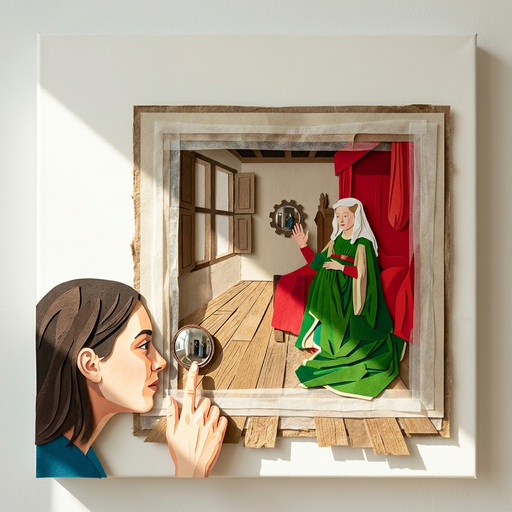
Step directly into the quiet of a bedchamber painted in Bruges in the year fourteen thirty-four. At the left, a man stands on bare oak floorboards, wrapped in a heavy, dark garment edged with sable fur. A wide black hat casts a cool shadow over his pale, angular brow. At the right stands a woman in an intensely vibrant green dress, gathering its heavy woolen folds across her stomach with one pale hand. Between them, the floor recedes toward a carved red bed along the right-hand wall. From a tall, shuttered casement on the left, soft daylight washes across the room. It touches a small scattering of fruit on a window bench and warms the wood beneath their feet. Down near the front of the space, a wiry little dog stands alert, its reddish fur painted hair by hair. Behind the couple, centered on the far wall beneath an elaborate brass chandelier, hangs a small circular mirror, curving outward into the room like the polished back of a silver spoon.
This scene exists on a wooden panel slightly over eighty-two point two centimetres high and sixty centimetres wide, preserved in the collection of the National Gallery in London. It was painted in oil by Jan van Eyck. At a time when many painters still mixed their ground earth and mineral pigments with egg yolk to produce quick-drying tempera, van Eyck suspended his pigments in drying oils, such as linseed and walnut. This medium dried slowly. It allowed an artist to build transparent glazes, soften transitions between light and dark, and render textures with luminous fidelity. The people depicted here belonged to the prosperous Italian merchant community living in fifteenth-century Bruges, then a thriving trade hub under the Dukes of Burgundy. On the wall above the round mirror, van Eyck brushed an ornate, flourishing Latin inscription that explicitly names him, records his presence, and supplies the date. Rather than signing as an aloof craftsman, he recorded that Jan van Eyck was here in fourteen thirty-four.
When people stand before a painting of this caliber, the instinct is often to retreat to the printed wall label to find out what it means. Yet every painting carries an internal architecture that speaks before any historical summary is read. To unlock that architecture, one can practice a simple, repeatable sequence. First, find the light. Second, follow where attention is pulled and ask why. Third, find your level by locating the horizon or implied viewpoint. Fourth, watch what the hands and the edges are doing. And fifth, bring all these observations together to consider your place.
This brings us to a single governing question that serves as an open tool for looking: Where does this picture place me in relation to what it shows?
This question does not promise to reveal an artist's hidden secrets, nor does it require an interior room with human figures. It remains just as effective when looking at a patch of sky, a quiet landscape, or an arrangement of colored shapes. Vision itself is not a smooth, continuous recording like a camera panning across a wall. Laboratory research into eye movement confirms that our eyes navigate images through rapid, darting jumps called saccades, punctuated by momentary rests called fixations. During these brief pauses, the brain takes in detail. In seventeen sixty-seven, the philosopher Denis Diderot observed that a well-composed painting offers a guiding line that directs the viewer through the scene. Modern science affirms that intuition. A research study published in twenty twenty-five revealed that when people look at an image, their eyes spend the first two seconds in broad, ambient scanning, gathering a general sense of the whole before settling into tighter, concentrated clusters of attention. Painters have long anticipated this behavior, arranging contrast, color, and line to invite our eyes along structured paths.
Consider how this works in van Eyck's room. Begin with the light. It enters unmistakably from the left, passing through leaded window panes to strike the man's cheek, glint against the citrus on the wooden sill, and gleam along the curved brass of the chandelier. This is physical, natural daylight, rendering the room tangible. The single burning candle in the chandelier above might carry symbolic overtones, suggesting an unseen presence or a ceremonial hour. But the visible daylight grounds the entire scene in physical space.
Next, notice where attention travels. There is no single compulsory starting point. One eye might leap immediately to the brilliant green of the woman's gown set against the deep crimson of the bed hangings, drawn by the high contrast of complementary colors. Another might land upon the two pale faces suspended against the dark back wall, or drop to the delicate clasp of their hands, or seek the glowing reflection inside the convex mirror. Composition is simply the deliberate arrangement of elements across a surface, much like arranging furniture in a living room so that physical movement is drawn naturally through the space. The eye is naturally pulled toward places where the lightest tones and darkest shadows sit right against one another.
To find your level, look at how the room recedes. An eye-level line, often called the horizon line, is the level you would face if you stood looking straight ahead across flat ground. A vanishing point is the apparent meeting place where parallel lines traveling away from you seem to converge, much like railway tracks running toward the distance. In van Eyck's panel, the floorboards and the frame of the bed slant inward, but they do not converge into a single, geometrically rigid vanishing point. Fifteenth-century Netherlandish painters developed spatial depth through empirical observation rather than pure mathematical perspective. The horizon here is not an outdoor vista of sky and earth, but an implied height roughly level with the couple's heads. The viewer is placed standing directly in front of them on the same floorboards, close enough to feel the enclosure of the timber room.
Now watch the hands and the outer edges. The man holds his right hand raised upright, palm turned outward, while his left hand supports the woman's upturned palm. The woman gathers the fabric of her skirt with her left hand, letting the heavy drapery spill forward. Down at their feet, the cropped edges of the composition frame the hem of her gown and the pointed wooden clogs left on the floorboards. The wall mirror behind them deepens this sense of boundary. Because its glass curves outward like a spoon, it gathers a panoramic reflection of the room from behind. It reveals the couple's backs and, in the doorway opposite them, two miniature figures standing where the painter and the viewer would be positioned.
For generations, viewers have tried to reduce this panel to a single legal transaction, calling it a documented marriage ceremony, a legal certificate, or visual proof of an impending birth. Yet historical evidence urges caution. The sitters are associated with the Italian Arnolfini merchant family in Bruges, traditionally identified as Giovanni Arnolfini and his wife, though the precise identity of the woman remains actively debated among scholars. The abundant cloth gathered at her waist reflects the fashionable, voluminous tailoring of wealthy fifteenth-century Northern Europe rather than a confirmed pregnancy. By letting go of the urge to force a single tidy story onto the panel, looking becomes an honest encounter with what is visible. The painting places us at the threshold of a private world, invited close enough to inspect its textures, yet separated from its private domestic certainties.
That quiet threshold expands outward when we turn across time to seventeenth-century Amsterdam. In Rembrandt van Rijn's colossal canvas completed in sixteen forty-two, commonly known as The Night Watch, intimate domestic hands give way to an officer's gloved hand thrusting forward into the viewer's space.
Preserved in the Rijksmuseum in Amsterdam, this painting is an enormous group portrait spanning more than four metres across. Its subjects were not a modern police patrol on a nighttime beat, but members of an Amsterdam civic guard company, an organized militia of citizen burghers charged with civil defense and ceremonial duties. At the center strides Captain Frans Banninck Cocq, dressed in authoritative black slashed by a fiery red sash, accompanied by his lieutenant, Willem van Ruytenburch, who gleams in pale, embroidered yellow. Around and behind them presses a crowded, noisy company of townsmen carrying pikes, raising muskets, and beating a drum. An illuminated young girl moves mysteriously through the middle ranks, with a white fowl slung from her belt.
The painting acquired its popular nickname long after Rembrandt died, when layers of darkened varnish led viewers to mistake a daytime scene for a nocturnal sortie. There is no evidence Rembrandt intended a pitch-black midnight patrol, nor is there evidence of an exact outdoor weather condition. Instead, he employed chiaroscuro, an Italian term describing the dramatic organization of deep shadow and focused light. It is comparable to a single strong lantern isolating faces and figures in a dim hall.
Apply our sequence here, and the canvas springs into motion. The light does not behave like the cool, steady daylight of van Eyck's window. It falls selectively, igniting the lieutenant's pale yellow doublet, picking out the captain's face and white collar, and throwing a bright glow over the girl in the background, while plunging surrounding figures into murky atmospheric shadow. Attention bounces between these bright pockets and follows the sharp diagonals of raised spears, halberds, and the captain's outstretched left arm. That reaching hand is a masterclass in foreshortening, a visual effect where an object pointing directly toward the observer appears compressed in length. It is like a straight road seeming compressed when viewed from ground level. The captain's hand reaches out so convincingly that its shadow falls across the lieutenant's yellow coat, pinning the two men together in space.
Rembrandt does not ask us to solve a geometric puzzle of horizon lines. The viewpoint is positioned on the street, just below the advancing officers, making the company loom over us as they move into public territory. Yet the edges of this canvas carry a crucial historical lesson. In seventeen fifteen, the painting was moved to the Amsterdam town hall. Because the canvas was too large to fit between two doors on the designated wall, workmen simply trimmed strips from all four sides, cutting most heavily from the left. That alteration removed two entire figures and altered the compositional balance between figures and surrounding architecture. We know this because a smaller seventeenth-century copy by the painter Gerrit Lundens survives, now in the collection of the National Gallery in London, preserving the wider, original arrangement.
The material surface of a painting remains alive to change. That reality is visible in full public view. Under Operation Night Watch, an extensive research and conservation initiative begun on July eighth, twenty nineteen, conservators in October twenty twenty-six are actively working inside a glass chamber erected directly in the Rijksmuseum's Gallery of Honour. They are painstakingly removing aged, discolored varnish that had altered Rembrandt's colors over centuries. When we ask where the painting places us, the answer is dynamic. It places us on the pavement right in the path of a marching company, while its cut edges and ongoing preservation remind us that the visual invitation we receive today has been shaped by physical history.
Three centuries after van Eyck, across an ocean, Edward Hopper rearranged that relationship between observer and scene in his iconic canvas Nighthawks. Completed in nineteen forty-two and acquired that same year by the Art Institute of Chicago, this horizontal oil painting, about a metre and a half wide, turns the drama inward.
Hopper lived and worked in New York City, but the wedge-shaped diner depicted here is an artistic synthesis rather than a documentary portrait of an exact street corner. Painted during the early months of American involvement in the Second World War, the scene shows four figures late at night inside an illuminated corner restaurant: a counterman in a clean white uniform leaning forward, a couple sitting close together on wooden stools, a man in a dark fedora, and a woman in red holding a slip of paper. A solitary man is seen only from behind. Outside, the dark, empty street and closed storefronts sleep in silence.
Run the sequence across this modern American space, and notice how differently the tools behave. The light does not enter from a domestic window or flare from an officer's spotlight. It blazes entirely from within the diner itself. Harsh, cool, artificial light spills through seamless plate-glass windows, casting an eerie pale yellow-green glow across the empty sidewalk outside while carving sharp, geometric shadows against the brick building across the street.
Attention settles instantly on the bright interior, drawn by the attendant's white tunic and the warm mahogany curve of the counter, before circulating among the figures. Their hands tell an eloquent, understated story. The man and woman sit side by side, their hands resting on the counter mere inches apart, their fingers curled near one another without touching. The solitary patron sits with his hands quiet, facing away from us, his back an impenetrable dark shape.
Find your level here, and you discover you are standing outside on the darkened pavement. The lines of the counter and the roofline of the diner slant across the canvas, but there is no distant horizon line to anchor the outdoors. Instead, the curved plate glass wraps seamlessly around the prow of the diner. Crucially, Hopper shows no entrance door. The building may well have an entrance around the corner in physical reality, but within the painted composition, no doorway is offered. The glass remains an invisible, unbroken barrier. Viewers often interpret the scene as a statement on urban loneliness, wartime anxiety, or temporary sanctuary. Those are valid emotional responses invited by the composition, but they remain interpretations. What is physically present is an omitted door and an uninterrupted expanse of glass. The painting places us on the cold pavement outside, close enough to inspect every gesture, yet completely excluded from the light and the silence within.
These three works reveal how the governing question adapts across different visual worlds. Yet European oil painting is not the only way humans have made pictures. In a traditional Chinese landscape handscroll, for example, the image is not viewed as a single, static rectangle seen through a fixed window. It is unrolled gradually by hand, revealing winding rivers, misty mountain paths, and shifting perspectives as the viewer moves through space and time. There, single-point perspective and fixed light sources do not apply. Light may be diffuse, horizons may dissolve into empty silk, and hands may never appear. The method described here is not a rigid set of conditions a painting must fulfill; it is an open set of prompts that sharpens our ability to notice what is present.
To put this looking tool into everyday practice, one does not need to cross the globe to visit London, Amsterdam, and Chicago in a single journey. You can build the habit inside any collection, beginning in the National Gallery in London, where van Eyck's panel hangs.
The primary obstacle in large museums is not a lack of knowledge, but visual exhaustion. Rushing through crowded corridors trying to glance at hundreds of paintings in an afternoon guarantees that none of them will truly be seen. A far better practice is to choose a generous upper limit of twelve works for a visit. Plan for four unhurried anchor encounters, allowing brief looks at up to two neighboring pictures around each one, and leave the museum refreshed. When approaching an anchor painting, look quietly for about a full minute before reading the interpretive wall text. Take in the light, the attention paths, and the implied viewpoint. Then read the label to check dates, materials, and historical context, and turn back to the picture to see how that knowledge deepens or tests your initial impression.
Consider how a focused one-hour visit inside the National Gallery might unfold, measured from the moment you step past the entrance barriers. Spend the first five minutes near an information desk, picking up a current floor plan. Display arrangements change as works are conserved or loaned, so ask the gallery staff for the day's locations of four specific anchors: Jan van Eyck's Arnolfini Portrait, Hans Holbein the Younger's The Ambassadors, Pieter de Hooch's The Courtyard of a House in Delft, and Claude Monet's The Water-Lily Pond. As of October twentieth, twenty twenty-six, gallery records place the Arnolfini Portrait in Room fifty-two. But visitor planning should note that a major temporary exhibition, Van Eyck: The Portraits, is scheduled to run at the National Gallery from November twenty-first, twenty twenty-six to April eleventh, twenty twenty-seven. Because this forthcoming exhibition reunites all surviving van Eyck portraits, display locations and access arrangements may shift, making a quick check with staff worthwhile.
From orientation, dedicate about eleven minutes to van Eyck. Spend eight or nine minutes standing before the panel, tracing the cool daylight on the oak boards, the gleam of the chandelier, and the tiny figures mirrored in the spoon-like curve on the wall. Glance briefly at one or two neighboring Northern European panels before moving on.
Next, allow roughly thirteen minutes, including your walk, to find Hans Holbein the Younger's The Ambassadors. Here, two richly dressed Renaissance men stand flanking two shelves laden with globes, celestial instruments, and a lute with a broken string. Near the bottom edge floats a strange, elongated pale shape that looks like a smeared bone. If you move along the barrier to view the painting from an acute angle from the right, that distorted shape optically resolves into a human skull, a striking reminder of mortality tucked into a portrait of worldly power.
Give another thirteen minutes to Pieter de Hooch's The Courtyard of a House in Delft. Here, the sequence reveals a masterclass in thresholds. Sunlight falls over weathered red brickwork, crumbling mortar, and an open entryway through which a woman leads a small child, offering a view of domestic light and privacy that invites you to consider where the garden path begins and ends.
For the final thirteen-minute encounter, seek out Claude Monet's The Water-Lily Pond. Monet sweeps away the traditional Western horizon line entirely. The green Japanese arched bridge curves over still water, surrounded by weeping willows and floating lily pads. Without a distant patch of sky, Monet tilts the watery surface upward, placing you right at the edge of the pond, immersed in reflections of light and shadow.
Finish the hour with a quiet five-minute pause on a gallery bench, letting your eyes rest without seeking another label.
Looking closely at a painting is neither an academic test with a single hidden answer nor a passive exercise in consuming images. It is an act of sustained attention. When you step up to a canvas, pause before the label, and let your eyes follow the fall of light, the reach of a painted hand, or the edge of an illuminated window, the picture stops being an inert historical relic. It becomes a conversation across time, asking you, quite simply, where you stand.