How Much Protein Is Too Much?
In 2018, a McMaster team pooled every randomized trial on protein and lifting — 49 studies, 1,863 people, 54 years of research — and found the muscle-building curve flattens at about 1.6 grams per kilo per day. The gap between what lifters already eat and that number is one chicken breast. What the trials actually show, what the ISSN recommends per meal, what a year at double the dose did to healthy kidneys, and why everything past the number is markup — read from the papers, not the tub.
By MyAudioBooks.ai ·
Listen free: How Much Protein Is Too Much?
In twenty eighteen, at McMaster University in Hamilton, Ontario, an exercise scientist named Robert Morton and his colleagues finished assembling every randomized controlled trial ever published on protein and lifting — forty-nine studies, one thousand eight hundred and sixty-three participants, from seventeen countries, spanning fifty-four years of experiments from nineteen sixty-two to twenty sixteen. They pooled all of it into one meta-analysis — a study of studies, where the results of many small trials are merged into a single statistical answer — and asked the question every person who has ever bought a tub of powder has asked: how much is enough? The answer came back as a curve with a ceiling in it. Beyond about one point six grams of protein per kilogram of body weight per day, the pooled data show, the muscle-building return simply stops. Our verdict, after reading the trials and the industry's price list, is that the number is real, the science is unusually clear, and everything sold past it is markup. This is the protein number.
The fitness industry sells protein the way casinos sell hope: in ever-larger scoops. Two grams per kilo. Two point two. Three, if you are serious. The implication is linear — more protein, more muscle, forever. The pooled record says the line bends and then it ends, and where it ends is a number you can hit with groceries.
At My Audio Books dot A I, you can create your own audiobooks from prompts, turn your documents into audio, all with one subscription, and store your items in your own personal library.
Section One. What the Tub Actually Buys
First, give the supplement its due, because the meta-analysis is genuinely pro-protein. Across the forty-nine trials, lifters who supplemented gained significantly more than lifters who did not: one-repetition-maximum strength up two point four nine kilograms on average, fat-free mass — the paper's term for lean tissue, the muscle and everything that is not fat — up zero point three kilograms, and measurable increases in muscle-fiber size. The effect was bigger in people who already trained: resistance-trained participants gained zero point seven five kilograms of fat-free mass with supplementation. So the powder is not snake oil. Protein plus training measurably builds more than training alone.
But two other findings in the same tables matter more for your wallet. The first is age: the supplement's benefit shrank significantly as participants got older — the muscle-building response to extra protein fades with the years, a phenomenon researchers call anabolic resistance. The second is the comparison almost nobody quotes: the paper states plainly that, quote, "performance of RET alone is the much more potent stimulus" — resistance exercise training itself. The tub is the supporting act. The barbell is the show. Whatever the optimal protein intake turns out to be, it multiplies what the training does; it does not replace it.
Section Two. Where the Curve Ends
Now the finding this whole book exists to deliver. Inside the meta-analysis, the team ran a breakpoint analysis — a statistical search for the intake level where additional protein stops adding anything. They found it. In the paper's words, they report "an unadjusted plateau in RET-induced gains in FFM at 1.62 g protein/kg/day," with a ninety-five percent confidence interval of one point zero three to two point two zero. And the abstract states the conclusion flatly: "protein intakes at amounts greater than ~1.6 g/kg/day do not further contribute RET-induced gains in FFM."
Read that sentence the way the industry hopes you never will. It does not say one point six is optimal for everyone at all times. It says that past one point six, across forty-nine trials and nearly two thousand lifters, the average measurable return is zero. Not smaller. Zero. The confidence interval is honest about the uncertainty — the true breakpoint could sit anywhere from about one point zero to two point two grams — but the center of the evidence is one point six two, and no trial in fifty-four years of research has produced a pooled reason to eat more.
Here is the detail that turns the finding into a purchase decision. The same paper notes that the lifters in these studies were already eating, on average, about one point four grams per kilo per day — seventy-five percent above the official recommended dietary allowance, which works out to zero point eight grams per kilo. Do the subtraction the industry never prints: the gap between what lifters already eat and the plateau is zero point two grams per kilo. For an eighty-kilogram man, that is sixteen grams of protein. That is one small chicken breast. It is not a subscription.
Section Three. The Number in Real Life
What does one point six look like on a plate? Take an eighty-kilogram lifter: one point six grams per kilo is one hundred and twenty-eight grams of protein per day. The International Society of Sports Nutrition, in its twenty seventeen position stand — the document the field's own professional society publishes to answer exactly this question — lands in the same neighborhood: "1.4–2.0 g protein/kg body weight/day (g/kg/d) is sufficient for most exercising individuals," with the note that more may be needed when cutting calories while trying to keep muscle. Two independent documents, two different methods, one overlapping range, and one point six sits comfortably inside both.
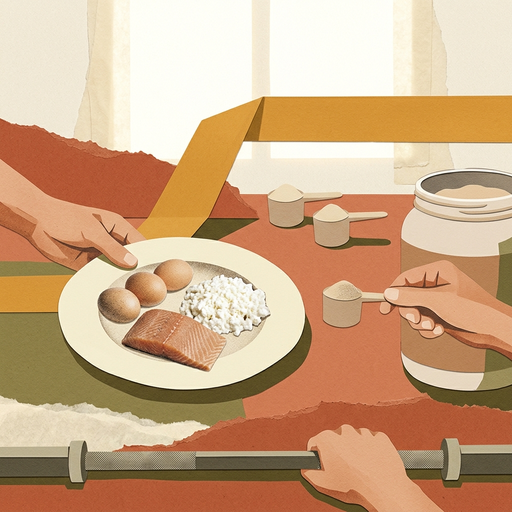
The position stand adds the practical engineering. Per serving, it recommends "0.25 g of a high-quality protein per kg of body weight, or an absolute dose of 20–40 g," each dose containing "700–3000 mg of leucine" — the amino acid that acts as the trigger for muscle protein synthesis — spread evenly across the day, every three to four hours. For our eighty-kilo lifter, that is twenty grams at a time, five or six times a day: a carton of Greek yogurt at breakfast, eggs at lunch, a piece of fish at dinner, cottage cheese before bed. No scoops required. The stand also flags the one group that may need bigger doses: older adults, whose muscles answer protein less eagerly and may need around forty grams per serving to get the same response.
Section Four. The Industry's Answer
So why does the shelf sell two point two and beyond? Our read is the usual one: follow the incentive, not the evidence. Protein is the one fitness product that must be bought repeatedly forever — a barbell is purchased once; a tub is purchased monthly. Every gram of perceived need is inventory, and the perception that serious people eat two grams per kilo is worth more than the fact that the pooled trials show nothing past one point six. The marketing is not a lie exactly — it is a rumor with a price tag, repeated until it hardened into bro-science scripture.
One more kind of too much needs answering, because it is the one your family actually worries about: is a high-protein diet too much for a healthy body? The position stand reviews that literature directly, and its answer is blunt. The renal concerns, it notes, come from kidney-failure patients, and extending that pathology to healthy, training people is inappropriate — published reviews, in its words, consistently find "no indication of hepato-renal harm or damage" in healthy active individuals. Then it cites the extremes: trials feeding healthy, resistance-trained men two point five to three point three grams per kilo per day — up to double the plateau — for as long as a full year, reporting no harmful effects on kidney function, liver function, or blood lipids. So the title's question has three answers, and the record gives all of them. Too much for your health? In a healthy, training body, the research has not found the ceiling. Too much for muscle building? One point six grams per kilo. Too much for your wallet? Everything past that. The only too much most of us will ever meet is the invoice.
Now the honest case for the tub, at full strength, because there is one. The meta-analysis shows supplementation is, in the paper's words, both sufficient and necessary to optimize training gains when intake is below one point six — if you cannot hit the number with food, the powder closes the gap cheaply and precisely. The confidence interval around the plateau is wide, so individuals may genuinely vary. People cutting calories benefit from higher intakes, the position stand says so, and older adults need bigger doses per meal. And the tub has one advantage no chicken breast offers: you know exactly how many grams are in the scoop. That is a convenience argument, and it is legitimate. It is just worth sixteen grams a day of groceries, not a lifestyle brand.
Section Five. The Number, Used
So here is the whole book in one instruction, and it costs nothing. If you lift, aim for about one point six grams of protein per kilogram of body weight per day — call it one point four to one point six, inside the society's range — hit it with food first, use powder to close a gap rather than build a tower, split it into doses of about zero point two five grams per kilo across the day, and spend the savings on a gym membership you actually use, because the training is the lever and the protein is the fulcrum, never the other way around. If you are older, go higher per meal. If you are cutting, go higher overall. And the next time someone sells you two point two, ask them for the trial that beats forty-nine.
We think the protein number is the perfect emblem of everything this series exists to do. The claim was linear and endless. The record is a curve with a ceiling. The ceiling has a confidence interval, the exceptions have names, and the whole thing fits on a plate. One point six is not a limit on your ambition; it is a refund on your markup. That is the protein number — and the only thing left to max is the training.
At My Audio Books dot A I, you can listen to this story and thousands of others that explore the hidden science and mechanics behind the headlines.
Section Six. What We Would Watch Next
Three gaps in the record are worth watching. First, the plateau's confidence interval — one point zero three to two point two zero — is wide enough to hide real individual differences, and a trial designed around the breakpoint itself, rather than extracted from pooled data, would sharpen it. Second, women: the meta-analysis notes far less work has been done in women than men, so the number's shape for female lifters is an open question, not a settled one. Third, age: the age-related resistance finding means the one-size number almost certainly bends upward past sixty, and the per-meal dosing trials for older adults are still thin. The day those three studies land, the protein number gets a revision — and the record, not the shelf, will decide what it says.
At My Audio Books dot A I, you can create fiction, non-fiction, and turn your documents into audio, all stored in one place with a single subscription — plus get instant access to thousands of audiobooks and deep-dive investigations. Learn more today at My Audio Books dot A I.