How Gothic Terror, Police Work, and Medicine Shaped Detective Fiction From Poe to Sherlock Holmes
From Poe’s locked-room Paris to Sherlock Holmes’s haunted Dartmoor, detective fiction transformed Gothic terror into mysteries that disciplined observation could unravel. Its evolution drew on Vidocq’s police tradecraft, the expanding crime press, and Dr. Joseph Bell’s diagnostic methods, culminating in Holmes’s fusion of analytical brilliance and practical evidence. Yet Poe’s inconclusive attempt to solve a real death and Holmes’s imperfect victories reveal the tradition’s essential limit: a compelling explanation is not necessarily proof, and understanding danger cannot undo its harm.
By MyAudioBooks.ai ·
Imagine climbing the dark stairway of an apartment house in the heart of Paris. The year is eighteen forty-one, but the setting is not drawn from police archives. It belongs entirely to the imagination of Edgar Allan Poe. His story, The Murders in the Rue Morgue, appeared that spring in the April issue of Graham's Lady's and Gentleman's Magazine in Philadelphia. Poe was then working as an editor. Inside the fourth-floor flat, two women, Madame L'Espanaye and her adult daughter, have met violent deaths. Yet the scene presents an unsettling contradiction. The entrance door is locked from the inside, the chimney flue is far too narrow to permit an exit, and bags containing four thousand francs in gold coin remain undisturbed across the floor. Meanwhile, the testimonies of the neighbors seem hopelessly at odds.
Those who rushed up the stairs in the dead of night agreed that they heard two distinct voices behind the bolted door. One was clearly a Frenchman, shouting in distress. The other voice was shrill, harsh, and utterly baffling. A Dutch merchant testified that he believed the second speaker was French, though he did not speak French himself. A French confectioner swore the accent was Spanish. An English tailor was positive he had heard a German speaking, while an Italian witness was convinced the voice belonged to a Russian. Every listener was certain the voice sounded foreign, yet each identified it as a language they did not personally understand.
Here Poe introduces the character of Monsieur C. Auguste Dupin, an impoverished young gentleman of aristocratic background who takes up the inquiry purely as an intellectual challenge. Alongside him walks an admiring friend, an unnamed companion who narrates the story. This companion is essential to the machinery of the tale. He observes everything Dupin observes, walks the same streets, and reads the same daily papers. Yet he cannot assemble the pieces until Dupin demonstrates how they connect. Dupin possesses no mystical intuition. Instead, he practices what Poe called ratiocination, which is simply the act of deliberate, disciplined reasoning through evidence. It is rather like methodically tracing a household plumbing problem through every pipe and valve to find where the water actually stops, rather than settling for the first noisy drain.
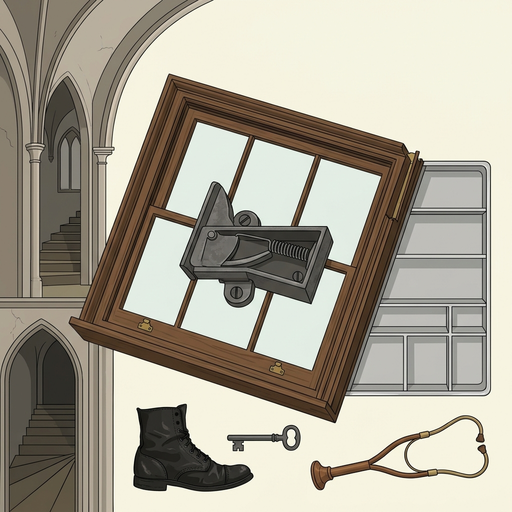
When Dupin inspects the apartment, he does not accept the locked room as an inexplicable miracle. A locked-room mystery presents an apparently impossible intrusion, rather like finding an object missing from a desk drawer whose lock has never been picked and whose key has stayed in your pocket. Dupin examines the window frames and discovers a concealed spring mechanism in one sash. It allows the window to slide down and latch securely by itself after an intruder swings outward. More importantly, he reconsiders the witnesses and their conflicting impressions of the mysterious voice. The listeners did not disagree because the speaker had mastered five languages. They disagreed because the voice was not using human speech at all.
The intruder was an escaped orangutan that had climbed a lightning rod, swung through the open window, and panicked in the dark. The frantic cries were the screeches of an agitated animal, while the French words belonged to a sailor who had pursued it to the window ledge in helpless terror. By questioning the fundamental assumption of the case, Dupin realized that what seemed to be a linguistic riddle was actually a biological one. The animal acted without malice or criminal design, but the horror of the scene remains palpable. The mathematical elegance of the solution does not soften the grim reality of the victims' deaths.
That lingering sense of dread points back to an older storytelling tradition. Long before amateur investigators stepped onto the pages of periodicals, readers had developed an appetite for dark, confining spaces and unexplained terrors. Poe was not creating narrative suspense out of thin air. He was reshaping the tools of Gothic fiction, a literary movement that had flourished in Britain over the previous century.
The modern Gothic tradition is usually dated to seventeen sixty-four, when Horace Walpole published The Castle of Otranto. Walpole offered readers an imaginative realm of crumbling castles, ancient curses, trapped heirs, and undeniable supernatural events, from gigantic armored apparitions to bleeding portraits. Thirty years later, in seventeen ninety-four, Ann Radcliffe refined that world in The Mysteries of Udolpho. Radcliffe placed her vulnerable heroines in brooding Italian fortresses surrounded by desolate mountain passes. But she introduced a technique that would prove vital to the future of detective fiction.
Where Walpole accepted genuine magic, Radcliffe frequently provided ordinary physical explanations for apparent marvels. An eerie midnight groan behind a bedroom wall would eventually be traced to wind whistling through a concealed architectural passage. An ominous figure stalking the ramparts would turn out to be a living person carrying out a secret errand. The terror felt real, but the world remained governed by physical laws. Poe took this Radcliffean principle and reorganized its emotional rhythm. In a Gothic romance, the ordinary explanation often arrived at the very end as a tidy relief after hundreds of pages of fright. In Poe's fictional Paris, the dark atmosphere remained, but the deliberate examination of the evidence became the central drama and the chief pleasure of the story.
If the Gothic novel provided the atmosphere and the habit of explaining away the supernatural, the real streets of early nineteenth-century Paris supplied the practical figure of the investigator. Within the pages of the Rue Morgue, Dupin explicitly mentions a living historical person: Eugène-François Vidocq.
Vidocq's career was the subject of widespread fascination across Europe. Born in seventeen seventy-five, he spent his youth drifting through the French underworld, enduring harsh sentences of hard-labor imprisonment, and mastering the practical arts of the street. In eighteen oh nine, weary of living as a fugitive, Vidocq offered his intimate knowledge of the criminal trades to the Paris police. His expertise proved so formidable that within a few years he was placed at the head of a specialized plainclothes investigative brigade that evolved into the Sûreté.
Unlike traditional watchmen who patrolled in conspicuous uniforms, Vidocq and his men moved through the city unnoticed. They dressed in ordinary working-class clothing, blended into crowded taverns, adopted disguises, and quietly observed transactions that uniform police could never approach. Vidocq demonstrated that effective investigation required an insider's familiarity with criminal habits, trade tools, and urban geography.
In eighteen twenty-eight, a four-volume edition of Vidocq's memoirs was published in Paris. The books were produced with considerable assistance from literary collaborators, and historians have long emphasized that their dramatic pursuits, clever escapes, and theatrical undercover operations were polished and embellished for a popular audience. Yet whether an episode was strictly factual or heightened for dramatic effect, the memoirs became an international publishing phenomenon. For the first time, readers could enter the hidden underworld of the metropolis through the eyes of an operative who had lived inside it.
Poe read Vidocq, but he had Dupin treat the real investigator with measured intellectual skepticism. Dupin acknowledges that Vidocq was an energetic, persevering man with good instincts, but he criticizes him for lacking educated, systematic thought. Vidocq, in Dupin's view, focused too intensely on individual details without grasping the larger principles that organized them. This impaired his perspective, like someone holding an object an inch from their eyes. Poe was staking out new territory: his investigator would possess the street awareness of a policeman, but govern it with the abstract, dispassionate logic of a mathematician.
Vidocq's influence rippled far beyond American magazines. When Victor Hugo published Les Misérables in eighteen sixty-two, the memory of the former convict turned police leader was still deeply resonant in France. Many literary historians have observed echoes of Vidocq's dual history in both Jean Valjean and Inspector Javert, though historical records do not establish Vidocq as Javert's exclusive or exact historical model. What is certain is that Vidocq's memoirs established the practical pursuer as a fixture of modern literature.
By the early eighteen forties, the boundary between real-world crime and popular print was dissolving rapidly. The growth of steam-powered printing and cheaper daily newspapers fostered a widespread fascination with police reports, court trials, and sensational violence. In eighteen forty-two, while living in Philadelphia, Poe decided to apply Dupin's methods to an actual American tragedy that had seized the public imagination.
In late July of eighteen forty-one, the body of a twenty-year-old woman named Mary Cecilia Rogers was found floating in the Hudson River near the shoreline of Hoboken, New Jersey. Rogers had worked behind the counter of a popular tobacco shop in lower Manhattan, and her disappearance prompted weeks of lurid, competing speculation in the New York press. Journalists spun wildly conflicting theories, suggesting everything from an attack by a gang of street rowdies to an unexpected medical complication during a clandestine appointment.
Poe saw an opportunity to demonstrate the power of his analytical method. In a three-part serialized story titled The Mystery of Marie Rogêt, published between late eighteen forty-two and early eighteen forty-three, he transferred the entire case from the Hudson to the Seine. Mary Rogers became Marie Rogêt, a Parisian perfume salesgirl, while the New York newspapers were recast as French journals. Dupin never visited the riverbank, nor did he examine any physical traces. He sat in his shuttered room, comparing the published reports line by line, identifying contradictions, and attempting to separate reliable facts from commercial sensationalism.
Poe believed that logical analysis of printed accounts could deduce what had actually happened on the New Jersey shore. Yet the outcome revealed the profound difference between a compelling story and an established historical conclusion. Newspaper reports of the era were frequently inaccurate, selective, or entirely invented to drive sales. Deliberate reasoning based on incomplete or distorted premises does not uncover the truth. It simply constructs a well-argued illusion. Poe found himself forced to revise his installments as new and contradictory reports arrived from New York, and the real-world death of Mary Rogers was never definitively solved by the authorities. The Marie Rogêt experiment stands as a crucial warning: a coherent, persuasive explanation on the page is not the same thing as a proven fact in the world.
To find the practical discipline that would bring empirical rigour to the detective story, we must travel across the Atlantic to the late eighteen seventies, inside the Royal Infirmary of Edinburgh.
There, a distinguished Scottish surgeon and teacher named Doctor Joseph Bell instructed his medical students in the art of clinical inspection. Among those sitting in his lecture room was a young medical student named Arthur Conan Doyle, who eventually served as Bell's outpatient clerk. In that post, Doyle's duty was to interview incoming patients, note their names and basic complaints, and usher them into the clinical theater for Bell's examination.
Bell was a master of medical diagnosis. In ordinary healthcare, diagnosis is the practice of identifying the nature of an illness by examining a patient's symptoms, physical signs, personal history, and clinical tests. Central to that work is differential diagnosis, a disciplined method of comparing several plausible explanations for a patient's distress. The clinician actively searches for specific evidence that rules out some possibilities until the most warranted conclusion remains. It works much like systematically checking the possible reasons why a familiar machine has suddenly stopped running. You test the electrical wiring and the fuel line in turn, rather than guessing at the first cause that comes to mind.
Bell realized that an illness does not exist apart from the life of the person who suffers from it. He trained his students to notice small, overlooked physical signs: the calluses on a tradesman's hand, the specific color of quarry dust clinging to a coat, or the peculiar stiffness of a veteran's posture. In his nineteen twenty-four autobiography, Memories and Adventures, as well as in a letter written to Bell in eighteen ninety-two, Doyle recalled how his teacher would deduce a patient's trade, habits, or recent travels before asking a long series of questions. In one memorable instance recalled by Doyle, Bell noted a patient's military bearing, an unusual skin condition, and the lingering effects of a tropical illness. From those clues, he concluded that the man was a discharged soldier who had recently served overseas. Bell did not discover these details through magic or mind-reading. He combined sharp visual observation with a few targeted questions, verifying his impressions as he went.
The connection between Bell's clinical theater and criminal investigation remains a subject of active study. On the twentieth of October, twenty twenty-six, the historian Lindsey Fitzharris published Sleuth-Hound: The Case of the Real Sherlock Holmes with the publisher Allen Lane, drawing renewed biographical attention to Bell's methods and his lasting mark on Doyle. While some popular accounts have exaggerated the degree to which Bell served as a regular consulting detective on historical murder cases, his core legacy is clear. Bell provided the practical, bedside demonstration that human bodies, clothing, and habits carry an articulate, readable history if an observer knows how to interpret the signs.
After completing his medical studies, Doyle set up a modest medical practice in Southsea, near Portsmouth, on the southern coast of England. Patients were infrequent, the waiting room was often quiet, and Doyle used his empty hours to write.
He remembered Poe's brilliant, aristocratic Dupin, but he felt that Dupin's deductions were sometimes too abstract, functioning like clever parlour games. He also remembered Doctor Bell's outpatient room, where keen observation and practical knowledge had life-or-death consequences. Doyle decided to bring those two traditions together. He imagined an amateur consulting investigator named Sherlock Holmes and paired him with Doctor John Watson, a wounded army surgeon whose medical training, sensible observations, and warm loyalty made him the perfect narrator.
Holmes made his debut in late eighteen eighty-seven in a short novel titled A Study in Scarlet, published in Beeton's Christmas Annual. The story attracted modest attention, but Holmes's fame truly exploded four years later, in eighteen ninety-one, when Doyle began publishing standalone short cases in The Strand Magazine. The fictional London that Holmes inhabited, with its damp yellow fogs, rattling four-wheeled cabs, and quiet gas-lit doorways, quickly captured readers across the English-speaking world.
Doyle was acutely aware of his literary predecessors, and he used his new detective to establish his independence from them. In the opening chapters of A Study in Scarlet, Watson innocently compares Holmes to Poe's Dupin. Holmes reacts with immediate, sharp professional disdain, dismissing Dupin as a distinctly inferior fellow. He says that Dupin's habit of breaking into his companion's silent thoughts after a quarter of an hour of quiet reflection was merely showy and superficial. When Watson then suggests Vidocq, Holmes is even more dismissive, describing the famous French investigator as an energetic bungler whose only real asset was stubborn perseverance.
This was a classic act of literary rivalry. Doyle had his new creation push away the very figures who had built the road he was walking on. In truth, Holmes was the direct heir of both men. He inherited the analytical solitude and bohemian lifestyle of Dupin, combined them with the disguise-wearing, street-level energy of Vidocq, and anchored the entire synthesis in the empirical, diagnostic method of Doctor Joseph Bell.
The full convergence of these historical threads—Gothic terror, police tradecraft, and clinical diagnosis—arrived in Doyle's most celebrated long story, The Hound of the Baskervilles, serialized in The Strand Magazine between nineteen oh one and nineteen oh two.
To tell this story, Doyle stepped outside the paved streets of London and brought Holmes and Watson to Dartmoor in Devon. The setting is thoroughly Gothic: an ancient, wind-swept moor covered in treacherous peat mires, rolling grey fogs, prehistoric stone ruins, and a gloomy ancestral hall haunted by an eighteenth-century family legend. According to the Baskerville family manuscript, an ancestor of cruel character had been slaughtered on the moor by an enormous, spectral hound. The same monstrous animal was rumored to stalk his descendants down through the generations.
When the elderly Sir Charles Baskerville is discovered dead near his garden gate, his heart stopped by apparent terror, the local authorities assume he died of natural causes. But his personal physician, who was first to examine the path, whispers a detail that changes everything: beside the fallen man lay the footprints of a gigantic hound.
The threat now turns toward the young Canadian heir, Sir Henry Baskerville. While Watson travels to Devon to protect Sir Henry and chronicle the mounting dread on the moor, Holmes works behind the scenes to untangle the physical evidence. Consider how Doyle handles the peculiar episode of the stolen boots. While staying at an upscale hotel in London, Sir Henry notices that a brand-new tan boot has vanished from his doorway, only to be returned shortly before an older, worn black boot is taken in its place.
To Watson and Sir Henry, the incident seems like a bizarre, irritating hotel blunder. To Holmes, it is a critical diagnostic symptom. A new, unworn boot carries only the generic smell of factory leather and shoe paste. A worn boot, by contrast, is saturated with the distinct personal scent of the wearer. Holmes realizes that someone is actively training an animal to track a specific human quarry across the vast expanse of the moor. The ancient family curse is not a ghostly judgment. It is a calculated weapon being wielded by an ambitious relative who hopes to clear the path to an inheritance.
When the hound finally leaps through the rolling fog in the climax of the story, it appears truly demonic, surrounded by an eerie, bluish luminescence that outlines its jaws and eyes. But Holmes and Watson do not treat it as an unearthly apparition. They fire their revolvers and kill the beast. Upon close inspection, Holmes discovers that the animal is a ferocious cross between a bloodhound and a mastiff. Its terrifying spectral glow was produced by an odorless preparation of phosphorus carefully applied to its muzzle by its handler.
The scene represents the complete translation of Gothic nightmare into modern investigative evidence. The demonic hound is revealed to be a mistreated animal; the ancestral curse is unmasked as a plot of human greed; and the primeval fog of Dartmoor is penetrated by empirical observation. Yet Doyle is careful not to present Holmes as an omnipotent machine. Holmes arrives late to save one victim, he misjudges aspects of the suspect's movements, and Sir Henry is left with a nervous shock that requires a long voyage to heal. The rational method can explain the mystery, but it cannot undo the danger or make human life entirely safe.
Notice how the arc of this history returns naturally to its beginning. From the perplexing voice heard on the stairway of the Rue Morgue to the glowing hound running across the Devon mire, the fundamental challenge remains the same. When people are frightened, they easily reach for the wrong category of explanation. A strange cry is misread as an unknown foreign language, and a large, painted animal is mistaken for an emissary from hell. Fear encourages us to invent monsters and miracles where ordinary physical realities are at work.
The modern detective story developed because nineteenth-century life was confronting that dilemma on an unprecedented scale. Growing cities, expanding daily newspapers, organized police forces, and scientific medicine all forced ordinary people to navigate an increasingly complex, uncertain environment. The detective narrative offered reassurance that confusion was not permanent. By weaving together the atmospheric fear of the Gothic novel, the practical experience of Eugène-François Vidocq, and the diagnostic discipline of Doctor Joseph Bell, it showed that an unnoticed scratch on a window latch, a misidentified voice, or an old boot could provide the material clue that restores order to the room.
That remains the true achievement of the tradition. Detective fiction does not promise that every real-world crime will be solved, or that the messy circumstances of history will always end with a neat demonstration in a sitting room. What it offers instead is the enduring pleasure of watching a disciplined mind step into the dark, examine the particulars without panic, and quietly turn on the light.