Frozen Graves and Flu Genes: Svalbard’s Burial Myth and the Nineteen Eighteen Influenza Genome
Longyearbyen’s frozen cemetery holds victims of the 1918 influenza pandemic, but it was not the source of the virus scientists later reconstructed. That breakthrough began with fragmented viral RNA from a grave in Alaska and archived autopsy tissue—not a living virus thawed from the ice. The distinction turns an Arctic horror story into a more compelling account of painstaking science, community consent, and what frozen remains can actually reveal.
By MyAudioBooks.ai ·
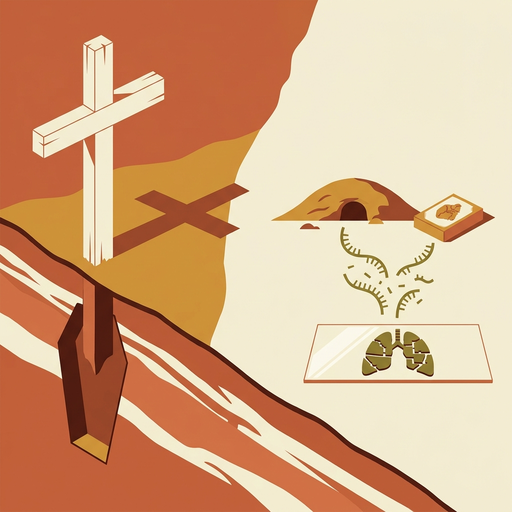
In Longyearbyen, a remote Arctic settlement on the Norwegian archipelago of Svalbard, conventional coffin burial has largely been discontinued. The frozen earth resists excavation, prevents natural decomposition, and can slowly push buried objects back toward the surface.
The town cemetery also holds the graves of young miners who perished during the nineteen eighteen influenza pandemic. That haunting intersection of permafrost and historical catastrophe has fueled a widespread rumor: that the deadliest respiratory virus in modern history lies sleeping beneath the Arctic tundra. Yet the celebrated frozen tissue that allowed scientists to reconstruct the nineteen eighteen virus came from Alaska, not Svalbard. Tracing the real scientific journey reveals a sharp divide between local Arctic burial practices, historical rumor, and the painstaking molecular work that actually deciphered the pandemic.
At My Audio Books dot A I, you can create your own audiobooks from prompts, turn your documents into audio, all with one subscription, and store your items in your own personal library.
Longyearbyen sits high above the Arctic Circle on the island of Spitsbergen, serving as the administrative center of Svalbard under Norwegian sovereignty. Established in the early twentieth century as a company coal-mining town, its daily life has always been shaped by extreme cold and an unforgiving landscape. The town cemetery, marked by simple white wooden crosses set against bare mountain slopes, reflects both that industrial origin and the unusual physics of the ground beneath it.
The entire area rests on permafrost, defined scientifically as ground that remains at or below zero degrees Celsius for at least two consecutive years. In reality, permafrost in Svalbard extends hundreds of meters deep and has remained frozen for millennia. Only a shallow layer at the surface, known as the active layer, thaws during the brief Arctic summer and refreezes in autumn.
This continuous freeze-thaw cycle makes the earth unstable. As moisture inside the active layer freezes, it expands, creating powerful mechanical pressures known as frost heave. Over time, shifting ground can lift large stones, deform structures, and push buried wooden coffins upward toward the surface. At the same time, permanently sub-zero temperatures halt the ordinary biological processes of decomposition. The soil microorganisms and autolytic enzymes that naturally break down organic matter become dormant in the deep freeze. Bodies buried in permafrost do not decay in the customary way; instead, they can undergo a form of natural mummification.
These physical constraints turned catastrophic in the autumn of nineteen eighteen. The global influenza pandemic, carried north on supply vessels, swept through the crowded coal camps. According to historical records from the Svalbard Museum, seven young miners died of the infection in late autumn and were buried in the town cemetery. The museum accounts note that the ground was already frozen rock-hard, forcing workers to use commercial dynamite to blast open burial trenches in the permafrost. To prevent further contagion within the isolated settlement, authorities burned the bedding and personal clothing belonging to the deceased men.
Over the following decades, local administrators confronted the practical hazards of maintaining a traditional graveyard in frozen soil. Shifting ground risked exposing older caskets, creating public health concerns and attracting scavenging Arctic wildlife. Around nineteen fifty, the cemetery effectively ceased accepting conventional coffin burials.
Today, people who die on the archipelago are routinely transported by air to mainland Norway for funeral services and conventional burial. Families wishing to inter remains in Longyearbyen may do so only with cremated ashes, and only after securing formal approval from the Governor of Svalbard. Popular accounts sometimes sensationalize this policy, claiming that dying in Longyearbyen is illegal. The reality is far more practical: it is an administrative adaptation to the severe geological reality of Arctic ground. The cemetery proves that pandemic victims were interred in permafrost, but whether any biologically intact pathogen survived there is an entirely different matter.
Evaluating historical burial claims requires separating what popular stories blend together. You can think of biological survival as a ladder with five distinct rungs: a recognizable body, preserved microscopic tissue, fragments of viral genetic material, an intact and infectious viral particle, and an engineered laboratory reconstruction. Jumping from the bottom rung to the top is where most public misunderstandings begin.
At the bottom rung, freezing temperatures can preserve gross anatomical features, such as skin, hair, and skeletal shape. Yet gross preservation does not guarantee intact tissue histology. Within cells, ice crystals form during slow freezing, piercing cell membranes and tearing microscopic structures apart.
Furthermore, permafrost is not equivalent to a continuous, temperature-controlled laboratory freezer running at minus eighty degrees Celsius. Natural ground experiences subtle thermal fluctuations, moisture migration, and seasonal shifts. Enzymes and chemical oxidation can slowly degrade biological material even in sub-zero soil.
The third rung involves genetic material. Influenza A is an enveloped virus containing single-stranded ribonucleic acid, commonly known as RNA. Unlike double-stranded DNA, which possesses a robust chemical architecture that can survive for thousands of years under ideal circumstances, RNA is an exceptionally fragile molecule. Environmental water, trace nucleases, and chemical oxidation break the fragile phosphate backbone of RNA into short fragments. When scientists find viral RNA in historical tissue, they do not find pristine, unbroken strands; they find microscopic debris.
The fourth rung, an intact infectious virus, requires something far rarer. For an influenza virus to infect a host cell, its delicate lipid envelope must remain undamaged, and its surface proteins must retain their exact three-dimensional shapes. In addition, all eight separate RNA segments must remain complete and properly packaged inside. If any single component is fractured, the virus cannot replicate and is biologically inert.
The genuine molecular breakthrough regarding the nineteen eighteen pandemic occurred not in Svalbard, but in the remote coastal village of Brevig Mission, Alaska. In November of nineteen eighteen, the pandemic struck the village, then known as Teller Mission, killing roughly eighty-five percent of its adult population in less than a week. The victims were buried together in a mass permafrost grave marked by simple wooden markers.
In nineteen ninety-seven, a team led by pathologist Johan Hultin and molecular virologist Jeffery Taubenberger received permission from the local village council to exhume the grave. Hultin had attempted to culture live virus from the same site in nineteen fifty-one without success. During the nineteen ninety-seven exhumation, researchers recovered preserved lung tissue from a woman who had died during the outbreak. Her body had been buried beneath several feet of permafrost, and her body fat had provided natural insulation that protected her internal organs from seasonal thaw.
Inside that Alaskan lung tissue, scientists detected genetic traces of the nineteen eighteen influenza virus. Crucially, they did not discover a living, infectious pathogen waiting in the ice. What survived were minute, broken fragments of viral RNA, often only one hundred to two hundred base pairs in length. The Alaskan tissue provided authentic historical blueprints, but not an active agent of disease.
Researchers combined those Alaskan specimens with another vital historical source: formalin-fixed, paraffin-embedded autopsy tissue collected from American soldiers who had died at Camp Upton in New York and Fort Jackson in South Carolina. Those military autopsy specimens had been preserved in chemical fixatives and wax, stored safely at room temperature in medical archives for nearly eighty years. Longyearbyen's cemetery contributed no biological tissue to this sequencing effort. The scientific trail leads entirely through Brevig Mission and archived military pathology collections.
Assembling the complete genetic blueprint of the nineteen eighteen influenza virus was a painstaking molecular puzzle that spanned nearly ten years. An influenza A genome is not one continuous molecule; it is split across eight distinct negative-sense RNA segments that encode the instructions for ten or eleven viral proteins. Because the historical RNA was degraded into thousands of tiny, overlapping pieces, scientists had to isolate, amplify, and sequence each fragment repeatedly to deduce the original genetic code.
The chronology of publication reveals how gradual this process was. In nineteen ninety-seven, researchers published initial fragments confirming that viral RNA had indeed survived in the historical specimens. Two years later, in nineteen ninety-nine, the team assembled the complete sequence of the hemagglutinin gene. Hemagglutinin is the major surface protein that allows the virus to bind to host cells and gain entry.
In two thousand, the team published the sequence for neuraminidase, the enzyme that enables newly formed viral particles to cleave themselves from infected host cells and spread. The non-structural gene segment, known as N S one, followed in two thousand one, providing clues about how the virus disarmed human immune responses. The matrix gene, encoding structural proteins that maintain the viral shell and regulate internal acidity, was sequenced in two thousand two. The nucleoprotein gene was completed in two thousand four.
Finally, in two thousand five, researchers completed the three massive polymerase genes: P A, P B one, and P B two. These segments form the molecular engine that copies viral genetic material inside infected cells. With the polymerase sequences determined, all eight segments were fully deciphered for the first time.
Having the complete digital sequence made the next step possible: reconstructing the physical virus in a secure laboratory using reverse genetics. In traditional virology, scientists isolate a natural virus from an infected individual and grow it in cell cultures or eggs. In reverse genetics, the workflow runs backwards. Scientists use chemical synthesis to manufacture double-stranded DNA copies of the viral genes based on published sequence data.
Researchers inserted those synthesized DNA sequences into circular DNA rings called plasmids and introduced them into cultured human and canine cells. The cellular machinery of the host cells read the synthetic plasmids, transcribed the viral RNA, manufactured the viral proteins, and spontaneously assembled complete, functional influenza particles.
The resulting virus was a synthetic laboratory reconstruction generated from informational blueprints. It was neither revived directly from permafrost nor thawed from a deceased miner's grave. Confusing synthetic rescue with physical exhumation distorts the nature of molecular science, turning a brilliant feat of laboratory engineering into an exaggerated myth about ancient pathogens emerging intact from melting ice.
Once the nineteen eighteen virus was reconstructed in high-containment biosafety facilities, researchers could finally study its biology directly. Sequence analysis revealed that the virus was an H one N one influenza A strain displaying strong avian-like genetic characteristics.
Its nucleotide composition, guanine-cytosine balance, and amino acid sequences showed deep similarities to bird influenza lineages. This distinguished the nineteen eighteen virus from the later pandemic strains of nineteen fifty-seven and nineteen sixty-eight. Those mid-century pandemics arose through genetic reassortment, an event where an existing human influenza virus and an avian influenza virus simultaneously infect the same animal, swapping genetic segments like shuffled playing cards. By contrast, the nineteen eighteen virus appeared to be an avian-related lineage that adapted as a whole to mammalian hosts, acquiring the ability to replicate efficiently in human respiratory tissue.
Yet the genome cannot answer every historical question. Scientists still debate whether the avian ancestor jumped directly into humans or passed through an intermediate host, such as domestic swine, before triggering the global outbreak. Because wild bird and agricultural sampling was practically nonexistent in the early twentieth century, the historical record lacks the comparative baseline needed to pinpoint the exact geographic origin or date of emergence.
The viral genome also provides only a partial explanation for the pandemic's most terrifying clinical feature: its unusual mortality pattern. Ordinary seasonal influenza typically exhibits a U-shaped mortality curve, causing severe disease primarily in infants and the elderly. The nineteen eighteen pandemic produced an unprecedented W-shaped curve, claiming hundreds of thousands of healthy young adults between the ages of twenty and forty.
Reconstruction studies demonstrated that the nineteen eighteen virus replicated aggressively in lung tissue and triggered massive inflammatory cascades known as cytokine storms. In these cases, a vigorous immune response flooded lung tissue with fluid, causing severe pulmonary edema and rapid suffocation. However, viral genetics alone cannot account for why that outcome concentrated so heavily in young adults.
Epidemiologists point toward complex immunological history. Individuals born between eighteen eighty and nineteen hundred had childhood exposures to specific circulating influenza strains. Those early encounters may have primed their immune systems poorly for the subsequent H one N one virus, an immunological effect sometimes called original antigenic sin. Furthermore, historical autopsy records show that the majority of deaths were ultimately caused by secondary bacterial pneumonias from pathogens like Streptococcus pneumoniae and Staphylococcus aureus. In an era before commercial antibiotics, intensive care units, and mechanical ventilators, viral damage to the respiratory lining left patients defenseless against routine bacterial infections.
Wartime conditions compounded the crisis. Massive military mobilization, crowded transport ships, poorly ventilated barracks, severe physical exhaustion, and malnutrition accelerated transmission and worsened clinical outcomes. Biological properties determined how the virus interacted with human cells, but societal conditions determined how the pandemic swept across the globe.
Our understanding of this evolutionary landscape continues to expand. In recent years, a peer-reviewed study reported the recovery of a nineteen eighteen influenza genome from historical pathology specimens in Switzerland. That specimen revealed distinct mutations associated with mammalian adaptation, demonstrating that the virus continued to evolve and diversify across different geographic regions during the pandemic waves. Yet each historical specimen represents only a single data point from an individual patient. Deciphering a localized genome does not eliminate the vast uncertainties that remain across the broader global pandemic.
Returning to Longyearbyen's cemetery, the true meaning of the site becomes clear. The white crosses on the Svalbard hillside represent a community enduring an extraordinary historical crisis under the most demanding environmental conditions imaginable. They illustrate how human settlements adapted their mourning and burial customs to the immutable physics of permanently frozen earth. What they do not represent is a reservoir of active contagion or the source of modern genomic discovery.
The conflation between Svalbard and Alaska is easy to understand. Popular imagination naturally connects vivid, cinematic details: dynamite-blasted graves, polar twilight, preserved bodies, and a terrifying pandemic. Brevig Mission provided the biological material, while Longyearbyen provided an evocative backdrop. When those distinct histories merge in casual conversation, they create a myth that feels compelling but lacks scientific foundation.
The research that unraveled the nineteen eighteen pandemic also carries profound ethical dimensions. Exhuming human remains touches core questions of community sovereignty, human dignity, and historical consent. The individuals who died during the pandemic could never have anticipated that their genetic material would be sequenced and reconstructed in future laboratories.
At Brevig Mission, scientific progress was possible only because researchers engaged directly with the local Indigenous village council, seeking their permission, explaining the public health objectives, and honoring their cultural protocols. Modern scientific ethics recognizes that historical graves are not open repositories of data; they are the resting places of individuals whose living descendants hold legitimate authority over how ancestral remains are treated.
Today, climate change introduces a new layer of urgency across the Arctic. Temperatures in polar regions are rising significantly faster than the global average, driving widespread permafrost thaw. As the active layer deepens and ancient ice wedges melt, roads buckle, hillsides collapse, and historic cemeteries face severe structural displacement.
Yet the environmental thaw does not validate horror stories about ancient pandemic viruses returning from the soil. When permafrost melts, it exposes long-buried organic material to active water, air, and voracious soil bacteria. Far from preserving fragile structures, the thawing process dramatically accelerates decomposition. Enveloped respiratory viruses like influenza degrade within hours or days once temperature and moisture permit microbial activity. Biological structures as delicate as lipid membranes and single-stranded RNA do not survive prolonged warmth and oxidation.
The story of the nineteen eighteen influenza genome is an extraordinary intellectual achievement, rooted in rigorous laboratory science and careful archival investigation. It is a chronicle of ten years spent piecing together shattered molecules, deciphering avian adaptations, and respecting the communities whose history made that research possible. The frozen ground of Longyearbyen remains an enduring monument to Arctic history and human resilience. Yet the science that unlocked the secrets of the pandemic belongs to the laboratory benches, where fragments were slowly, deliberately assembled into understanding.
Whenever you encounter a compelling historical claim about ancient pathogens surviving in the ice, examine the chain of custody. Ask which burial site was studied, what tissue was recovered, and whether scientists found a living organism or merely the chemical echoes of its genetic code.