Forest Fungi and Tree Networks: What Field Evidence Says About Carbon Sharing and Mother Trees
The “Wood Wide Web” is real enough to connect some trees through fungi, but evidence that mother trees feed their offspring or warn neighbors remains far weaker than the popular story suggests. Tracing the research from labeled seedlings to wild forests reveals an underground world shaped less by benevolence than by trade, competition, and unanswered questions about who actually benefits.
By MyAudioBooks.ai ·
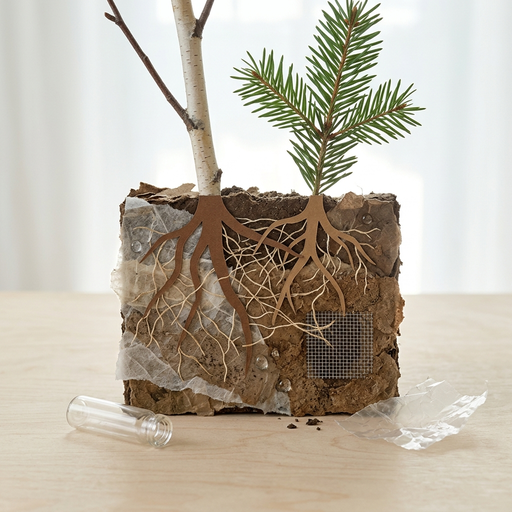
Walk into an old-growth forest, and it is easy to imagine that the silence beneath the canopy is a sign of quiet harmony. Over the past two decades, a captivating narrative took hold in books, documentaries, and popular culture: the idea of the Wood Wide Web. In this telling, the forest operates like a cooperative, interconnected society. Ancient canopy trees act as benevolent mothers, recognizing their offspring and nursing them through subterranean fungal threads. When an insect attacks, chemical or electrical alerts race through underground networks to warn neighboring trees to raise their defenses. It is an enchanting vision that transforms a cutthroat wilderness into a sanctuary of mutual aid. Real scientific experiments helped inspire that story. Yet underneath the forest floor, the gap between verified biological data and romantic metaphor is wide. The living world beneath our feet is governed by rigorous trade, physical constraints, and intense evolutionary competition. In the minutes ahead, we will trace the journey from laboratory petri dishes to old-growth timber stands. We will explore what fungal networks actually do, where the popular story outran the evidence, and how forests truly function underground.
At My Audio Books dot A I, you can create your own audiobooks from prompts, turn your documents into audio, all with one subscription, and store your items in your own personal library.
Every forest on Earth rests on a biological partnership that began hundreds of millions of years ago. That partnership is the mycorrhiza, an intimate union between a plant root and a specialized soil fungus. The plant is an engine of photosynthesis, converting sunlight, water, and atmospheric carbon dioxide into energy-rich sugars. The fungus is an underground excavator. Its microscopic filaments, known as hyphae, are far thinner than the finest plant root. These hyphae weave through tiny soil pores, extracting vital mineral nutrients like phosphorus and nitrogen that roots cannot reach on their own, while also gathering water.
The exchange between them is a reciprocal transaction. Plants allocate up to twenty or thirty percent of their photosynthetic carbon to their fungal partners, while the fungi deliver soil nutrients in return. This is not unconditional generosity. If a plant receives abundant fertilizer, it frequently scales back the carbon it feeds to the fungus. If a fungus cannot deliver nutrients, the plant can restrict sugar flow to that part of its root system. This is an ongoing biological trade whose terms fluctuate with soil moisture, temperature, light, and nutrient availability.
These underground partnerships take two dominant forms. Ectomycorrhizal fungi wrap around the exterior of fine roots, forming a thick protective sheath called a mantle and growing between the outer root cells in a network called the Hartig net. These fungi partner predominantly with temperate and boreal trees, including pines, spruces, firs, beeches, birches, oaks, and Douglas-firs. In contrast, arbuscular mycorrhizal fungi physically penetrate the interior of root cortical cells, branching into microscopic, tree-shaped structures called arbuscules. Arbuscular fungi partner with the vast majority of land plants, including grasses, agricultural crops, and most tropical trees.
Because these two fungal groups possess fundamentally different evolutionary histories, cellular structures, and nutritional strategies, what happens in a temperate pine forest cannot be assumed to happen in a tropical rainforest.
When the hyphae of a single fungal individual physically bridge the root systems of two or more plants, scientists call it a common mycorrhizal network. The connected plants can belong to the same species or entirely different species. Yet finding the same species of fungus on two adjacent trees does not mean they share an unbroken, functional pipeline.
To evaluate any claim about these networks, three distinct questions must remain separated. First, are the plants physically connected by a continuous, living fungal thread? Second, does material actually move through that fungal thread from one plant to the other? And third, does that movement measurably improve the recipient plant's growth, survival, or reproduction?
Proving physical connection does not prove transport. Proving transport does not prove an ecological benefit. Conflating these three separate steps is how a nuanced physiological experiment was transformed into a sweeping story of forest cooperation. That transformation began with a landmark field experiment in the nineteen nineties.
In nineteen ninety-seven, forest ecologist Suzanne Simard and her research team published a study in the journal Nature that changed how people envisioned forests. Working in an experimental field site in British Columbia, the researchers examined two ectomycorrhizal tree species: paper birch and Douglas-fir. Alongside them, they planted western red cedar, a species that forms associations with arbuscular mycorrhizal fungi, meaning it could not join the ectomycorrhizal network and served as a biological control.
To trace the movement of carbon, the team used stable and radioactive isotopes, giving the carbon atoms a measurable tag. They enclosed birch seedlings in sealed plastic bags and injected carbon-thirteen labeled carbon dioxide. They enclosed Douglas-fir seedlings in separate bags and injected carbon-fourteen labeled carbon dioxide. The seedlings photosynthesized, incorporating those distinct isotopic signatures into their sugars.
When the researchers tested the tissues days later, they detected labeled carbon moving in both directions between the birch and the Douglas-fir. Very little label appeared in the western red cedar control. Crucially, when the researchers shaded the Douglas-fir to reduce its photosynthesis, the net flow of carbon shifted. The shaded Douglas-fir absorbed more labeled carbon from the sunlit birch than it sent back.
The paper interpreted this bidirectional movement as transport occurring primarily through shared ectomycorrhizal hyphae. In popular retellings, this finding quickly evolved into a headline: trees share sugar across fungal cables to rescue struggling neighbors.
Within plant physiology, however, that transfer reflects source-sink dynamics. Carbon compounds in plants and fungi move naturally along concentration gradients, flowing from areas of high production, known as sources, toward areas of high demand or deficit, known as sinks. When the researchers shaded the Douglas-fir, its sugar production plummeted, creating a metabolic deficit that increased its sink strength. The carbon movement observed in the experiment was consistent with physical diffusion and physiological gradients, requiring no conscious benevolence or evolutionary intent.
Furthermore, the researchers acknowledged that direct fungal pipelines were not the only possible route. Carbon could leak out of donor roots into the soil solution, travel through soil water, and be absorbed by neighboring roots or their associated fungi. The western red cedar controls absorbed trace amounts of isotope as well, confirming that non-fungal pathways operate in forest soils.
The nineteen ninety-seven experiment demonstrated that under specific field conditions, labeled carbon atoms could move between young seedlings of different species. But it did not prove that trees routinely subsidize their neighbors, that mature forest canopies operate on mutual aid, or that shared networks overcome competitive self-interest.
To understand why carbon transfer is so difficult to prove in a forest, you have to look closely at the soil itself. When a researcher detects a labeled carbon atom in a neighboring plant, that isotopic signal does not arrive with a return address. It does not prove that an intact sugar molecule traveled through an unbroken fungal tube.
Soil is a dense slurry of competing life and moving water. When a plant photosynthesizes, it routinely releases organic molecules into the soil through its root tips, a process called root exudation. Once in the soil, those carbon compounds can be absorbed by free-living bacteria, metabolized, released as carbon dioxide in soil pores, and reabsorbed by nearby roots. Carbon can also dissolve in ground water and migrate along moisture gradients. In many forest stands, neighboring trees of the same species physically fuse their roots together through root grafting, creating direct vascular conduits that bypass fungi altogether. Furthermore, deep tree roots can pull water from profound depths and release it into dry upper soil layers overnight, redistributing moisture without requiring fungal transport.
To isolate fungal transport from these competing pathways, researchers design experiments using physical barriers. They plant seedlings in compartments separated by fine synthetic mesh. A mesh with pore sizes between thirty and fifty micrometers allows slender fungal hyphae to pass through while blocking plant roots. To test whether the fungus drives resource transfer, researchers compare this with a much tighter mesh of around zero point five micrometers, which excludes both roots and hyphae. Alternatively, they rotate mesh cores to physically sever any bridging fungal threads.
These barriers solve one problem while introducing others. Inserting a fine plastic mesh into soil alters the physical environment. It disrupts capillary water movement, changes how dissolved minerals diffuse through the ground, creates artificial soil compaction, and alters the microbial community. When a seedling separated by a severed-hyphae barrier grows more slowly than one with intact hyphae, that difference may stem from altered soil moisture or aeration rather than a lost fungal supply line.
This illustrates the trade-off at the heart of forest ecology. In a sealed laboratory growth chamber, scientists can control every variable: sterilizing the soil, introducing a single fungal strain, and regulating light and temperature. But these simplified systems use young seedlings in plastic pots with artificial soil mixes, leaving open the question of how mature forest ecosystems behave. In a wild forest, where thousands of fungal species, mature trees, fluctuating weather, and complex soil horizons interact, isolating a single fungal conduit becomes extraordinarily challenging.
Even when carbon atoms do move between plants, the quantity matters. Detecting an isotope requires only trace amounts of material, often less than one percent of a seedling's total carbon budget. A young tree requires substantial quantities of carbon every day simply to maintain cellular metabolism and expand its tissues. Receiving a microgram of carbon from a neighboring plant is physiologically trivial, offering no measurable boost to growth or survival.
Finally, fungi are living organisms with their own evolutionary priorities. A fungus is not an inert fiber-optic cable or an indifferent postal worker. It relies entirely on plant carbon to build its own cell walls of chitin, power its cellular respiration, and produce reproductive spores. Any carbon entering a fungal hypha is subject to fungal metabolism first. If a fungus can consume that carbon to fuel its own growth, it will. A common mycorrhizal network is an arena of competitive negotiation where fungi pursue their own reproductive success.
As the popular narrative gathered momentum, it culminated in the concept of the mother tree. In this framework, the oldest, largest trees in a forest serve as central hubs in mycorrhizal networks. According to the story, these matriarchs detect their own seedlings in the understory, recognize their genetic kin, and deliberately channel water, carbon, and protective chemical signals through fungal threads to nurture them.
In twenty twenty-three, forest ecologists Justine Karst, Melanie Jones, and Jason Hoeksema published a rigorous systematic review in the journal Nature Ecology and Evolution that scrutinized every field experiment behind these claims. Their findings challenged the foundations of the popular consensus.
Karst and her colleagues documented widespread positive citation bias across the literature. A pattern had developed where an initial study would report a modest or tentative finding, heavily qualified with caveats and alternative explanations. Subsequent papers would cite that study while dropping the caveats, framing the possibility as an established reality. Over decades, repeated citations turned preliminary hypotheses into accepted scientific doctrine without new field data to support them.
When Karst and her team audited the field evidence, they found that continuous common mycorrhizal networks linking trees across entire forest stands had rarely been mapped or proven in mature wild forests. More critically, they found no consistent evidence that seedlings connected to fungal networks enjoyed improved survival or growth in the field. In many studies, seedlings isolated from mycorrhizal networks survived at equal or higher rates. Cutting them off from the network freed them from the carbon costs imposed by fungi, protected them from soil pathogens, or eliminated direct root competition.
In twenty twenty-four, ecologist David Robinson and a team of researchers published an extensive critical analysis in New Phytologist examining kin recognition and preferential carbon transfer. They evaluated the experimental claims that parent trees selectively provision their own offspring through underground fungal connections. Their conclusion was straightforward: rigorous empirical evidence demonstrating that trees preferentially feed their kin through common mycorrhizal networks is essentially lacking or methodologically inconclusive.
When saplings flourish near a large tree, standard ecological mechanisms explain the pattern without requiring underground benevolence. A mature tree drops thousands of seeds beneath its boughs, meaning high seedling numbers simply reflect seed dispersal. The overarching canopy shields seedlings from extreme heat and frost, while decaying leaf litter builds moisture-retaining organic soil. Furthermore, the soil beneath an old tree is saturated with fungal spores, allowing young roots to establish their own mycorrhizal partnerships quickly.
Simultaneously, large trees compete aggressively with the understory. A massive canopy intercepts sunlight, while extensive root systems drain soil moisture and consume scarce nitrogen. In many forests, understory seedlings are not being nurtured by canopy giants; they are fighting to survive in their shade.
The claim that trees send alarm signals through fungal networks to warn neighbors of insect herbivory faces similar scientific hurdles. While greenhouse trials using potted crop plants have demonstrated that defense genes can activate in a neighbor linked by hyphae, wild forests operate under far different dynamics. When insects chew through foliage, trees release volatile organic compounds directly into the air. These airborne plumes travel rapidly on the wind, alerting neighboring branches and nearby trees within minutes. In a natural forest, proving that an internal chemical alert travels through slow fungal hyphae, separate from airborne chemical plumes or soil-water diffusion, remains an unverified hypothesis.
The Wood Wide Web metaphor became popular because it fulfilled a deep human desire to see nature as a cooperative community. It offered an alternative to the harsh Victorian framing of nature red in tooth and claw, replacing brutal competition with mutual support and connection. But metaphors become counterproductive when they obscure how living systems actually operate.
Natural selection does not design organisms to sacrifice their own fitness for an idealized forest collective. Trees and fungi interact through evolutionary strategies developed over millions of years of shifting environmental pressures. Trees compete for light, water, and soil space. Fungi extract carbon from their hosts while providing mineral nutrients when it serves their own survival. The forest operates as an intricate biological marketplace where trees and fungi negotiate their survival under selective pressure.
Setting aside the myth of the benevolent mother tree does not make the underground forest any less remarkable. Mycorrhizal fungi are essential to the biosphere. They weather minerals directly out of bedrock, scavenge scarce organic nitrogen, and protect roots from heavy metal toxicity and soil-borne diseases. Fungal hyphae produce proteins that bind mineral particles into stable soil aggregates, preventing catastrophic erosion and locking carbon deep in the earth. These are foundational ecological contributions, and none of them require trees to run an underground welfare system.
Recognizing the limits of the evidence also matters for practical forest management. Some conservation arguments have suggested that leaving mature trees behind during timber harvesting is necessary so they can feed replanted seedlings through subterranean pipelines. The science does not substantiate that specific mechanism. Yet retaining mature trees remains vital for completely valid, verified reasons. Old trees provide critical wildlife habitat, moderate local microclimates, act as essential seed sources, and maintain rich soil microbial communities so new seedlings can form their own mycorrhizal partnerships. Grounding conservation in robust science ensures that forest management decisions produce predictable, lasting results.
As research continues, significant questions remain unanswered. Ecologists are still investigating how frequently carbon transfer occurs in mature forests, whether the quantities ever reach physiologically meaningful thresholds, and how environmental stresses like severe drought influence fungal exchanges.
Whenever you encounter an extraordinary claim about nature, three foundational questions cut through the romance. First, are the organisms physically connected by a continuous, verifiable pathway? Second, did biologically meaningful quantities of resources actually move along that pathway? And third, did that transfer measurably improve the recipient's survival, growth, or reproduction?
The forest underground is neither a ruthless machine nor a conscious collective. It is a dynamic, living web of trade, competition, and survival, carrying out its silent business beneath our feet.
The next time you walk beneath the canopy and hear that trees share sugars across an underground network, remember those three questions: what is connected, what actually moved, and who measurably benefited? Taking a clear look at the science reveals a living world far more complex than any metaphor. Spend a moment reflecting on what other familiar nature narratives might look different once you inspect the evidence beneath them.