Fabian’s Spare
When his charming new neighbour turns a nighttime intrusion into a campaign against his sanity and livelihood, Bristol piano tuner Arthur Baines fabricates evidence in a desperate bid to be believed. But after discovering that his neighbour’s unpaid employee is being set up to take the blame, Arthur chooses to help her leave rather than use her to vindicate himself. His eventual confession costs him a trusted client’s easy faith, leaving him with no restored reputation—only firmer boundaries and a fragile return to playing his own piano.
By MyAudioBooks.ai ·
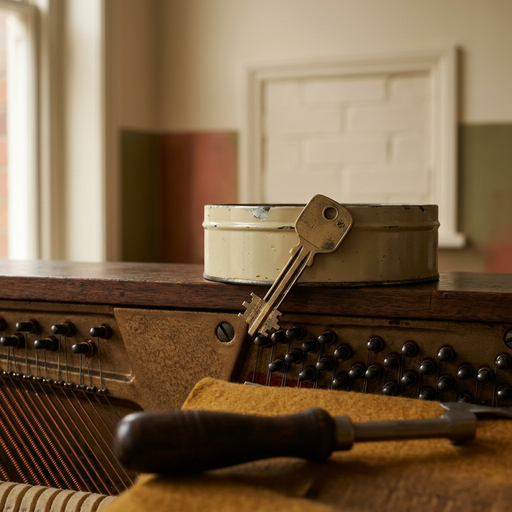
Arthur lifted his hand from the tuning lever when Fabian’s laugh came through the wall. One piano string still needed tightening. He waited, holding the tool above the pin, while his new neighbour enjoyed whatever had been said next door.
Late afternoon, early autumn, and he wanted ten uninterrupted minutes in his own front room. At fifty-seven, Arthur Baines still earned his living tuning pianos across Bristol. Eight years after his divorce, he lived alone in the Bishopston semi and generally preferred it.
Earlier that afternoon, his longstanding client Dorothy Penrose had apologised for a sticking G.
“It’s felt,” he had told her. “It wears out. You’re under no obligation to defend it.”
He had measured the replacement she needed and promised to return before her chamber evening. Now, at his own upright, he tried the note again.
Work depended on listening carefully and being trusted with people’s houses. Fabian Kerrigan, who had moved into the adjoining Victorian house three weeks earlier, had made much of that trust. Would Arthur keep a spare house key? Such a relief to have somebody reliable next door. Arthur had put it in a biscuit tin labelled “Fabian’s spare”.
They shared a drive. Their kitchens shared a bricked-up serving hatch covered with remarkably thin plaster. Excluding Fabian required rather more effort than closing a door.
The laugh came again. Arthur tightened the string by a fraction and stopped precisely where he meant to.
In the small hours, a hard corner struck his hallway wall.
Arthur came downstairs in his dressing gown. Two people were carrying crates through his open front door. A woman in a black work shirt backed towards the understairs cupboard, directing another carrier past her.
“Mind the door. Put yours through first.”
“What are you doing?”
She lowered her crate. Her voice, when she answered, retained its practical firmness.
“Fabian said we could cut through. His lock’s playing up.”
“Put that down. Leave my house.”
“We were told—”
“Out.”
She pulled the cupboard door wide to clear the passage. The other carrier hurried towards the drive, and she followed. Arthur shut the front door behind them and turned the lock twice.
No splintered wood surrounded the latch. During last week’s drive-measuring favour, Fabian had held Arthur’s keys while Arthur stretched the tape. He tried to remember how long. He could prove nothing about that interval.
By breakfast, he could still hear the woman saying, “Mind the door.”
Fabian arrived with two mugs and a spoon balanced across them.
“You look dreadful. Coffee?”
“Your people came through my house last night.”
“My people?”
“Carrying crates. They said you’d arranged it.”
Fabian set a mug beside Arthur’s elbow. “I got home late. You probably heard me unloading. Dreams do that, don’t they? Borrow bits.”
“I was standing in my hall.”
“Then perhaps you came down half asleep.”
Arthur led him to the skirting beside the cupboard. He remembered the impact distinctly. Smooth white paint gave him nothing.
Fabian crouched obligingly. “All present and correct.”
After he left, Arthur stood with the coffee cooling in his hand. A fact ought to leave something behind. He fetched his tuning lever, pressed its metal end against the skirting and lifted a pale flake of paint.
He could have stopped before the wood showed. He pressed again.
“Forgot my spoon.”
Fabian stood in the kitchen doorway. Arthur had left the lever beside the mug.
“Oh,” Fabian said. “Found some damage.”
Arthur put his foot over the fallen paint.
“Keep the spoon.”
As Fabian reached for it, Arthur took the spare from its tin.
“You’ll have this back when you acknowledge what happened.”
Fabian straightened. “I gave you that for emergencies.”
“You gave it to me for safekeeping.”
“Arthur. Listen to yourself.”
Later that morning, Arthur found a borrowed estate car across the mouth of the drive. His own car sat trapped behind it. Under its wiper, Fabian had left a courteous note inviting Arthur to pop in if he needed it moved. He had a key, after all.
A house key. Arthur held it until its teeth hurt his palm.
He could knock. Fabian could open with that concerned expression, perhaps with somebody behind him to enjoy it. Arthur stood on the gravel long enough to miss his departure time, then phoned his client.
“No, I can’t wait in all morning,” the woman said. “We’ll leave it.”
Through the kitchen plaster that evening came music, laughter and Fabian saying, “He’s convinced we’ve got a freight depot in his hall.”
Arthur knocked once.
“Would you lower the music, please?”
“Of course, neighbour. You only had to ask.”
For several minutes, they spoke in voices Arthur could almost distinguish. Then the music rose.
He stood close to the thin rectangle of plaster.
“Keep your fucking people out of my house.”
Too loud. He tried again.
“You lying, patronising fuck. Don’t tell me what I dreamed.”
He rehearsed a third version, with fewer adjectives. Next door, somebody laughed before he reached the end.
Another night passed in scraps of sleep. At breakfast his phone rang. A man whose piano Arthur had maintained for six years cancelled his autumn tuning.
“Everything all right?” Arthur asked.
“Fine. We’re going to try someone else.”
“Any difficulty with the work?”
“No. Just thought someone a bit more settled.”
Arthur kept the phone against his ear after the call ended. He had left that piano exactly in tune.
At midday he walked to Dorothy’s with the replacement felt in his tool bag. Working on her upright, he had to trim the strip twice; his first cut wandered.
“You’re tired,” she said.
“My neighbour’s been entertaining.”
“He’s been talking, too. Something about you keeping his key.”
“I’d rather you asked me.”
“I am asking you.”
Arthur fitted the felt beneath the sticking key and worked it gently.
Dorothy returned from the kitchen carrying a saucepan. “You’ll take some soup. I made enough for a committee.”
“Expecting one?” Arthur asked.
“I forgot how small a cabbage can become when you start cutting it. My husband used to apologise to that piano after practising.”
“For the noise?” Arthur asked.
“For disappointing it. Very solemn. Then he’d play the same wrong note.”
Arthur laughed, properly, and had to set down his scissors. “He sounds considerate.”
“The piano never forgave him.”
He could have told her then. He even began, “About the damage—”
“What damage?”
Arthur tested the G. “It’ll need tuning once that’s settled. Tomorrow afternoon?”
Dorothy agreed. He packed his tools with unnecessary care and walked home carrying the soup. Halfway down his street, he wished he had left the scissors alone and finished his sentence.
That evening, the woman’s voice came through his kitchen wall.
“You said he’d agreed.”
Arthur stopped washing his mug.
“And I’m saying,” Fabian answered, “that you never went into his house. You moved stock into mine.”
“I carried—”
“He’s already inventing women in his hallway. Don’t encourage him.”
Arthur dried his hands. In the hall, he opened the understairs cupboard.
Inside, almost covered by his winter coat, sat a plastic crate.
Cheap prosecco filled it. An envelope lay beneath a loose cardboard divider, bearing the name Sian Lowry and the word “wages”.
He rested his hand on a bottle neck. Here, finally, stood something he could put in front of another person.
The woman spoke again next door.
“I need paying before I do anything else.”
Arthur took out the envelope without opening it. The bottles established that stock had been left in his house. The envelope supplied a name. Neither established who had given permission, and Fabian had already begun arranging who would answer for it.
Arthur’s phone sat beside the sink. He left it there until he had decided whom to call.
Dorothy said she would come round after washing up. When Fabian knocked a little later, bringing the woman to apologise for the noise, Arthur admitted them both.
“Dorothy’s joining us.”
Fabian’s smile held. “Splendid. Better to clear everything up together.”
Arthur kept them in the kitchen. Behind Fabian’s chair, the thin plaster patch carried the bass of music still playing in his house.
“This is Sian,” Fabian said when Dorothy arrived. “She manages the floor at the bar. Kindly helping me with some stock.”
Sian remained standing beside the door.
“Sit down,” Arthur said.
“I’m all right.”
Fabian spread his hands. “First, apologies for the disturbance. We work late. Sometimes we forget ordinary people don’t.”
“Ordinary people manage to get through doors without entering the wrong house,” Arthur said.
“Which brings us to the misunderstanding. I’m quite happy to forget the key business, and the performance over the car. Arthur accepts he may have been confused. Fresh start.”
Dorothy put her bag between her feet.
“What are you apologising for, Arthur?”
“I haven’t agreed to apologise.”
“Nobody’s asking you to grovel,” Fabian said. “Just allow the possibility that you’ve muddled something.”
Sian shifted towards the hall.
“Was there an arrangement?” Dorothy asked her.
Fabian answered first. “If an employee takes a shortcut without checking, that’s hardly an instruction from me.”
“You told us he’d said yes,” Sian said.
“I told you to get the stock inside.”
“You said he’d left the door for us.”
Fabian pushed his chair back a few inches. “You’re still waiting for wages, aren’t you? Perhaps we should establish which hours you actually worked.”
Arthur put both hands flat against the worktop. His tiredness had become clumsiness; he wanted something solid beneath them.
Dorothy addressed him. “What can you honestly show me?”
Beyond the kitchen door lay the scrape. He could lead her there. Fabian would point out the tuning lever, perhaps, but Arthur could say it belonged in his house. Of course it belonged there. Dorothy knew his work. She might believe him.
Fabian gestured towards the hall.
“Arthur found some damage this morning. Eventually.”
Arthur lifted one hand, then put it down again.
“I’m not showing you a mark.”
“Why ever not?” Fabian asked.
“I saw people carrying stock through my hall. I ordered them out. I can’t prove who opened the door or what you told them.”
“So we agree.”
“No. We don’t.”
Arthur took the envelope from his pocket.
Fabian reached across the table. “That’s mine.”
Arthur held it towards Sian. “Your name’s on it.”
She took it, folded back the flap and checked inside.
“Two weeks,” she said. “That’s what he owes me.”
“Then perhaps,” Fabian began, “we could remember whose money—”
“My wages.” She pressed the flap closed.
Arthur placed the spare key in her free hand.
“My bag’s still next door,” she said.
“You can collect it,” Fabian said. “We’ll discuss tomorrow when you’ve calmed down.”
“I’m collecting it now. You’ll need someone else for tomorrow.”
Dorothy stayed seated. Arthur wanted her to say she understood what had happened. He wanted Sian to repeat every word spoken in the hallway. He could ask. He had the crate, her name, her wages.
Instead he moved clear of the kitchen door.
Fabian stood. “This is a remarkable little production.”
“I’m not asking her to prove anything for me,” Arthur said. “She can go.”
Sian slipped the envelope into her jacket. “I’ll put your key through when I’ve got my things.”
Fabian stepped towards Arthur. “You’ve enjoyed this, haven’t you?”
“Get out of my house.”
“We’re neighbours.”
“Then keep your fucking people out of it. And stop telling my clients I’m confused. Do it again and I’ll tell them exactly what happened. What I saw, what I heard, and what I can’t prove. No improvements.”
“You sad bastard.”
Arthur held the door open.
Sian left first. Fabian followed without saying goodbye. Dorothy collected her bag.
“Tomorrow afternoon,” she said.
“Do you believe me?”
“I believe you’re frightened. That isn’t the same question.”
She went before he could ask it differently.
The following afternoon, Arthur parked on the street rather than pull into the shared drive. He walked to Dorothy’s with his tools and tuned her piano. When he finished, she tried the G twice.
“Better.”
“It should hold now.”
“You seemed perfectly capable of doing the work,” she said. “You also seem afraid of that man. Fear and confusion aren’t interchangeable.”
“I’d like you to tell people that.”
“I’m not carrying messages between houses.”
Arthur closed his tool bag, then opened it again. His tuning lever lay in its fitted pocket.
“The mark I wouldn’t show you. I made it.”
Dorothy took her hands off the keys.
“With that?”
“Yes.”
“To make me believe you?”
“To make somebody believe me.”
“That includes me.”
“Yes.”
He left the bag open. Dorothy waited, and he kept himself from adding anything about the crates or the two nights without sleep.
“I’m glad you told me,” she said at last. “I’m not glad you did it.”
He nodded and put the lever away. She paid him for the tuning, no more warmly than she had greeted him.
Arthur walked home past his car. Next door, Fabian’s front door stood open while somebody carried in groceries. Arthur used his own key and shut his door behind him.
Polly called from Cardiff while he was rinsing the soup saucepan.
“How’s everything, Dad?”
“Work’s a bit thin this week.”
“You keeping busy otherwise?”
“Oh, the usual.”
He asked about her journey to work and listened carefully to the answer. He told her nothing.
After the call, the saucepan slipped and knocked the tap.
“Fuck’s sake.”
He dried it, put it away, then took the oil to the front gate and worked a drop into the hinge. Back inside, he returned the oil to the cupboard. The scrape remained plainly visible beside his shoe.
In the kitchen, he opened the empty biscuit tin. “Fabian’s spare” still covered the lid in his own neat writing. He closed it without peeling off the label.
Then he sat at his piano and chose a short phrase. His hands needed a second attempt, and he gave them one, letting the notes pass through the brick.
He closed the lid when he had finished.