Exploring Paris in 5 to 7 Days Through Museums, Neighborhood Walks, and Local Food
Discover Paris over five to seven unhurried days, using the Seine as your compass and balancing iconic sights—from Notre-Dame and the Louvre to the Eiffel Tower—with neighborhood markets, hidden passages, and the hills of Montmartre and Belleville. Blending history, food culture, local etiquette, and practical travel advice, this guide shows you how to build each day around one meaningful visit while leaving room for the unexpected encounters that make the city your own.
By MyAudioBooks.ai ·
Listen free: Exploring Paris in 5 to 7 Days Through Museums, Neighborhood Walks, and Local Food
**Introduction**
A bakery door swings shut behind you, and the warmth of the shop gives way to cool morning air. Through the paper around your breakfast, you feel the crust still holding its heat. Ahead, a narrow street opens toward the Seine. A delivery worker eases a trolley over the curb, someone hurries past with a folded newspaper, and above the roofs, the towers of Notre-Dame give your first walk a direction. Before you reach a monument, Paris is already asking for your attention.
You have five to seven days in the French capital, enough time to find a comfortable rhythm, but not enough to follow every tempting street. That is the useful tension of this journey. How do you meet a city so crowded with famous images without spending your visit chasing them? The answer begins with a little orientation and the freedom to leave some hours unclaimed. You do not need to see everything. You need a way to choose, and enough room around those choices to notice where you are.
The river gives you your first bearings. The Seine links the central islands with the great museum buildings and the western skyline, while bridges make the neighborhoods on either bank feel within reach. Beyond this corridor, the ground rises toward Montmartre in the north and Belleville in the east. The Métro connects these different landscapes, letting you save your walking for streets you want to explore. As addresses begin to make sense, you will hear the word arrondissement. It simply means one of Paris’s numbered administrative districts, a useful clue rather than something to memorize.
Yet a map alone cannot explain the changes you feel from one street to another. Medieval places of worship stand close to former royal precincts. Broad avenues cut through older patterns of lanes. Much of that contrast comes from the vast nineteenth-century rebuilding associated with Georges-Eugène Haussmann, whose public works helped give Paris its long views and familiar boulevard façades. Elsewhere, the city keeps a smaller scale: a carriage entrance, a shaded courtyard, a staircase climbing between houses. Learning to notice those shifts makes history something you can read while walking.
Your route takes in the central islands, the Marais, and the scholarly streets of the Left Bank, with time for art, gardens, and the river’s changing light. The Louvre, the Musée d’Orsay, and the Eiffel Tower each invite a different kind of visit. Farther from the monumental center, covered shopping passages, canal-side paths, and hillside neighborhoods broaden the picture. These are choices to shape around your curiosity, not obligations to squeeze into every day.
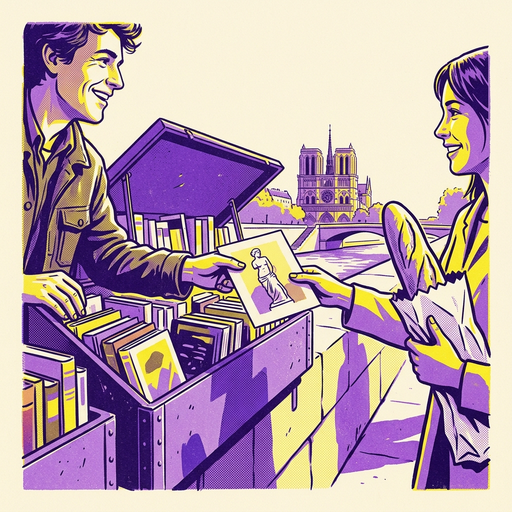
People give those choices their texture. At a bakery counter, you begin with bonjour, a simple hello that acknowledges the person serving you before the order begins. Along the upper riverbanks, the bouquinistes, Paris’s riverside secondhand booksellers, offer another reason to slow down. At lunch, a server’s chalkboard menu may draw you into a neighborhood you had expected merely to cross. Such encounters need neither a grand occasion nor a large budget. They need a little time, courtesy, and willingness to look beyond the destination printed on your ticket.
There will be practical decisions along the way: where to stay, when to reserve, and when a train ride serves you better than another long walk. Those decisions should support the pleasure of being here, not consume it. For now, the river appears at the end of the street. You reach the pavement beside the water and pause before choosing a bridge. Paris offers several directions at once. Which one makes you want to keep walking?
**End of Introduction**
Welcome to Paris. If you have ever pictured this city from afar, chances are your mind conjures a montage of glowing monuments, café terraces spilling onto sidewalks, and the broad, silver-gray ribbon of the Seine catching the afternoon sun. Being here in person is even better. The sheer density of history, art, and neighborhood life can feel overwhelming, though, if you try to absorb it all at once. So we will begin by building a clear, elegant foundation for your journey.
Across a five- to seven-day stay, you never need to race from monument to monument with your nose buried in a smartphone. With the right mental compass, a comfortable daily rhythm, and a handful of practical local habits, you will navigate these historic streets with genuine ease, cultural insight, and independent confidence.
To experience Paris at its best, give each day a simple architecture. Anchor the day with one substantial cultural visit, such as a major art collection or a historic royal chapel, and let the surrounding hours unfold naturally through nearby streets, hidden courtyards, public gardens, and riverside walks. A single timed reservation gives your morning or afternoon a purposeful center without locking you into an exhausting schedule. The neighborhood around that anchor becomes your playground for discovery. If an unexpected rain shower rolls across the rooftops, you can duck into a glass-roofed passage or linger over coffee. If the sun breaks through, you can carry a warm pastry down to a quiet garden bench. One firm plan, with loose hours wrapped around it, keeps a cultural trip rewarding rather than exhausting.
Before you set foot outside your hotel, you need a mental map of the city that depends on neither street names nor digital navigation. Everything in Paris begins with the Seine, which cuts through the historic heart of the city, flowing broadly from east to west on its way toward the sea. Picture yourself standing on a bridge, facing the direction the water travels and looking downstream toward the west. To your right, stretching across the northern side of the river, lies the Right Bank, the Rive Droite. This bank historically carried the city's commercial energy, its finance, and its royal theater, and it holds grand boulevards, glittering department stores, and palaces like the Louvre.
To your left, spreading across the southern side of the river, lies the Left Bank, the Rive Gauche. It has long been the city's intellectual, academic, and artistic counterweight, shaped by centuries of university life, independent publishing, quiet residential gardens, and sidewalk cafés where thinkers once gathered.
In the middle of the flowing river, like two stone ships moored in the current, sit the central islands of Paris. The larger, western island is the Île de la Cité, the ancient civic, judicial, and religious center of the capital. This is where the island later became a fortified Roman stronghold, after the Gallo-Roman town had spread across the Left Bank, and where the twin towers of Notre-Dame Cathedral rose into the medieval sky alongside the jewel-like Sainte-Chapelle.
Immediately to the east, connected by short bridges, sits its smaller sister, the Île Saint-Louis. Where the Île de la Cité is grand and institutional, with major landmarks and steady visitor traffic, the Île Saint-Louis is almost entirely residential. Developed in the seventeenth century as an aristocratic enclave, it has no major monuments, no Métro station, and relatively little automobile traffic. Instead, it offers quiet stone townhouses, hidden interior courtyards, leafy river quays shaded by plane trees, and small independent food shops. Keeping the two islands' distinct characters clear in your mind will orient you whenever you cross the central bridges.
The Seine also serves as the city's finest pedestrian highway. Along the central river corridor, between the two islands and the Eiffel Tower to the west, walking beside the water offers a continuous visual timeline of Parisian architecture. You have two levels to choose from. The upper stone embankments run alongside street traffic and the famous dark green boxes of the bouquinistes, the riverside secondhand booksellers. The lower paved quays run right down at water level, with car-free park spaces, trees, benches, and clear views of passing riverboats.
Whenever you are moving between nearby central landmarks in daylight, the lower path can offer a serene, traffic-free stroll. For longer leaps, such as from the western monuments to the northern or eastern neighborhoods, switch to the Métro. Those districts sit much farther apart than the central river corridor suggests.
Keep in mind, too, that the Seine is a living, working river. Between late autumn and early spring, heavy rainfall and snowmelt across the eastern river basins can raise the water level. The river tends to rise slowly, but municipal authorities may close the lower riverside paths during high-water episodes for safety. If you find a lower staircase gated off, simply stay on the upper stone embankments and carry on; your riverside journey continues without a change of plans.
Step away from the river and the city organizes itself into arrondissements, its twenty numbered administrative districts. They are arranged in a clockwise spiral that begins in the historical center and curls outward like the shell of a snail. The first through fourth districts form the compact historic core on the Right Bank, known collectively, for municipal purposes, as Paris Centre. As the spiral winds on, the fifth, sixth, and seventh districts curve across the inner Left Bank. The pattern continues through the northern boulevards and eastern quarters, then reaches the hillside neighborhood of Montmartre in the eighteenth district.
You never need to memorize every boundary. Just remember that smaller numbers mark the central historic river core, while larger numbers point toward the outer neighborhoods encircling it. The final two digits of a five-digit Parisian postal code often indicate the district, giving you another clue about where an address sits in your mental map.
Choosing where to base yourself for a five- to seven-day stay means balancing your budget against your preferred daily pace. If your priority is stepping directly from your door into historic lanes, grand private mansions, and walkable clusters of museums, the central neighborhoods are hard to beat. The Marais, across the third and fourth districts, and Saint-Germain-des-Prés, in the sixth, provide convenient access; you can walk to the river in minutes. You may pay a premium for relatively compact hotel rooms, though, and some surrounding streets bustle with visitors late into the evening.
If you prefer a more lived-in neighborhood texture, casual bistros, and better value for your lodging budget, look slightly farther out. The Canal Saint-Martin area in the tenth district offers tree-shaded waterways, lively footbridges, and a varied dining scene. The southern slopes of the ninth district, below the hill of Montmartre, place you within easy reach of nineteenth-century shopping passages and useful transit links.
When comparing places to stay, apply one practical rule above all: proximity to a direct, versatile Métro line often matters more than being within sight of a famous monument. Staying near a line that crosses the historic center can save considerable walking time over the course of your trip. Evaluate your midrange budget as a complete daily package, too, rather than judging a room rate in isolation. A moderately priced hotel slightly outside the tourist center may free up money for memorable bistro lunches, good wine, and museum admissions, while keeping the city within easy reach by transit.
Arriving in the French capital brings your first logistical choice. If you land at Charles de Gaulle Airport, northeast of the city, or Orly Airport, to the south, you have several reliable ways to reach the center. Suburban commuter rail lines, known as the RER, connect the airports with major central hubs. The train can be fast and economical, but transferring from a crowded suburban carriage onto a deep Métro line and hauling heavy luggage up and down historic staircases can be physically exhausting after a long flight. The cheapest headline fare is rarely the whole cost of an arrival; weigh luggage, transfers, and fatigue alongside the ticket price.
If you are traveling with several bags, with companions, or simply want to arrive rested, consider an authorized taxi. Official taxis operate from marked, dedicated ranks outside the terminals, and airport taxis into Paris charge regulated flat fares based on whether your destination is on the Right Bank or the Left Bank. Ignore unlicensed drivers who solicit passengers inside the terminal corridors. Instead, follow the signs to the official taxi queue outside, where staff can direct you to a licensed cab.
Once settled, the Métro becomes your trusty subterranean steed. The network is dense and frequent, and stations are often within a short walk.
Navigating it without staring at a screen relies on a simple, repeatable sequence. First, identify your line number and its color from the station signs. Second, check your direction of travel. In Paris, trains run toward the terminal station at the end of the line rather than toward compass points like north or south. Locate your destination along the line and follow the signs showing the name of the terminal in your direction. Third, if your route requires a change of trains, look for the word correspondance, meaning interchange, followed by the number of your connecting line.
When you reach your destination, resist taking the nearest staircase. Look instead for the blue and white signs marked sortie, meaning exit. Station signs may indicate exits by nearby street names or landmarks, helping you surface close to where you intend to be.
Physical accessibility across the transport network calls for clear expectations. The Parisian Métro opened its first underground lines in nineteen hundred, and much of the system reflects early twentieth-century engineering. Many historic stations feature extensive flights of stone stairs, winding pedestrian tunnels, and few elevators. Newer automated lines and major regional transit hubs offer more step-free access, but many older Métro stops do not.
If you are traveling with a wheelchair, pushing a stroller, or managing joint pain, the city's bus network may offer a more comfortable and accessible alternative. Many modern Parisian buses have low boarding floors, fold-out ramps, and dedicated interior spaces for mobility devices, while providing street-level sightseeing through large windows. Check the accessibility of your particular route before setting out.
Once you are back at street level, the terrain shifts. Older neighborhoods like the Marais, the Latin Quarter, and the slopes of Montmartre bring historic stone paving, raised curbs, and occasional steep flights of outdoor steps. Supportive shoes make those historic textures easier on your feet.
When you begin structuring your itinerary, treat advance booking as a useful tool for stress-free exploration. Timed-entry ticketing is common at celebrated cultural institutions, including the Louvre, the Musée d'Orsay, and Sainte-Chapelle. Rather than risking unpredictable ticket queues that eat into your day, check each institution's official booking information and reserve directly when required. Booking direct gives you the institution's current prices, policies, and updates about schedule changes.
Give third-party ticket brokers offering inflated skip-the-line passes a wide berth, especially for attractions that do not need them. Entry to the main nave of Notre-Dame Cathedral remains free, with optional reservations managed through the cathedral's own channels.
Just as important is leaving breathing room around your scheduled visits. Resist the temptation to book two rigid, timed cultural appointments on opposite sides of the river on the same day. Racing from a morning entry at the Louvre across town to an afternoon appointment at the Eiffel Tower can turn a holiday into a series of frantic transit transfers. Schedule one major visit per day instead. Dedicate the morning to your primary museum or monument, linger over a relaxed sit-down lunch in a neighborhood bistro, and leave the afternoon flexible for open-air wandering through public parks, historic arcades, and church interiors that require no ticket.
Managing money in Paris is straightforward once you understand local practices. France uses the euro. Contactless payment by credit card, debit card, and smartphone is accepted at many businesses, from restaurants to neighborhood bakeries. Even so, keep a modest reserve of cash. Small bills and coins can be useful for self-service laundries, open-air flea markets, and the occasional coin-operated public convenience.
When you need cash, use an automated teller machine attached to an established bank rather than a freestanding machine inside a souvenir shop or near a major monument. Bank-affiliated machines may offer a more secure and straightforward option, but check any fees shown on the screen before proceeding.
One choice at the payment terminal deserves special attention. When paying by card or withdrawing money, the machine may ask whether you wish to be billed in your home currency or in euros. Choose euros. Opting for your home currency triggers dynamic currency conversion, which allows the terminal's processing bank to set its exchange rate and may add to your bill. Paying in euros lets your own financial institution handle the conversion according to its terms.
Blending into Parisian life means tuning in to the city's subtle social courtesies. In French culture, public spaces are often treated with quiet consideration; voices on the Métro, inside restaurants, and along residential streets tend to stay at a gentle, conversational volume. Historic churches and basilicas are active places of worship. Travelers are welcome to admire the stained glass and ribbed vaults, but quiet contemplation takes precedence over sightseeing chatter.
Similarly, the picturesque residential courtyards tucked behind heavy wooden carriage gates in the Marais and Saint-Germain are private living spaces. If an arched doorway stands open, you may glance inside with respectful curiosity. Keep your voice low, step lightly, and respect the privacy of the people who live there.
The single most powerful cultural tool you carry is the everyday French greeting. In France, opening an interaction with an immediate question or order, without a greeting, can seem jarring and impolite. A brief exchange of pleasantries acts as a social passport, acknowledging the person standing before you.
So whether you are stepping into a bakery, hailing a taxi, approaching a museum information desk, or entering a tiny clothing boutique, look the person in the eye, offer a warm smile, and say Bonjour, pronounced bohn-zhoor, meaning hello or good day. After twilight, switch naturally to Bonsoir, pronounced bohn-swahr, meaning good evening.
When you conclude your purchase and leave, say Merci, pronounced mehr-see, meaning thank you, followed by Au revoir, pronounced oh reh-vwahr, meaning goodbye. If you need to squeeze past someone on a crowded train platform or politely catch a waiter's attention, say Excusez-moi, pronounced ehk-skew-zay-mwah, meaning excuse me. Adding Madame or Monsieur to these greetings sets a respectful, welcoming tone and turns everyday encounters into warm human connections.
Like any major capital hosting enormous crowds, Paris sees opportunistic pickpocketing, a practice that thrives on distraction and density rather than confrontation. The most vulnerable moments can come in crowded Métro doorways during boarding and in busy ticket lines at major transit interchanges. Open plazas deserve the same care, especially around landmarks like the Eiffel Tower and the Sacré-Cœur basilica, where street performers or unauthorized petition-solicitors may draw crowds.
Protecting your belongings takes a few deliberate habits rather than anxiety. Carry your daypack or shoulder bag in front of your body, or tucked firmly under your arm, in crowded transit settings rather than hanging loosely behind your back. Keep wallets and phones out of unzipped outer pockets and rear trouser pockets. At a sidewalk café terrace, avoid resting your phone on the outer edge of a small table, where a passing pedestrian could take it, and loop your bag strap around the chair leg rather than leaving it loose on the pavement.
Balancing a midrange budget rewards a little daily strategy. Paris has a reputation for high prices, but it also offers an abundance of affordable sensory luxuries. One way to stretch your funds is to make lunch your primary sit-down meal of the day. Many neighborhood bistros offer a midday fixed-price menu, the menu du jour, featuring a selection of courses based on market cooking, often for less than an evening meal.
In the evening, keep things light and informal. Pick up a baguette, a wedge of regional cheese from a neighborhood fromagerie, and some fresh fruit from a market stand. Then carry your meal down to the riverbank or into a public park, and dine alongside local residents as the city lights begin to sparkle.
With your mental map oriented by the gentle curve of the Seine, your daily rhythm anchored by thoughtful planning, and your pocket equipped with the basic courtesies of local life, the city opens itself to you as an intimate, layered, and endlessly fascinating home. In the next part, we will put this foundation into practice. We will step onto the ancient paving stones of the central islands to explore Notre-Dame and Sainte-Chapelle, then fan out into the courtyards of the Marais and the vibrant, storied streets of the Left Bank.
To explore central Paris with genuine ease, you need only step out onto its bridges and let the city unfold in natural, connected clusters. Rather than turning your days into an endurance contest between far-flung monuments, you will find more joy by grouping your wanderings around the river and letting historic neighborhoods speak to one another across the water. Our route through the heart of the capital begins on the Île de la Cité, before branching into the courtyards of the Marais, the scholarly lanes of the Left Bank, and the grand vistas of the western river corridor.
When you walk onto the Île de la Cité today, you are standing at the historic crossroads of royal justice, civic administration, and sacred faith. Two architectural masterpieces dominate this narrow island. Toward the eastern end, facing open water, rises the twin-towered façade of Notre-Dame Cathedral. Farther west, within the ancient royal palace precinct, sits the jewel-like Sainte-Chapelle. The two monuments are only a short stroll apart, yet each opens a radically different window onto the medieval world. Bridges extending from the island offer distinct onward choices, toward the Marais on the Right Bank or the Latin Quarter on the Left.
Notre-Dame is, first and foremost, a living sanctuary. Construction began under Bishop Maurice de Sully in eleven sixty-three, starting with the choir and continuing in major phases through the thirteenth century. Over the centuries, the cathedral witnessed royal ceremonies, revolutionary desecrations, and nineteenth-century restorations. Then came the devastating fire of April twenty-fifteenth, two thousand nineteen, which brought down the timber roof and spire while the world watched a painstaking reconstruction effort. The cathedral reopened for worship and public visits on December eighth, two thousand twenty-four. The historic ascent up the towers resumed on September twentieth, two thousand twenty-five, with a redesigned visitor route.
Approaching the western façade from the broad stone square, pause to take in the mass of pale limestone against the Parisian sky. The cathedral anchors the river landscape with a profound sense of permanence, yet what you see today is an evolving dialogue across centuries. In seventeen fifty-six, cathedral authorities considered the interior far too dim for modern tastes. In an act of eighteenth-century redecoration, they whitewashed the medieval stonework and replaced much of the nave's stained glass with clear panes to flood the aisles with daylight, sparing the great rose windows. That episode is a quiet reminder that great monuments are rarely frozen in time; each generation reshapes, alters, and renews what it inherits.
Stepping inside through the carved portals, you leave the roar of central Paris behind. It falls away into the soft shuffle of shoes on flagstones, the murmur of prayer, and the faint, sweet scent of beeswax and incense. Look up into the soaring ribbed vaults. Filtered daylight washes down through the high windows, meeting the rich, jewel-toned reflections cast by the south rose window. Entry to the cathedral nave remains free, with optional official reservations that can help visitors manage queues during busy periods. Steer clear of third-party vendors selling skip-the-line tickets for the cathedral sanctuary; free admission is the cathedral's own arrangement, and anything paid is a separate product. The towers require a separate paid booking through official heritage channels, and are best given an unhurried stretch of the day.
A short walk westward along the island brings you to Sainte-Chapelle, commissioned in the twelve forties by King Louis the Ninth to house sacred relics, including the Crown of Thorns. Where Notre-Dame took generations to complete, royal craftsmen finished Sainte-Chapelle in less than seven years, creating a royal reliquary of stone and glass.
The architectural experience hinges on a dramatic contrast between two levels. You enter first through the lower chapel, an intimate, low-ceilinged vaulted space painted in rich reds, blues, and golds, originally intended for palace servants and court staff. Then you climb a tight, winding stone staircase and emerge into the upper royal chapel. The effect is breathtaking. The stone walls practically disappear, replaced by fifteen soaring stained-glass bays filled with narrative scenes. More than one thousand one hundred panels glow in saturated ruby reds and deep cobalt blues, and roughly two-thirds of the glass is original. The chapel has not always been treated reverently. During the French Revolution it was stripped of its royal emblems and used as a flour warehouse, then as an archive, before nineteenth-century conservationists restored its radiant beauty.
Visiting Sainte-Chapelle rewards thoughtful planning. Because the chapel stands inside the working law-court precinct of the Palais de Justice, visitors pass through security before reaching the ticket barrier, so check the current admission arrangements and reserve a timed slot when required. Even with stained-glass conservation work continuing during two thousand twenty-six, visitor access is being maintained. Give yourself a generous buffer of time, and avoid scheduling another rigid appointment immediately before or after.
Once you step off the island, a bridge crossing to the north delivers you into the Right Bank's historic quarter, the Marais. The word marais means marsh, recalling the damp meadows that once spread north of the Seine before religious orders drained the land for market gardening. In the seventeenth century, French nobility transformed the district into a fashionable aristocratic enclave.
As you wander down narrow, curving streets like the Rue des Francs-Bourgeois, you will notice the architectural signature of this quarter, the hôtel particulier. An hôtel particulier is a grand, freestanding private urban mansion built for a single aristocratic family. Whatever the word hôtel suggests to your ear, it is a residence, never a lodging. These houses were set back from the noise and mud of public streets. From the sidewalk you see an imposing arched carriage entrance; when the portal stands open, you may glimpse a private, quiet world. A paved courtyard built for horse-drawn carriages is framed by classical stone wings, with a garden tucked behind the main residence.
The heart of the neighborhood beats at the Place des Vosges, a planned square in Paris, completed in sixteen twelve. Its symmetry of red-brick façades, creamy limestone quoins, vaulted arcades, and clipped linden trees offers a tranquil refuge from the bustling shopping lanes. A short stroll away lies the historic Jewish quarter centered on the Rue des Rosiers, where bakeries offering braided challah and poppy-seed pastries stand alongside falafel counters. To the north and west, the Marais thrives as a hub of contemporary art galleries, independent fashion boutiques, and Parisian LGBTQ culture. The result is a neighborhood at once progressive and deeply rooted in centuries of preserved architecture.
To connect with the living memory of the city, stop into the Musée Carnavalet on the Rue de Sévigné. Occupying two adjoining historic mansions, this municipal museum tells the story of Paris through everyday artifacts, shop signs, personal letters, and models of the city across the ages. It is particularly illuminating on the French Revolution. Many travelers head to the Place de la Bastille expecting to find an ancient fortress, only to discover a busy traffic circle centered on the July Column. The Bastille prison was torn down almost immediately after July fourteenth, seventeen eighty-nine. An enterprising building contractor named Pierre-François Palloy organized the demolition, carving stones from the fortress into miniature souvenir models and commemorative paperweights that circulated the memory of liberty across France. At Carnavalet, you can see examples of those models and encounter physical reminders of a vanished stronghold.
When you are ready to pivot from aristocratic courtyards to academic life, return toward the river and cross over to the Left Bank. Here, one of the most persistent myths about the city's origins runs into trouble: the belief that Roman Paris began and ended on the Île de la Cité.
In reality, the Roman city of Lutetia flourished primarily across the Left Bank. Founded during the reign of Augustus, Roman civic life climbed the hillside along the cardo maximus, the principal north-south street of a Roman town, whose direction survives in today's Rue Saint-Jacques. Public life centered on the Left Bank, where a forum, an arena, and thermal baths formed part of the ancient city. Only as security deteriorated from the third century onward did the island become a fortified defensive center, while some Left Bank settlement contracted. So when you stand on the Île de la Cité, picture the Roman civic town climbing the Left Bank behind you rather than hiding beneath the cathedral.
You can meet this Roman past firsthand in the Latin Quarter. The neighborhood takes its name from Latin, the shared academic language of medieval scholars and students who gathered here, a name borrowed from the classroom rather than from Latin America. In the twelfth and thirteenth centuries, teaching spread beyond the cathedral schools on the island, giving rise to institutions like the Sorbonne. Because students and teachers arrived from across Europe, Latin served as their shared language in classrooms and other settings.
At the intersection of Boulevard Saint-Germain and Boulevard Saint-Michel, step into the Musée de Cluny, the national museum of the Middle Ages, where ancient and medieval history merge within a single building. The museum incorporates the stone hall of the Gallo-Roman public baths and shelters the fifteenth-century Lady and the Unicorn tapestries. From Cluny, wander uphill toward the neoclassical dome of the Panthéon. Then drift down the Rue Mouffetard, an old market street lined with cheese shops, wine merchants, and casual student bistros, where the neighborhood's scholarly spirit is on daily display.
Continuing westward along the Left Bank brings you into Saint-Germain-des-Prés, anchored by the square bell tower of its Romanesque abbey church, one of the city's oldest surviving church foundations. Throughout the twentieth century, this neighborhood was a celebrated center of French intellectual and artistic life. Philosophers like Jean-Paul Sartre and Simone de Beauvoir held court at sidewalk tables at the Café de Flore and Les Deux Magots, turning the corner café into an open-air office and debating society.
Today, Saint-Germain has evolved into a polished commercial district of designer boutiques, art galleries, and antiquarian bookshops. The Sartre-and-Beauvoir era is one historical layer of the neighborhood rather than a portrait of every café today. You may pay a premium for an espresso at the famous literary cafés. The quieter pleasure of Saint-Germain lies in side streets like the Rue Bonaparte or the Rue Jacob, where small courtyards and independent publishers maintain a historic Left Bank grace.
Crossing back to the Right Bank over the Pont du Carrousel brings you before the monumental expanse of the Louvre. Before diving into the collections, take time to appreciate the building itself as an extraordinary architectural timeline. The Louvre began as a fortress around eleven ninety under King Philippe Auguste, became a royal residence in thirteen sixty-four, and opened as a public museum in seventeen ninety-three. In the twentieth century, the Grand Louvre transformation added the glass Pyramid.
You can read this architectural progression simply by walking between the building's two principal exterior spaces. Begin in the Cour Carrée, the square courtyard tucked at the eastern end. Enclosed by Renaissance and classical façades, it possesses a quiet, harmonious dignity. Your footsteps echo softly on the pavement and the sky feels framed in a square. Then walk through the central vaulted passage into the Cour Napoléon, and the space expands dramatically. The historic stone wings now surround the sleek glass pyramid designed by I. M. Pei, where sky, pale limestone, and reflecting pools meet in a burst of modern energy. The courtyard experience rewards you even on a day when the galleries are not on your schedule.
If you do plan to visit the galleries, a little forethought is essential, and there is recent news worth knowing. In reports dated October fourteenth, two thousand twenty-six, the Louvre's president, Christophe Leribault, warned that the museum could eventually be forced to close without a substantial, funded program of modernization and security improvements. The program at stake is called Louvre Nouvelle Renaissance. Reporting through October sixteenth describes a museum that intends to continue operating while these plans are developed: a long-term warning rather than an immediate shutdown. The financing, timetable, and effects on individual galleries all remain unresolved. Before your visit, confirm current opening status, gallery access, timed-entry procedures, and security arrangements through the museum's official channels.
To enjoy the museum without cultural exhaustion, apply a simple decision framework: never attempt to see everything. The Louvre holds more art than any single visit could absorb, its galleries branching through vast wings. A breathless sprint to catch every highlight in one morning guarantees museum fatigue. Instead, choose one or two wings or curatorial departments that speak to your curiosity, whether that means Greek and Roman antiquities, Dutch masters like Vermeer and Rembrandt, or room-sized canvases of French romanticism. Book timed entry when required. Evening openings, when available, can change both the light and the crowd rhythm.
Standing outside the glass pyramid, look westward, and you will observe one of the great achievements of urban design, the grand urban axis. An urban axis is a long, deliberate alignment of streets, public spaces, and monuments, organized to carry a view across a city. The Parisian axis begins at the Arc de Triomphe du Carrousel, just outside the Louvre. It travels down the central path of the Tuileries Garden and crosses the Egyptian obelisk at the center of the Place de la Concorde. From there it climbs the Avenue des Champs-Élysées to the Arc de Triomphe, and continues to the modern arch of La Défense on the distant horizon.
It is tempting to imagine that this breathtaking vista was created all at once by a single visionary ruler. In truth, it accumulated across centuries, shaped by royal landscape designers, imperial decrees, and public works. Strolling westward through the Tuileries Garden, past sculptures, ponds, and rows of green iron park chairs, offers a wonderful way to decompress after a few hours of museum walking.
As you step out into the bustling avenues beyond the garden, the city takes on a remarkably harmonious appearance. This is part of the enduring legacy of the mid-nineteenth-century modernization of Paris. Appointed Prefect of the Seine in eighteen fifty-three by Emperor Napoleon the Third, Georges-Eugène Haussmann led a colossal transformation of the capital. He is the name attached to the works, but he coordinated a large network of civil engineers, architects, financiers, and municipal officials rather than working as a lone designer.
Together, they carved wide, straight boulevards through dense older quarters, improving circulation and infrastructure and linking important parts of the expanding city. Look up at the apartment buildings lining these boulevards and a rhythm emerges. Pale stone façades carry continuous wrought-iron balconies along repeated levels. Chamfered corner buildings frame wide intersections, and sloping gray zinc roofs punctuate the skyline with dormer windows. Beneath it all, engineers laid modern water mains and an extensive network of sewers, infrastructure that helped modern Paris thrive.
If you find yourself on the Left Bank looking for a major art museum without the overwhelming scale of the Louvre, the Musée d'Orsay offers a compelling alternative. Housed in a grand Beaux-Arts railway terminal constructed for the World's Fair of nineteen hundred, the museum traces art from the Second Empire to the outbreak of the First World War.
Beneath the soaring glass and barrel-vaulted iron roof where steam locomotives once arrived, you can trace the birth of modern painting. Here hang the sun-dappled landscapes of Claude Monet, the ballerina studies of Edgar Degas, the vivid paintings of Vincent van Gogh, and the café scenes of Pierre-Auguste Renoir. Because the Musée d'Orsay is anchored to the Left Bank, treat it as your primary cultural visit for the day. Pair it with a leisurely walk through Saint-Germain or along the river quays, rather than trying to combine it with the Louvre on the same afternoon.
Following the river farther west, the landscape opens wide as you approach the Eiffel Tower. Erected by engineer Gustave Eiffel for the Universal Exposition of eighteen eighty-nine, the wrought-iron lattice tower was initially disliked by many Parisian artists and intellectuals, who criticized its appearance against the classical skyline. Today it stands as an internationally recognized symbol of France.
When planning your time here, make a deliberate distinction between the desire to experience the Eiffel Tower and the desire to ascend it. Experiencing the tower from ground level offers some of the city's most spectacular views. Stroll across the lawns of the Champ de Mars to stand beneath the massive arched iron pillars. Listen to the elevators and consider the millions of rivets holding the structure together. For another broad vista, cross the river over the Pont d'Iéna to the elevated esplanade of the Trocadéro. From there, the tower rises against the sky, glowing amber at dusk. After dark, its lights sparkle for a few minutes at the start of each hour.
Ascending the tower, by contrast, can require considerable planning. Timed tickets may sell out well in advance, and security checks and elevator queues can take time. On the open-air observation decks, wind and chill can make a wait demanding. If standing on top of Paris is a lifelong dream, check ticket availability ahead of time and dress for the conditions. If your goal is simply to feel the tower's magic, an evening picnic on the lawns below or a walk across the Trocadéro terrace offers the experience without the same logistics.
As you move between these central landmarks, keep your geographic bearings clear. The islands, the Marais, the Latin Quarter, and the Louvre sit close enough for short transitions on foot, linked by historic bridges that invite you to pause and watch the river traffic glide beneath you. The full stretch from Notre-Dame on the Île de la Cité west to the Eiffel Tower covers several kilometers of stone pavement. When your legs need a rest, or when daylight begins to fade, you have options. Take an RER commuter train that runs along the Left Bank, catch a direct Métro line, or board a city bus and glide past the lit monuments.
Having explored the monumental spine of central Paris, you have only begun. In the final part of our guide, the grand palaces give way to hidden corners and elevated neighborhoods. You will slip into the world of nineteenth-century glass-roofed shopping passages, climb the staircases and vineyard slopes of Montmartre, follow the locks and calm water of the Canal Saint-Martin, wander the creative hillside quarters of Belleville and Ménilmontant, and end among the tranquil pathways of Père Lachaise.
Welcome back to Paris. Over our earlier walks, you stood beneath the soaring vaults of the central islands, crossed the courtyards of the Louvre, and watched the iron lattice of the Eiffel Tower catch the western daylight. Now our path turns away from the grand riverside palaces and carries you into the northern and eastern neighborhoods that give this city its everyday spirit.
Before you step outside, keep one transit rule firmly in mind. The distance between the western river monuments and the northern heights looks deceptively modest, but walking straight from the Eiffel Tower to Montmartre or the eastern hills can turn an afternoon into an exhausting cross-city march. Whenever you move between the river corridor and these outer districts, take the underground. A Métro ride can sweep you beneath the boulevards and rest your legs, so that you surface ready to walk where the streets are most rewarding.
Your northern journey begins on the central Right Bank, tucked into the second and ninth districts just behind the grand boulevards. Here, carved through the centers of dense residential blocks, lie the covered passages of Paris. These glass-roofed shopping arcades flourished in the first half of the nineteenth century, offering pedestrians an indoor promenade sheltered from rain, muddy horse-drawn carriages, and the noise of open streets. Many once crisscrossed the capital. When Haussmann's wide boulevards were driven through the historic urban core, most were demolished, leaving a small number of survivors tucked away like interior streets.
Stepping into one of these passages changes the sensory world in an instant. Outside on the boulevard, buses rumble and horns sound; inside, the air grows still, and the noise softens into the clatter of ceramic cups, the rustle of turning pages, and the rhythm of your footsteps on patterned mosaic tile. Look straight up, and an arched canopy of glass and iron floods the narrow corridor with pale, diffused daylight. On a rainy afternoon, the patter of raindrops overhead makes these corridors feel like warm, private sanctuaries.
Two notable passages sit near one another, making it easy to compare their architecture. Begin at the Passage des Panoramas, which opened in seventeen ninety-nine and is among the oldest covered shopping arcades in the city. Its name honors panoramic illusions, painted on rotating cylindrical canvases, that once drew crowds to its rotunda entrance. Today the passage retains an intimate, old-world warmth, lined with stamp and postcard dealers, print shops, and wooden bistro counters where people gather over coffee.
When you reach the far end of the Passage des Panoramas, step out into the daylight, cross the Boulevard Montmartre, and slip into the Passage Jouffroy. Opened in eighteen forty-seven, Jouffroy was the first passage in Paris built entirely of cast iron and plate glass. Its higher ceiling and industrial iron ribs give the space an airy, theatrical elegance. As you wander past antique clocks, secondhand books, walking sticks, and miniature figurines, you are experiencing the birth of modern shopping culture, preserved in working iron and glass.
Because each passage is privately owned and maintained, opening hours and gate closures vary. Treat them as charming pedestrian connections to enjoy at your leisure rather than a checklist to complete in a single morning.
Leaving the passages behind, take the Métro northward into the eighteenth district, where the ground begins to tilt upward beneath your feet. Here you meet the city's topography, the physical shape, slope, and elevation of the land. Most of central Paris spreads across a relatively flat plain along the Seine, but Montmartre is a limestone hill, its crown standing about one hundred thirty meters above sea level. For centuries, this elevation kept Montmartre physically and culturally separate from the capital. It was a village dotted with vineyards, plaster quarries, and flour mills before being annexed into Paris in eighteen sixty.
This topography explains why the streets here look and feel unlike those elsewhere in the city. Instead of the straight, ceremonial boulevards of Haussmann, the roads curve around the contours of the hill, giving way to steep staircases that cut directly up the slope. Climbing these hillsides on foot can be demanding. The famous outdoor stairway of the Rue Foyatier runs up the southern face of the hill, with two hundred twenty-two steps and a rise of about thirty-six meters.
Climbing every step is optional. If you want to protect your knees and save your stamina for the village at the top, take the Montmartre funicular. Running parallel to the Rue Foyatier staircase, this inclined railway carries you from the base to the crest, and accepts standard public transport tickets. Alternatively, take the local Montmartrobus, which threads its way up the back slopes and delivers you near the summit without a flight of stairs.
At the top of the hill, the pale travertine domes of the Basilica of Sacré-Cœur gaze out over the Parisian basin. Built between eighteen seventy-five and nineteen fourteen in a Romano-Byzantine style, the basilica's stone contains a mineral that lightens when it is washed by rain, helping the church gleam against gray skies. From the broad terrace in front of the basilica, the city spreads out below you, from the Montparnasse Tower on the southern skyline to the curve of the river.
Sacré-Cœur and the nearby painters' square of the Place du Tertre concentrate many visitors into two compact spaces. So treat the summit view as your starting point rather than your destination. Step away from the crowds and begin walking downhill along the quieter northern and western slopes.
Wander along the curve of the Rue Cortot, past the garden of the Montmartre Museum, where Pierre-Auguste Renoir once kept a studio. Just around the corner, along the cobblestones of the Rue des Saules, you will come upon the Clos Montmartre, a small working hillside vineyard that still produces wine each autumn, a reminder of the rural community that once farmed these slopes. Downhill, along the winding Rue de l'Abreuvoir, ivy trails over pink plaster walls, historic lampposts cast warm light on uneven cobblestones, and the neighborhood settles into residential calm. By following the hill downward rather than fighting your way up, you discover the village atmosphere that drew generations of painters, poets, and musicians to Montmartre.
From the northern heights of Montmartre, your mental compass swings east and downhill, into the tenth and eleventh districts. The natural gateway to this quarter is the Place de la République, a broad pedestrian plaza that connects the northern edge of the Marais with surrounding neighborhoods. Radiating northeast from République is the Canal Saint-Martin.
The Canal Saint-Martin is a human-engineered waterway, even though first-time travelers sometimes mistake it for a branch of the Seine. Napoleon Bonaparte ordered its construction, and it opened in eighteen twenty-five to bring water and goods into the capital. The canal stretches four and a half kilometers from the Bassin de l'Arsenal near the Bastille to the Bassin de la Villette in the north. Roughly two kilometers of its southern course run underground beneath boulevards and vaulted tunnels, before the water surfaces in the tenth district.
Walking along the canal offers a relaxing contrast to the grandeur of the river. Here the water sits calm and green, shaded by rows of mature plane trees and horse chestnuts. High, arched cast-iron footbridges leap across the water, built with steep clearance so cargo boats can pass underneath while pedestrians cross from quay to quay.
Take a seat on a stone bench and watch the engineering of the canal in motion. The waterway descends through a series of double locks, and watching a boat navigate the chambers is a lesson in nineteenth-century hydraulics. Water rushes in through iron sluices, the heavy wooden gates slowly creak shut, and the vessel rises or falls on the bubbling surface. Nearby, iron road bridges pivot on turntables, swinging outward to clear the channel for boat traffic while cars and cyclists wait on the quays.
Because the canal district is lined with independent bakeries, coffee roasters, and casual neighborhood bistros, it makes a restorative half-day outing. It is a natural place to spend an easy afternoon unwinding after a morning spent absorbing the collections of the Louvre or the Musée d'Orsay.
Following the urban landscape farther east brings you into the elevated nineteenth and twentieth districts, where the hills of Belleville and Ménilmontant rise above the city. Where the Marais offers aristocratic courtyards and the western districts their manicured boulevards, these eastern quarters have long been defined by working-class roots, traditions of social activism, and successive waves of immigrant communities.
Over the decades, Belleville has welcomed newcomers, including Jewish communities from Eastern Europe, families from North Africa, and Chinese merchant communities. That multicultural heritage is stamped onto the neighborhood's streets, visible in the aromas of noodle soups, baguettes, and spiced pastries drifting from storefronts. Today, this diverse commercial fabric sits alongside artist collectives, independent theater spaces, and contemporary murals that turn walls into open-air galleries.
Belleville is an old hillside neighborhood in its own right, straddling the border between the nineteenth and twentieth districts, with an identity older than the district numbers themselves. Travelers sometimes call it the endpoint of the city's clockwise arrondissement spiral, but geographically and administratively, that is not correct.
Belleville's history is also written in water. Centuries before modern engineers laid pipes through the capital, the natural hillside springs of Belleville collected rainfall and channeled water toward monasteries and public fountains in Paris. You can still read that buried water history in street names as you climb the eastern slopes. Pass the Rue des Cascades, named for hillside waterfalls and collection basins, or turn down the Rue des Rigoles, named for channels that diverted spring water toward the city center.
At the summit of the neighborhood lies the Parc de Belleville, terraced steeply into the hillside. Climb its gravel paths and you are rewarded with a broad open-air panorama. Looking west from the upper terrace, the cityscape lies at your feet, with the Eiffel Tower rising on the far horizon. Because the park sits outside the main tourist circuit, you may find a quiet bench, neighborhood children playing, and local residents reading, with a view that rivals Montmartre's without the same concentration of visitors.
Just south of Belleville, occupying the rolling crest of the twentieth district, lies Père Lachaise Cemetery. Established in eighteen hundred four under Napoleon Bonaparte, it was among the early landscaped garden cemeteries designed to replace overcrowded burial grounds inside the old city.
Covering more than forty hectares, Père Lachaise is built around a striking architectural duality. Its older, lower sections feel like an untamed English romantic garden, where narrow, moss-covered cobblestone paths wind beneath chestnut, maple, and willow trees, leading past stone mausoleums, Gothic chapels, and carved angels draped in ivy. As you climb toward the upper plateau, the layout shifts into the more orderly avenues of the later nineteenth century, reflecting the urban planning of the Second Empire.
International travelers often come to find the resting places of celebrated figures such as the playwright Oscar Wilde, the singer Édith Piaf, or the composer Frédéric Chopin, but the cemetery is first and foremost a monument to Parisian history and civic memory. In the southeastern corner of the grounds stands the Mur des Fédérés, the Communards' Wall. It was here, in May eighteen seventy-one, during the final hours of the Paris Commune, that one hundred forty-seven defenders of the uprising were shot by firing squads and buried in an open trench. The wall remains a revered site of memory for French labor and democratic movements, a quiet reminder of the fierce ideological battles that shaped modern France.
Visiting Père Lachaise calls for a respectful mindset. It is an active cemetery where local families still lay their loved ones to rest. When you walk its avenues, keep your voice low, stay on the designated paths, step aside for funeral processions or cemetery gardeners, and leave every gravestone undisturbed.
So how do you choose among these rich outer neighborhoods when your hours are limited? Let your own travel style decide. If your heart is set on elevated village charm, sweeping church domes, and winding pedestrian staircases, spend your morning in Montmartre, remembering to wander down its quiet back streets. If you crave peaceful waterside strolling, tree-shaded quays, working locks, and café terraces, head to the Canal Saint-Martin. If you want the living pulse of a multicultural, working-class neighborhood, with immigration history, vibrant street art, and hilltop parks, spend your afternoon climbing through Belleville and Ménilmontant. Each offers a window into Parisian life beyond the museum district, and choosing one or two gives your trip depth without turning your days into transit marathons.
All this walking builds an appetite, and Paris rewards you for understanding how its food culture works. Eating in France is a shared cultural rhythm, shaped by daily customs and unwritten courtesies. To eat well, match your appetite to the right kind of establishment, because each serves a distinct social purpose, moves at its own pace, and carries its own price expectations.
Start your morning at a neighborhood bakery, the boulangerie. A true boulangerie makes and bakes its bread on site from raw flour. Step through the doorway, greet the baker with a warm smile, and order a baguette de tradition, often simply called a tradition. Unlike standard industrial baguettes, a tradition contains only flour, water, salt, and yeast, and its slow fermentation yields a crisp, blistered golden crust and an open, chewy, fragrant crumb. Pair it with a flaky, all-butter croissant or a pain au chocolat, and you have a memorable breakfast for a modest price, ready to enjoy on the go or carry to a nearby park bench.
The sidewalk café, by contrast, is the neighborhood's open-air living room. Here the experience is about time and observation rather than speed. If you need a quick burst of caffeine on your way to a museum, step inside to the zinc counter, order un café, and drink your espresso standing alongside delivery drivers and commuters for a modest price. If you prefer to watch the neighborhood go by, sit at a terrace table. Your coffee may cost a little more, but that charge buys unhurried time and a place to linger. A Parisian waiter is unlikely to rush you or drop an unsolicited bill on your table. You are welcome to sit over a single cup, writing in your journal, reading a novel, or watching the passing street life.
When midday arrives, turn your attention to the neighborhood bistro or traditional brasserie. Midday is often when French dining offers good value. Many bistros post a chalkboard menu, the menu du jour or formule déjeuner. For a fixed price, you can enjoy a two- or three-course lunch built from seasonal ingredients. A classic meal might begin with a warm leek vinaigrette or a rustic country terrine, followed by tender braised beef with potato purée, and finish with chocolate mousse or a tarte tatin. In the evening, the same dining rooms may shift to a more leisurely à la carte service, where prices are higher and meals are meant to stretch across a relaxed conversation and wine.
As you explore, notice how each neighborhood expresses its heritage through food. In the Marais, the Rue des Rosiers carries the city's Jewish culinary tradition, with bakeries offering challah and counters serving falafel. In the Latin Quarter, student life gathers around the crêperies and fondue rooms of the Rue Mouffetard, though you may eat better a street or two away from the busiest pedestrian corridor, away from restaurants where hosts stand outside waving menus. Out in Belleville, the food scene reflects its immigrant roots, where North African couscous and tagines share the street with Chinese dumpling shops, Vietnamese noodle kitchens, and modern bistros where young chefs reinvent classic French recipes.
Visiting an open-air neighborhood market or a historic covered hall, like the Marché des Enfants Rouges in the third district, is one of the sensory pleasures of Parisian life. Piles of artichokes, fragrant melons, wheels of raw-milk cheese, and fresh seafood rest on beds of crushed ice. Navigating these stalls takes a touch of market etiquette, and the golden rule is simple: look with your eyes, not your hands. At traditional produce stalls, the vendor selects and bags the items for you, often choosing fruit that will ripen when you plan to eat it. Wait your turn in line, say what you would like, and let the merchant handle the produce. If you are buying cheese from a fromagerie, tell the merchant when you plan to enjoy it; they can choose a wedge of Comté or a wheel of Camembert at its best.
If you have specific dietary needs, whether vegetarian, vegan, or gluten-free, direct communication is essential. Parisian restaurants can be adaptable, but traditional French cooking often leans on butter, cream, eggs, and meat stocks. Do not assume a dish is meatless simply because a vegetable appears in its name. State your dietary needs clearly and politely before ordering, and look for modern bistros that highlight seasonal market produce.
When it comes to paying, local customs will save you money and confusion. In France, displayed restaurant prices include value-added tax and a service charge, marked on your receipt as service compris. Because service is included in the bill, there is no obligation to calculate a mandatory tip. Tipping in Paris is discretionary, a small gesture of gratitude for warm, attentive service. If your waiter was welcoming and your meal wonderful, leaving a few coins or rounding up the bill is a gracious way to say thank you.
When your meal concludes and you are ready to depart, remember that the bill often arrives only when you ask for it, since rushing a guest is considered poor hospitality. To settle up, catch your server's eye, offer a polite nod, and use a classic spoken phrase: L'addition, s'il vous plaît, pronounced lah-dee-syohn seel voo pleh. This simply means the bill, please.
Another useful phrase will help you navigate the streets with confidence. If you ever find yourself turned around on a cobblestone hill and want to get back underground, approach a passerby, offer a warm greeting, and ask: Où est la station de métro, pronounced oo eh lah stah-syohn duh may-troh. This asks, where is the Métro station? With that sentence, you can find your way back to a transit line from almost any corner of the capital.
As you wander, remember that Paris is an ancient, living metropolis of about two million residents. The steep staircases of Montmartre, the quiet courtyards of the Marais, the stone avenues of Père Lachaise, and the local market stalls are places where people live, work, mourn, and raise their families. Treat these shared spaces with the care you would show your own neighborhood. Keep your voice gentle on residential stairways, step softly through church portals, leave closed private gates closed, and respect the boundary between public enjoyment and private life.
Now let us bring everything together into a balanced plan for a stay of five to seven days, designed to give you cultural depth without exhaustion.
For a five-day stay, structure each day around a geographic anchor, balancing monumental history with neighborhood texture, and let your meals happen inside each day's neighborhood rather than far from it. On day one, anchor your arrival on the central islands, taking in the vaults of Notre-Dame Cathedral and the stained glass of Sainte-Chapelle, before spending a relaxed afternoon walking the quiet river quays of the Île Saint-Louis.
On day two, commit your morning to one major cultural institution, such as the Louvre or the Musée d'Orsay, checking current arrangements before you go and reserving timed entry when needed. Follow the visit with a leisurely stroll through the Tuileries Garden or along the Left Bank's booksellers, leaving the afternoon open for unplanned wandering.
On day three, immerse yourself in the Right Bank, exploring the courtyards and Jewish food culture of the Marais, admiring the brick symmetry of the Place des Vosges, and connecting with the human story of the French Revolution at the Musée Carnavalet.
On day four, experience the western river corridor, taking in the Eiffel Tower from the lawns of the Champ de Mars and the terraces of the Trocadéro, before boarding a riverboat or strolling the lower quays as the city lights begin to flicker across the water.
On day five, venture into the northern heights, taking the funicular up to the domes of Sacré-Cœur, then spending your afternoon drifting downhill through vineyard lanes, hidden staircases, and village squares of Montmartre.
If your trip extends into a sixth or seventh day, resist the urge to pack your schedule with more famous monuments. If your appetite for art calls for a second museum, add one; otherwise, choose another neighborhood cluster and explore the city's less crowded layers. Dedicate day six to the engineering of the Canal Saint-Martin, watching boats move through the locks from the iron footbridges, and wandering through the historic glass-roofed passages near the grands boulevards. On day seven, ride the Métro east into the working-class hills of Belleville and Ménilmontant, taking in the views from the Parc de Belleville, before spending a reflective afternoon among the shaded paths of Père Lachaise.
When your departure day arrives, a little thoughtful planning ensures your journey ends as smoothly as it began. Check your departure terminal or station carefully, because Paris operates several major mainline rail stations, each serving different regions of France and Europe. If you are catching the Eurostar to London or high-speed trains toward northern Europe, you will leave from the Gare du Nord; trains heading south and east depart from stations like the Gare de Lyon or the Gare de l'Est.
If you are heading to the airport, whether by commuter train or official taxi, give yourself a generous cushion of time. Rail transfers with heavy luggage through crowded underground stations can take longer than anticipated, and highway traffic toward Charles de Gaulle or Orly can be unpredictable during rush hours. Keep your final morning simple: enjoy a quiet croissant and coffee at your neighborhood café, pick up a baguette for the journey, and stay close to your primary transit link so your departure remains calm and unhurried.
As our journey comes to a close, step back for a moment and bring the whole city into focus one last time. Paris resolves, in the end, into an elegant, legible landscape organized by water, stone, and hills, rather than an impossible puzzle of twenty separate districts.
Picture yourself on a central bridge, facing the way the water flows. At the center runs the Seine, traveling steadily from east to west, carrying the centuries on its current. To your right stretches the Right Bank, with its grand palaces, historic shopping passages, and vibrant commercial energy. To your left rises the Left Bank, with its ancient Roman foundations, quiet academic courtyards, and storied literary traditions. In the middle of the river sit the two central islands, the sacred heart of the medieval city. And rising in the distance, framing the rooftops, stand the northern hill of Montmartre and the eastern slopes of Belleville, holding the living memory of village life, working-class resilience, and neighborhood commerce.
With this mental compass in mind, you have what you need to explore Paris with freedom, cultural understanding, and confidence. Step out across the bridges, greet the city with a warm smile, and let these historic streets tell you their magnificent, layered story. Safe travels, and enjoy every step of the journey.
Sources
Paris je t’aime and the City of Paris: Official tourism pages, municipal maps, and neighborhood resources supported the guide’s orientation, walking suggestions, and descriptions of covered passages and local districts.
UNESCO: The World Heritage entry for Paris and the Banks of the Seine provided the broader architectural context, explaining how the river connects monuments and layers of the city’s history.
The Carnavalet Museum, the Archaeological Crypt of Île de la Cité, and France’s National Institute for Preventive Archaeological Research: Museum histories, archaeological material, and exhibition resources informed the historical background. These sources were especially useful for distinguishing Roman settlement on the Left Bank from the island’s later defensive role.
The Louvre: Official visiting pages and the museum’s two-thousand twenty-six visitor regulations informed admission and access guidance. The museum’s own notices remain the reference for opening arrangements and gallery closures.
France twenty-four: The cited report dated October fourteenth, two-thousand twenty-six, supplied background on renovation and security concerns at the Louvre. A warning about future closure risk should not be treated as confirmation of an immediate shutdown.
Notre-Dame de Paris: The cathedral’s official visiting, reservation, and opening-hours pages informed practical guidance on free entry, optional reservations, and visiting a working place of worship.
Île-de-France Mobilités and Paris Aéroport: The regional transport authority’s ticket information and the airport operator’s public transport pages supported guidance on ticket formats and airport connections. These official services are also the appropriate references for checking changes before travel.
Sources listed are for reference only and were compiled through automated research. Inclusion does not imply endorsement by, affiliation with, or sponsorship from any source listed.