Corona Film Buckets: How Cold War Spy Satellites Brought Photographs Home
At the height of the Cold War, the secret Corona program photographed Soviet territory from orbit, then sent its film back in capsules that aircraft had to catch over the Pacific. Discoverer Fourteen’s historic catch showed the system could work, but the story of a “missing bucket” reflects many possible failures rather than one definitive incident. Despite those risks, Corona transformed U.S. intelligence and showed that even the most advanced technology depends on getting its discoveries safely home.
By MyAudioBooks.ai ·
Listen free: Corona Film Buckets: How Cold War Spy Satellites Brought Photographs Home
High above the Pacific Ocean on August nineteenth, nineteen sixty, an altered military transport plane banked through heavy cloud cover southwest of Hawaii. Behind its opened cargo hatch, two long aluminum poles trailed into the slipstream, suspending a loop of nylon rope and specially designed copper hooks. The flight crew had already swept past their target twice and missed. On their third approach, descending through eight thousand five hundred six feet, the grappling gear snagged the suspension lines of a gold-and-silver parachute. Hanging beneath that parachute was an eighty-four-pound capsule containing the first photographic reconnaissance film ever returned from Earth orbit.
Returning that capsule proved that space could be used for intelligence, but it also exposed a profound operational truth. An orbital camera could execute every command flawlessly, yet if the descending canister slipped past the recovery aircraft, drifted off course, or sank into the ocean depths, the entire mission vanished. That physical fragility gave rise to a persistent question that circulated through the intelligence community for generations: what really happened on the day an orbital film bucket went missing?
At My Audio Books dot A I, you can create your own audiobooks from prompts, turn your documents into audio, all with one subscription, and store your items in your own personal library.
In October nineteen fifty-seven, the Soviet Union placed Sputnik into orbit, instantly transforming American national defense priorities. For senior military planners in Washington, the satellite was far more than a scientific achievement. It proved that Soviet engineers had mastered the rocket propulsion required to loft intercontinental ballistic missiles. The United States suddenly faced the possibility of surprise nuclear attack, compounded by an acute intelligence deficit. The Soviet landmass spanned eleven time zones, dotted with closed military cities, secret launch facilities, and remote testing grounds that remained completely hidden behind the Iron Curtain.
To breach that wall of secrecy, the Central Intelligence Agency had relied on the U-two reconnaissance aircraft. Flying at seventy thousand feet, the U-two produced remarkably sharp photographs, but its reach was fundamentally constrained. A single aircraft could only cover narrow geographical corridors, and every overflight carried immense geopolitical danger. That danger materialized decisively on May first, nineteen sixty, when a Soviet surface-to-air missile brought down a U-two piloted by Francis Gary Powers over Sverdlovsk. The incident triggered an international crisis and ended authorized American reconnaissance overflights of Soviet territory.
With airspace firmly closed to aircraft, the only viable path forward lay hundreds of miles higher, in the legal sanctuary of orbit. Yet crossing that technical frontier forced engineers to solve a fundamental physics problem. When people imagine satellite intelligence today, they think of digital sensors transmitting data packets instantaneously through radio frequencies. In nineteen sixty, that technology did not exist. The television sensors and communications transmitters of the era possessed neither the resolution nor the bandwidth to capture fine military details from orbit. Transmitting a single high-resolution image over radio telemetry could take days and would still yield a blurry, pixelated mess on the receiving end.
Physical film remained the only medium capable of capturing the microscopic grain and resolving power necessary to distinguish a surface-to-air missile launcher from a concrete culvert. Therefore, the pictures could not be broadcast down. The physical emulsion itself had to travel into space and expose its frames in orbit. It then had to survive a violent plunge through the atmosphere before it could be developed in a laboratory on the ground.
To conceal this audacious espionage effort from the public and foreign adversaries, the Eisenhower administration invented an elaborate cover identity. Officially, the program was known as Discoverer. The government presented it as a series of open scientific flights to test spacecraft stabilization, biomedical payloads, and satellite recovery techniques. Behind that public banner sat Project Corona, a deeply classified joint venture combining the covert operational authority of the Central Intelligence Agency with the aerospace infrastructure of the Air Force. The real payload was not a laboratory animal or a scientific meter. It was a high-resolution camera and a specialized recovery canister designed to return the photographic evidence of an adversary's military posture.
The operational architecture of a Corona mission was a multi-stage relay where any single mechanical failure meant total mission loss. A Thor booster, derived from an intermediate-range ballistic missile, lifted off from the coastal pads of Vandenberg Air Force Base in California. At altitude, an Agena upper stage took over, serving as both the orbital injection engine and the operational satellite body. Resting inside the Agena was a specialized panoramic camera designed by the Itek Corporation. As the satellite traveled in a polar orbit from north to south, a reciprocating lens swept across a wide arc perpendicular to the flight path. It painted sharp images onto fine-grained polyester-base film, developed specifically for the program by Eastman Kodak.
After exposing hundreds of individual frames, the transport mechanism spooled the film into a compact blunt-cone capsule mounted on the nose of the spacecraft. Intelligence personnel referred to this container simply as the bucket. When the photographic mission concluded, ground controllers transmitted radio commands to begin the recovery sequence. Explosive bolts severed the bucket from the satellite. Small solid-propellant spin rockets fired to stabilize the capsule along its longitudinal axis, followed by the ignition of a retro-rocket that bled off orbital velocity. Once the deceleration burn finished, counter-thrusters despun the capsule, and the spent retro-rocket package detached.
The bucket plunged into the upper atmosphere at more than seventeen thousand miles per hour. An ablative heat shield absorbed temperatures reaching thousands of degrees, shielding the heat-sensitive film negatives resting just inches behind it. Once atmospheric friction slowed the vehicle to subsonic speeds, a barometric sensor triggered a small drogue parachute at roughly fifty thousand feet. The heavy heat shield fell away into the ocean, and the main parachute deployed, slowing the capsule to a gentle descent through the lower atmosphere.
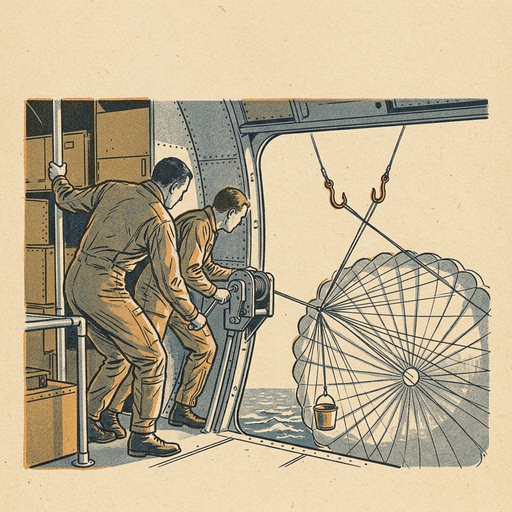
This was where the human element entered the chain. Operating out of Hickam Air Force Base in Hawaii, the sixty-five ninety-third Test Squadron, nicknamed the Star Catchers, flew modified C one-nineteen J Flying Boxcar transport aircraft. Each plane was outfitted with two thirty-four-foot aluminum poles mounted to the floor of the cargo bay. As the aircraft approached the descending parachute, the crew lowered the poles out of the open rear cargo doors. Between the tips of the poles hung a nylon trapeze line threaded with spring-loaded copper grappling hooks.
The pilots flew directly over the parachute canopy, aiming to drag the trailing trapeze across the suspension cords. If the hooks caught, the parachute collapsed, and an onboard hydraulic winch reeled the dangling capsule inside the cargo bay before it could strike the ocean waves. Recovery crews generally worked at altitudes between fifteen thousand and twenty thousand feet, though rough weather and erratic parachute descents often forced pilots to chase targets much closer to the water.
Discoverer Fourteen, designated internally as Mission nine thousand nine, brought this entire mechanical chain together for the first time. Launched on August eighteenth, nineteen sixty, the satellite completed its photographic passes and initiated reentry the following day. Flying an aircraft with the callsign Pelican Nine, Captain Harold E Mitchell spotted the gold parachute descending through the cloud deck. After two failed passes due to turbulence, Mitchell aligned his aircraft on a third run at eight thousand five hundred six feet. The grappling hooks locked onto the parachute lines, the winch engaged, and the crew hoisted the eighty-four-pound bucket into the aircraft.
That single capsule contained approximately three thousand feet of exposed film, capturing more than one point six five million square miles of Soviet territory. In one orbital flight, Discoverer Fourteen delivered more photographic coverage of the Soviet interior than all twenty-three previous U-two overflights combined. Yet the mission did not end in the cargo bay. While the public celebrated the recovery of another Discoverer engineering test, the bucket was slipped into an unmarked crate. It was transferred to an armed courier and flown directly to Rochester, New York. There, inside a windowless high-security facility known as the Hawkeye plant, specialized technicians processed the film in chemical baths before shipping the developed rolls to photographic interpreters in Washington.
The triumphant catch of Discoverer Fourteen concealed a brutal record of previous disappointment. The first twelve Discoverer launches failed to achieve a successful recovery. Rockets exploded on the launch pad, telemetry failed in orbit, and orientation systems fired at incorrect angles. On Discoverer Two, a timing error caused the capsule to deorbit over the Arctic near the Norwegian island of Spitsbergen. By the time American search teams reached the snow-covered area, the capsule had vanished, with persistent reports suggesting Soviet mining crews operating in the region had recovered the hardware first.
Discoverer Thirteen finally broke the losing streak by returning a capsule from orbit, but that mission was an engineering test carrying an American flag rather than a camera. Returning an empty shell and returning usable intelligence were completely different milestones.
This tension brings us directly to the persistent Cold War lore surrounding the day a bucket went missing. When historians and military researchers comb through declassified archives, they find that the phrase does not point to a single, isolated, catastrophic day. Instead, it captures a structural reality that haunted the program across its entire operational life. There were numerous distinct points where a film bucket could disappear, and the intelligence community categorized those losses with clinical precision.
The most straightforward losses occurred before recovery crews ever saw a parachute. If the Agena upper stage suffered an attitude control failure, the retro-rocket would fire in the wrong direction, boosting the capsule into a higher orbit rather than dropping it toward Earth. In those cases, the bucket remained stranded in space, eventually tumbling back into the atmosphere months or years later to burn up over an unpredicted coordinate. In other missions, the separation system failed, or the parachute shredded upon deployment, sending the capsule into the Pacific at terminal velocity like a piece of artillery shot.
Even when the atmospheric entry succeeded, an aircraft missing its catch was not an immediate catastrophe. The buckets were designed to float, finished with a bright gold exterior coating and equipped with a radio beacon and flashing strobe light. If the transport planes exhausted their fuel or missed their three authorized passes, the capsule splashed down into the water. This triggered a secondary recovery plan involving naval destroyers, amphibious aircraft, and helicopters.
Water recovery, however, introduced mortal danger to the film. Ocean water was corrosive, and rough sea swells could swamp the recovery beacon. To prevent a drifting capsule from falling into Soviet hands, engineers built a fail-safe mechanism: a plug made of compacted salt placed in the bottom of the capsule. In the water, the salt plug dissolved at a predictable rate over several days. If American ships failed to locate the bucket before the plug dissolved, seawater flooded the internal chamber and sank the capsule to the ocean floor.
Physical recovery did not guarantee photographic success either. On several occasions, capsules were hoisted from the sea only for technicians to discover that the seals had failed. Salt water turned the delicate film emulsion into a ruined, gummy block. Historical records indicate that across the entire Corona program, one hundred sixty-five film capsules were successfully recovered, and all but four contained operational quantities of usable film. But that leaves dozens of attempted missions across the early nineteen sixties where the satellite, the camera, and the intelligence product never returned home at all.
Furthermore, popular accounts frequently conflated Corona with later, larger photographic programs like Gambit and Hexagon. Hexagon satellites carried four massive film return capsules. In nineteen seventy-one, during Hexagon Mission twelve zero one, a parachute failure caused a capsule to impact the Pacific at high speed, sinking into sixteen thousand feet of water. The United States Navy eventually launched a deep-sea salvage mission using the bathyscaphe Trieste Two to recover the shattered pieces of the bucket from the ocean floor. The phrase "the day a bucket went missing" was never a single historical event. It was the ever-present shadow cast by an intelligence collection method that relied on gravity, parachutes, and open ocean retrievals.
As the program matured past its experimental beginnings, engineers moved from improvising recoveries to building institutional resilience. The camera systems evolved through successive generations designated K H one through K H four, with the K H four A and K H four B variants representing the peak of the system's capability. These improved configurations discarded the single-lens layout in favor of two panoramic cameras mounted in a convergent stereoscopic arrangement, pointing thirty degrees apart.
This design allowed analysts on the ground to view target terrain in three dimensions. By pairing the images, they could calculate the precise height of radar antennas, the depth of missile silos, and the volume of weapons bunkers. To mitigate the risk of losing an entire mission to a single recovery failure, the later K H four satellites introduced a dual-bucket system. Two separate return capsules were mounted in tandem at the forward end of the spacecraft.
The satellite could launch into orbit, expose its first thousand feet of film over high-priority targets, and eject the first bucket for recovery over the Pacific. The satellite would then remain dormant in orbit for weeks, conserving its power and attitude control fuel until new military movements required surveillance. Once the remaining film was exposed, the second bucket returned through the same atmospheric sequence. This redundancy halved the operational vulnerability of each launch and doubled the mission lifespan.
By the time Corona flew its final mission, the program had fundamentally altered Cold War history. The final satellite launched from Vandenberg on May twenty-fifth, nineteen seventy-two, and its recovery crew hooked the last capsule over the ocean on May thirty-first. Across twelve years of service, the program photographed millions of square miles of denied territory.
Those photographs dismantled the dangerous domestic political myth of the missile gap. They proved definitively that the Soviet Union possessed far fewer deployed intercontinental ballistic missiles than American defense planners had feared. The imagery tracked the construction of nuclear test facilities, revealed naval deployments, and provided the verifiable evidence required for the United States to negotiate the Strategic Arms Limitation Talks, known as SALT One.
The existence of Corona remained an absolute state secret until February nineteen ninety-five. That month, Executive Order twelve thousand nine hundred fifty-one authorized the declassification of the program's history and its eight hundred thousand surviving satellite frames. When researchers finally examined the hardware and the mission logs, they discovered a striking historical contrast.
In late nineteen seventy-six, the United States deployed the K H eleven Kennan system, which replaced film with charge-coupled digital sensors and relayed its data through high-bandwidth satellite communication links. The dramatic era of modified cargo planes catching falling parachutes came to an end. Yet as digital systems replaced physical film, one set of engineering vulnerabilities was simply swapped for another. Parachutes, saltwater plugs, and copper hooks were traded for complex digital encryption, microwave downlink networks, solar array mechanics, and cyber software dependencies.
The essential lesson of Corona lives inside that trade-off. Technological sophistication in space means nothing if you cannot deliver the knowledge safely to the surface. Discoverer Fourteen succeeded not simply because it operated in orbit. It succeeded because an aircraft crew flew three passes through turbulent Pacific air, locked a mechanical hook into a nylon shroud, and winched a physical container through an open cargo door.
Corona proved that our most complex systems often rely on the most fragile human and mechanical links. The next time you rely on an effortless flow of data, think about the unseen supply chains that make it possible, and consider what it truly takes to bring knowledge safely home.