Coober Pedy Dugouts: How Mining, Sandstone, and Infrastructure Sustain Desert Homes
In Coober Pedy, South Australia, opal mining and desert extremes led residents to carve homes, churches, and businesses into sandstone, where the rock moderates the heat. But life underground is no simple escape: ventilation, water, power, structural care, and the hazards of abandoned mines make it a continuing feat of engineering and community adaptation.
By MyAudioBooks.ai ·
Listen free: Coober Pedy Dugouts: How Mining, Sandstone, and Infrastructure Sustain Desert Homes
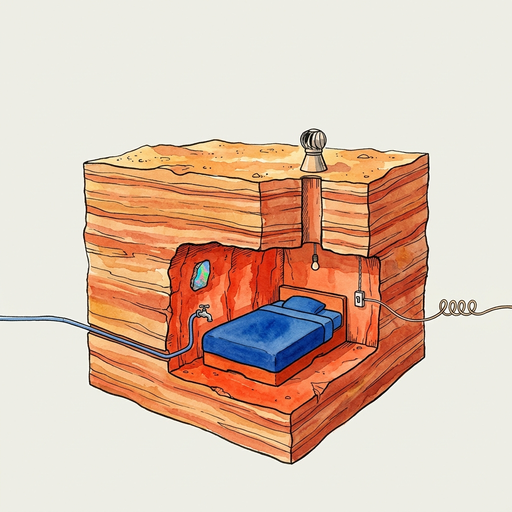
Step inside a bedroom carved directly into solid sandstone, where the air is still, dim, and surprisingly cool. A few metres above your head, relentless desert sunlight bakes the red stone and iron-hard clay of the South Australian outback. While surface temperatures climb past levels that strain human physiology, the subterranean room rests in steady, natural quiet.
This striking contrast raises a fundamental question about the remote desert settlement of Coober Pedy. Did its residents move underground simply to escape an unforgiving climate, did they descend to repurpose abandoned mine workings, or did both necessities converge to make subterranean living an enduring way of life?
At My Audio Books dot A I, you can create your own audiobooks from prompts, turn your documents into audio, all with one subscription, and store your items in your own personal library.
Coober Pedy sits along the Stuart Highway in northern South Australia, roughly nine hundred fifty kilometres northwest of Adelaide, near the edge of the Stuart Range and the Great Victoria Desert. That distance is an approximation based on the primary paved route, and it highlights a defining reality of the region: absolute geographical isolation. The town has no permanent natural surface-water source anywhere in its immediate surroundings.
The surrounding desert sets strict environmental boundaries. Sparse rainfall, intense solar radiation, and extreme temperature swings between midday and midnight, as well as between summer and winter, characterize the climate. Local weather summaries place average summer daytime temperatures around thirty-seven degrees Celsius.
Historical and secondary accounts frequently cite readings exceeding fifty degrees Celsius, including extreme figures near fifty-two degrees. Those higher numbers often reflect extraordinary heatwaves or uncalibrated roadside thermometers rather than standardized weather-station observations, yet they capture the harsh physical pressure felt on the surface.
Long before mineral prospectors arrived, Aboriginal people lived on and traveled across this country. Their relationship with the land remains active, enduring alongside the modern township.
The European mining settlement began with a chance encounter. In February nineteen fifteen, a fourteen-year-old boy named Willie Hutchison discovered pieces of precious opal on the surface while traveling with a prospecting party led by his father, James Hutchison. The find sparked an outback rush across the Stuart Range.
By nineteen twenty, the local Progress and Miners Association officially adopted the name Coober Pedy. The name originates from Aboriginal language terms, widely interpreted as white man in a hole or white man's hole in the ground, although historical spellings and linguistic analyses vary across archival records.
Following the First World War, returning Australian soldiers traveled to the opal fields to seek their fortunes. Popular accounts frequently suggest that their familiarity with wartime trench warfare inspired the rapid adoption of dugout homes. While the Hutchison party's opal discovery is documented in historical records, the role of European trench experience in driving subterranean housing remains an evocative local tradition rather than a verified engineering record.
The camp developed gradually into a structured township, receiving formal designation in nineteen sixty. Migration waves from Southern and Eastern Europe through the nineteen sixties and seventies reshaped the settlement, transforming a transient mining camp into a permanent, multicultural community.
Today, the town calls itself the Opal Capital of the World, an emblem of civic pride and tourism branding rather than an audited measurement of global mineral production. Population figures also shift depending on administrative definitions. Local council publications describe roughly two thousand residents, and a regional community plan counts about three thousand five hundred across the broader district. Meanwhile, the twenty twenty-one national census recorded an urban-centre population of around one thousand four hundred thirty-seven.
Behind these varying estimates lies a working community where an arid climate created an urgent need for shelter, and mining excavations offered an immediate, physical solution.
Turning an excavation into a habitable home requires a very specific geological foundation. Coober Pedy rests on horizontal layers of sandstone and siltstone, which sit directly above much older marine shale deposited tens of millions of years ago on an ancient inland sea floor.
This sedimentary stone provides an uncommon structural balance. It is soft enough to be carved with hand picks, pneumatic spades, and modern tunneling machines, yet dense and cohesive enough to remain structurally sound without collapsing under its own weight. It does not require the heavy timber shoring demanded by soft soil, nor does it present the extreme excavation costs of hard crystalline granite.
In local terminology, a dugout refers to any subterranean or semi-subterranean room, private residence, or commercial building carved into the ground. Some dugouts began as genuine opal mines, where prospectors chased thin veins of silica through the rock; others were planned and cut from the start purely as dwellings.
When miners removed stone in pursuit of opal, they inadvertently created usable interior volume. By enlarging worked-out tunnels and squaring off rough walls, residents acquired living space without the immense expense of hauling building materials across hundreds of kilometres of dirt tracks. In a landscape devoid of native timber trees, living inside excavated rock eliminated the need for conventional exterior framing, weatherboards, and corrugated iron roofs.
Crocodile Harry's Dugout provides a well-documented case study of this physical transformation. Originally hand-dug as an exploratory mining shaft, the underground structure was systematically expanded over decades into an eccentric residential home, before eventually becoming a celebrated visitor site. Its origins as a working mine, its practical adaptation into a household, and its eventual role in regional tourism represent distinct historical layers carved into the exact same stone.
The primary scientific reason dugouts offer shelter from desert heat lies in the physics of thermal mass. Ambient outdoor air responds rapidly to incoming solar radiation during the day and radiates heat out to the night sky, creating sharp daily temperature spikes and drops. Solid rock, by contrast, responds with deep thermal inertia.
Surrounding sandstone acts as a slow thermal flywheel rather than a mechanical cooling unit. It moderates the transfer of surface heat, absorbing warmth during the hottest hours and releasing it gradually over days and weeks.
Measurements reported by the National Aeronautics and Space Administration indicate that suitable subterranean rooms in Coober Pedy maintain an interior temperature around twenty-three degrees Celsius. Regional tourism literature often cites a broader ambient range between nineteen and twenty-five degrees Celsius. These numbers describe documented historical conditions rather than a legally guaranteed temperature for every underground chamber.
A dugout's actual interior comfort depends on several physical variables. Key factors include the depth of excavation, stone roof thickness, rock porosity, and the orientation of exterior openings. Airflow rates, seasonal weather patterns, and heat produced by cooking appliances or human occupants also directly alter the climate inside. Thermal mass dampens outside extremes, but internal heat generated inside the room still has to find a path to the surface.
Enclosing a living space inside solid stone solves the problem of surface heat, but it immediately introduces complex engineering requirements. A dugout cannot function without active air exchange. Because stone walls do not breathe, residents must install vertical ventilation shafts that extend through metres of bedrock to the surface.
These shafts, often capped with rotating wind cowls, rely on natural convection and atmospheric pressure differentials to draw in fresh air and flush out stale air, carbon dioxide, and airborne moisture. If these vents are obstructed, indoor air quality quickly deteriorates.
Arid desert conditions do not eliminate the danger of underground dampness. While rainfall is infrequent, sudden desert downpours can seep through natural surface fractures, internal plumbing pipes can develop undetected leaks inside the rock, and everyday human respiration generates airborne moisture.
If ventilation is restricted, humidity condenses against the cool sandstone walls, fostering mold growth and gradually degrading the structural strength of the rock. To counter continuous dusting and minor crumbling, residents commonly coat the exposed sandstone with clear bonding agents, sealing the rock surfaces while preserving their natural stratified colours.
Transforming a rough cavern into a modern home requires comprehensive building services. Electric cables must be run through channels cut directly into the walls, and specialized plumbing systems are required to pump wastewater up toward surface septic tanks and municipal lines.
Fire safety is a particularly serious consideration. In a subterranean space with few exit paths, smoke and toxic gases from combustion heaters or cooking stoves can become fatal within minutes. Every habitable dugout demands dedicated flue venting, clear emergency evacuation protocols, and carefully planned secondary escape routes.
Ceiling stability presents another continuous technical challenge. The structural integrity of an underground room depends on rock composition, natural horizontal bedding planes, vertical stress fractures, moisture exposure, and the proximity of neighboring excavations.
While local building lore frequently cites a four-metre layer of solid stone above the ceiling as a safe minimum, structural engineers note that thickness alone is not a universal guarantee against collapse. A thick rock ceiling that contains hidden geological faults or water damage can give way, whereas a thinner layer of sound, undisturbed sandstone can remain perfectly secure for generations.
The passive cooling offered by rock substantially reduces the electricity required for conventional air conditioning during peak summer months. However, that thermal advantage is easily compromised. Leaving outer doors open, permitting uncontrolled drafts of hot surface air, or operating heat-intensive electrical equipment inside the home will steadily raise the indoor temperature.
Furthermore, passive thermal mass does nothing to eliminate the need for electrical energy. Lighting, mechanical ventilation fans, water pressure pumps, and food refrigeration still draw steady power from the local electrical network, day and night.
Subterranean architecture in Coober Pedy extends far beyond private residences. The town's civic and communal life has also moved underground. The Serbian Orthodox Church of Saint Elijah, the Catacomb Anglican Church, and the Catholic Church of Saint Peter and Paul are all hollowed directly out of the sandstone. They offer quiet, acoustically resonant spaces for worship, shielded from desert wind and dust.
Underground hotels, motels, subterranean backpacker hostels, restaurants, retail shops, and opal galleries mirror this approach, providing comfortable amenities for travelers and generating steady employment for local residents.
While regional tourism promotions often suggest that the entire population lives underground, verified demographic figures show a more balanced reality. Research cited by the National Aeronautics and Space Administration reports that approximately half of Coober Pedy's residents live in dugouts, while other local surveys estimate the figure at roughly sixty percent. The precise proportion varies across seasons, shaped by workforce mobility, rental housing availability, surface construction choices, and the specific statistical boundaries used by researchers.
Thermal protection alone cannot sustain human life in a desert. Coober Pedy has always struggled with an absolute shortage of local fresh water. In nineteen twenty-two, the South Australian government constructed a five-hundred-thousand-gallon underground concrete tank to store rainwater runoff, but prolonged droughts rendered the supply chronically unreliable. Water had to be hauled over immense distances by rail and road, severely constraining settlement growth and sanitation.
In nineteen sixty-seven, the government constructed a solar desalination plant to treat saline groundwater pumped from approximately one hundred metres below the desert surface. As the community expanded, local authorities developed a more durable regional solution. A two-hundred-millimetre pipeline transports fresh water from artesian bores located roughly twenty-three kilometres northeast of the town, drawing from deep aquifers at depths around sixty metres.
This water pipeline demonstrates that subterranean architecture is not an exercise in complete self-sufficiency. Cool underground rooms remain utterly dependent on surface infrastructure, mechanical maintenance, water treatment facilities, and electrical power grids. Long transport distances also impose heavy logistical burdens on fuel supply, food deliveries, medical services, and emergency management. A rock ceiling keeps out the sun, but it does not shorten the highway.
A century of opal extraction has also left an indelible mark on the landscape. The desert surrounding Coober Pedy is punctured by tens of thousands of exploratory mining shafts, adits, and unmapped tunnels. When a resident excavates a new room or expands an existing dugout, they are cutting into ground that may already be hollowed out by previous generations of prospectors.
Unmarked, abandoned shafts hidden beneath loose gravel pose a recognized physical hazard to residents, visitors, and grazing animals, presenting continuous challenges for municipal safety, land surveying, and ground remediation.
The practice of living underground emerged from four converging forces: escaping brutal summer heat, sheltering from freezing winter nights, repurposing existing mine excavations, and avoiding the high cost of hauling timber and iron into the interior. Miners already accustomed to the steady climate of the tunnels recognized that living inside the rock was the most economical and practical answer to desert survival.
Over time, these pragmatic choices evolved into a distinct cultural identity. Underground architecture defined the community's civic image, and tourism emerged as a major economic pillar alongside opal mining.
However, popular media depictions of people living in caves tend to turn functional homes and workplaces into outback oddities. That romanticized view often obscures the grueling physical labor of excavation, the constant burden of structural maintenance, the critical dependence on imported water, and the persistent safety risks of living amidst old mine workings.
The scientific evidence for dugout performance is equally nuanced. While individual structures clearly demonstrate the moderating benefits of thermal mass, researchers lack the standardized, town-wide data required to establish a precise percentage of energy saved across the entire community. A rigorous calculation would need to account for differences in room depth, ventilation rates, internal heat sources, and how long heatwaves persist before the stone itself begins to warm.
Similarly, eye-catching claims of surface temperatures exceeding fifty degrees Celsius highlight the need to separate informal anecdotes from verified meteorological station records. On the ground, the hazard of unmapped mine workings underscores the unresolved work of mapping, inspecting, and securing legacy excavations.
The story of Coober Pedy is also tied to questions of historical ownership and narrative authority. The ongoing connection of Aboriginal custodians to Country reminds us that the history of this region predates the arrival of opal miners and military veterans. In turn, it raises continuing questions about whose voices shape the town's public identity.
Coober Pedy demonstrates that human adaptation relies on an interconnected system of geology, engineering, regional infrastructure, and local community tradition. The dugout is a compelling case study in living within environmental limits, rather than a universal blueprint that can be applied indiscriminately to other arid regions.
Returning to that subterranean bedroom, the cool, quiet air feels like a simple gift of the earth. Yet every hour of comfort in that room is sustained by vertical ventilation shafts, distant artesian boreholes, electrical networks, and decades of accumulated knowledge. The most revealing question is not simply why people chose to move underground, but what intricate systems of engineering and community effort quietly keep the room habitable today.
If this look into desert adaptation shifted your perspective on how architecture interacts with climate, consider how your own surroundings manage the balance between nature and engineering. There is always more to learn about how communities adapt to the most challenging environments in the world.