Chicxulub Crater and the Evidence Behind the Dinosaur-Killing Impact
An uncertain TikTok search spike opens a deeper detective story: how decades of chemical clues, buried crater maps, and drilled rock cores linked Mexico’s Chicxulub crater to the asteroid impact that ended the age of non-avian dinosaurs. New research explores the asteroid’s origins and a hydrothermal system that may have sheltered microbial life for millions of years, revealing how a global catastrophe also created opportunities for survival. Throughout, the story contrasts fleeting algorithmic signals with the enduring power of independent scientific evidence.
By MyAudioBooks.ai ·
Listen free: Chicxulub Crater and the Evidence Behind the Dinosaur-Killing Impact
On the morning of October twentieth, twenty twenty-six, anyone monitoring the odd undercurrents of the internet might have noticed a curious digital signal. Twelve days earlier, on October eighth, an analytics service called TokConnect published a worked example drawn from TikTok's search ecosystem. It highlighted a specific phrase: chicxulub crater now.
One version of the claim gave an exact pair of figures: twenty-four million, three hundred eighty-four thousand, eight hundred one as a topic figure, set against three thousand, six hundred sixty-seven videos. Those numbers deserve to be recorded, but they must be greeted with immediate caution. Searches across the available public record could not verify that particular pair. TokConnect's own documentation from October eighth told a slightly different, though equally striking, story. Its published table reported a seven-day search estimate of nineteen million, seven hundred sixty-two thousand, five hundred thirteen, with zero matched videos. It classified the sudden movement as a spike.
To understand what those numbers mean, it helps to understand what the tools are actually counting. TokConnect is a third-party analytics service, separate from TikTok itself, that monitors the platform's Creator Search Insights. That underlying dashboard is intended to give content creators a glimpse into what audiences might be looking for. It points out apparent gaps where audience curiosity seems to outpace the available supply of clips. A search estimate, however, is not an audited count of individual human beings typing into a search bar. It is not a tally of completed video views, nor does it prove that twenty million people suddenly became amateur geologists in a single week.
TokConnect itself notes that very large readings, particularly those reaching five million or more, typically indicate a pooled topic group. TikTok's system bundles related queries, broad interests, and algorithmic associations under a single shorthand label. Furthermore, when the tool reports zero matched videos, it does not mean that the entire platform is devoid of clips about ancient asteroids or Mexican geology. It simply means that TikTok's categorization system had not officially filed existing videos under that specific topic header at that moment. The gap lists are personalized, dynamic, and subject to constant recalculation. A discrepancy between estimated interest and matched videos can certainly give a video maker an intriguing editorial hunch. But it cannot measure an underserved public or guarantee an audience.
We do not have evidence proving why that label surged in early October twenty twenty-six, nor can we point to a specific viral trend that provoked it. What we have instead is something far more durable. Behind that fleeting digital artifact sits one of the most thoroughly tested detective stories in the history of science. The crater that shares its name with a quiet coastal town in Mexico was not discovered by a social media algorithm, and our understanding of it does not rest on ephemeral platform metrics. It was uncovered by patient people who followed faint chemical clues across continents and read the structural memory of the Earth itself.
That physical journey began far from Mexico, high in the Apennine Mountains near the medieval town of Gubbio, Italy. In the nineteen seventies, an American geologist named Walter Alvarez was studying the region's steep limestone walls. These rocks had formed layer by layer on an ancient sea floor, accumulating over millions of years. Geologists read these layered successions like pages in a vast, stony book. They know that fossils—the preserved remains or physical traces of prehistoric organisms—change from layer to layer as species arise, flourish, and vanish.
At Gubbio, Alvarez noticed a peculiar boundary. Beneath a certain level, the limestone was packed with the fossil shells of diverse microscopic ocean creatures called foraminifera. Above it, those species abruptly disappeared, replaced by a much sparser collection of tiny survivors. Right at the dividing line lay a centimeter-thin seam of reddish clay, entirely devoid of those ancient shells. This seam marked the division between two great geological chapters, known today as the Cretaceous-Paleogene boundary, or the K-P-G boundary. Older scientific literature often referred to it as the Cretaceous-Tertiary, or the K-T boundary. The changing name refers to the exact same moment in Earth's history, roughly sixty-six million years ago, when the Cretaceous world gave way to the modern era.
A thin ribbon of clay in an Italian gorge is not a self-explanatory photograph of the past. It is an invitation to ask questions. Walter Alvarez wanted to know how much time that quiet layer represented. Did it settle slowly over millions of years, or was it laid down in a geologically instantaneous catastrophe? To answer that question, he turned to his father, the Nobel Prize-winning physicist Luis Alvarez, at the University of California, Berkeley.
The Berkeley investigation quickly expanded beyond father and son, becoming a four-person collaboration that included nuclear chemists Frank Asaro and Helen Vaughn Michel. They decided to measure the concentration of iridium within the boundary clay. Iridium is a dense, silvery-white metallic element that is vanishingly scarce in Earth's crust. Because iridium dissolves readily in molten iron, most of the planet's native supply sank down into the metallic core while the young Earth was still molten. In meteorites—pieces of space rock that travel through interplanetary space and occasionally fall to the ground—iridium remains comparatively abundant. The Berkeley team reasoned that if the boundary clay had accumulated very slowly, ordinary cosmic dust drifting through the atmosphere would have deposited a modest, measurable trickle of iridium.
When Asaro and Michel completed their measurements using neutron activation analysis, the result was astonishing. The boundary clay did not contain a quiet trickle. It held roughly thirty times more iridium than the limestone layers immediately above and below it, reaching an abundance of about nine parts per billion. Intrigued, the team sought samples from other parts of the world, testing exposed boundary layers at Stevns Klint in Denmark and Woodside Creek in New Zealand. Both locations revealed an identical, undeniable spike.
In nineteen eighty, the team published their findings in the journal Science. They proposed that roughly sixty-six million years ago, a massive extraterrestrial object had collided with Earth, vaporizing on impact and hurling vast quantities of pulverized dust into the upper atmosphere. Circulating winds would have draped the globe in an opaque shroud, cutting off sunlight.
Sunlight is the primary engine of life on Earth through photosynthesis, the biological process by which plants, algae, and microscopic marine organisms convert light into chemical energy. Without sunlight, the Berkeley researchers argued, primary food production would have collapsed, causing starvation to ripple outward through terrestrial and marine food webs. Later scientists would refine this portrait. They noted that while coarse dust would have settled within weeks or months, sulfur-bearing aerosols—tiny chemical droplets suspended in the upper atmosphere—and worldwide soot from fires would have extended the darkness and triggered a brutal global chill.
The Alvarez hypothesis was elegant, powerful, and testable, but it faced immediate, fierce skepticism. An unusual concentration of a rare metal could point to an extraterrestrial visitor, but geologists demanded a fundamental piece of physical evidence. If an asteroid capable of shattering a planet's biosphere had struck the Earth, where was the hole?
As it turned out, the first clues to the crater's whereabouts had already been recorded, though almost nobody in the wider scientific world realized it. In nineteen seventy-eight, two years before the Berkeley paper appeared, a geophysicist named Glen Penfield was working on an aerial survey of the northern Yucatán Peninsula for Petróleos Mexicanos, Mexico's national petroleum company, widely known as Pemex.
Geophysics is the science of investigating concealed rock formations through their measurable physical properties, allowing researchers to perceive hidden topography without stripping away the ground. By measuring local variations in the Earth's magnetic field and subtle differences in gravitational pull, geophysicists can map the density and composition of deeply buried strata. Working alongside Pemex geologist Antonio Camargo, Penfield was reviewing magnetic data gathered by survey aircraft flying over the shallow waters off the northern coast of the peninsula.
Penfield spotted an enormous, semicircular underwater arc of magnetic anomalies, centered near the coastal village of Chicxulub Puerto. When he compared his marine findings with older, ground-based gravity surveys conducted on the mainland, the arc matched up perfectly with an onshore structure. Together, the data outlined an enormous, intact circle roughly one hundred eighty to two hundred kilometres across, straddling both land and sea. This was not a visible crater, open to the sky like a giant bowl in the desert. It was a deeply buried ghost structure, concealed beneath hundreds of meters of younger limestone.
Penfield and Camargo recognized that the feature was far too large and structurally unusual to be an ordinary volcanic complex. In nineteen eighty-one, they presented their findings at the annual meeting of the Society of Exploration Geophysicists. Because Pemex was a commercial entity operating under strict rules of data confidentiality, the researchers were limited in the technical details they could share publicly, and their presentation passed almost without notice. For nearly a decade, the buried Yucatán structure and the global iridium anomaly remained two separate puzzles, filed in completely different drawers.
The bridge between them was built around nineteen ninety by Alan Hildebrand, then a graduate student at the University of Arizona, and his faculty advisor, William Boynton. Hildebrand and Boynton had been hunting for evidence of impact-generated sea waves, known as megatsunamis, around the Caribbean basin. They identified chaotic boundary deposits in places like Texas and Haiti that contained thick, violently churned debris layers, including glassy droplets called tektites, formed when molten rock was splashed into the air and quenched as it fell. The scale of the disturbances convinced them that the impactor must have struck somewhere in or near the Caribbean.
After learning of Penfield's earlier work through a tip from a journalist, Hildebrand contacted the geophysicist. Together with Pemex staff, they retrieved core samples from deep exploration wells that had been drilled into the Yucatán structure decades earlier. Inside those core cylinders, the geologists found the physical fingerprints of immense, violent shock.
Foremost among these was shocked quartz. Quartz is a tough, common mineral whose crystalline lattice is remarkably stable. Under ordinary volcanic pressures, it simply melts or fractures. But when subjected to the instantaneous, unimaginable pressures of an extraterrestrial impact, its internal crystal structure deforms along microscopic, parallel planes known as planar deformation features. Alongside the shocked quartz lay thick beds of impact melt—rock that had been flash-heated into liquid by the kinetic energy of the collision. By nineteen ninety-one, dating of these melt rocks confirmed their age: sixty-six million years, precisely matching the extinction horizon found in Italy, Denmark, and New Zealand.
For decades, the connection remained rock-solid, but one final, definitive piece of physical evidence was still missing. The global boundary layers contained extraterrestrial iridium, while the Mexican crater held shocked quartz and impact melt, but scientists had not yet demonstrated that the dust inside the crater matched the fallout scattered across the rest of the planet.
That conclusive link arrived on February twenty-fourth, twenty twenty-one, in a study published in Science Advances, led by Steven Goderis of Vrije Universiteit Brussel. Goderis and an international team analyzed rock samples retrieved during an ocean drilling expedition that had cored directly into the peak ring of the Chicxulub crater. A peak ring is a circular, mountainous ridge of shattered rock that rises inside the center of very large impact structures, formed when the pulverized floor rebounds immediately after the blast.
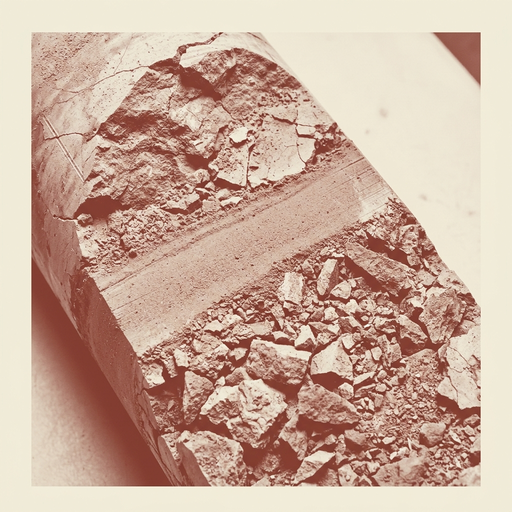
Inside a drill core—a long, cylindrical column of rock pulled up from deep beneath the Gulf floor—the researchers identified a specific sediment layer settling immediately above the impact debris. In that exact interval, right below the first limestone layers laid down in the new Paleogene era, they detected a pronounced iridium enrichment, bearing the identical chemical fingerprint found in the global boundary clay. The physical crater and the worldwide chemical dust were irrevocably tied together.
With that convergence of evidence, geologists, paleontologists, and atmospheric modelers have been able to reconstruct the catastrophe. It is essential to remember that this reconstruction is an evidence-based model, assembled from rock chemistry, microfossil records, physical shock experiments, and computer simulations, rather than an eyewitness report.
Roughly sixty-six million years ago, an asteroid approximately ten kilometres across entered Earth's atmosphere and struck the shallow carbonate platform of the Yucatán at tens of thousands of kilometres an hour. The energy released was equivalent to billions of atomic bombs. The asteroid and the immediate bedrock vaporized in a fraction of a second, gouging a temporary cavity tens of kilometres deep. Within minutes, the unstable rim collapsed inward, the center rebounded to form the peak ring, and an immense wall of displaced seawater rushed outward across the Gulf of Mexico. It generated waves hundreds of meters high that tore up coastal landscapes across the Caribbean basin.
Hot, molten rock and glassy droplets were thrown high above the atmosphere, re-entering around the world and superheating the upper sky. But the most devastating consequences unfolded over the weeks and years that followed. The vaporized limestone and gypsum released immense clouds of fine rock dust, soot from widespread fires, and billions of tons of sulfur gases. These suspended particles dimmed the sun, plunging the Earth into months of deep darkness and a prolonged impact winter.
Photosynthesis on land and in the sunlit upper ocean ground to a halt. In that protracted twilight, food webs shattered. The event produced a mass extinction, defined as a geologically rapid loss of a large proportion of global species. Roughly seventy percent of all living species disappeared forever.
The casualties included all non-avian dinosaurs, bringing an end to their more than one hundred fifty million years of dominance. Survival was not a total clean slate. Birds are surviving dinosaurs, modern avian lineages that managed to navigate the catastrophe. Many lineages of mammals, crocodilians, turtles, amphibians, fish, and plants endured as well, though survival was highly variable even within those resilient groups. Mammals had already existed alongside the dinosaurs for more than a hundred million years; they were not freshly minted by the impact. Survival was not a reward for intelligence or simple toughness, nor did it make human evolution an inevitable outcome. It was the messy, contingent preservation of lineages whose small size, burrowing habits, freshwater habitats, or dietary flexibility allowed them to endure through years of darkness and chill.
Yet the crater was not merely a tomb; it was also a birthplace for extraordinary, long-lived geology. This reality was highlighted on June ninth, twenty twenty-six, in a study published in the journal Communications Earth and Environment. Led by Annemarie Pickersgill of the Scottish Universities Environmental Research Centre and the University of Glasgow, alongside colleagues from Purdue University, the University of Texas at Austin, and the Universities Space Research Association, the team analyzed core samples drilled from the peak ring to explore its ancient hydrothermal system.
A hydrothermal system is a natural circulatory network where groundwater flows through deeply fractured, intensely heated rocks. Scientists had long known that the kinetic energy of the impact generated immense heat beneath the crater floor, but earlier models suggested that this fluid circulation lasted for perhaps two million years. Pickersgill's team utilized high-precision argon dating on minerals formed within the rock fractures, combined with advanced thermal modelling to track how the rock cooled over time.
Their findings revealed that fluid circulation within the Chicxulub peak ring persisted for at least eight million years, lasting from roughly sixty-six million years ago down to fifty-eight million years ago. Cooling to ninety degrees Celsius took roughly one point five to two point three million years, while cooling below fifty degrees Celsius required up to five million years. Circulation ceased by eight million years. This makes it the longest-lived impact-generated hydrothermal system ever documented on Earth. This sustained heat was not simply a matter of water boiling indefinitely from the blast itself. Rather, the impact deeply shattered the crust, creating extensive permeability that allowed water to circulate continuously, drawing on residual impact heat as well as the Earth's normal geothermal warmth. The study underscores how an event that extinguished so much of the surface biosphere also carved out deep, warm, mineral-rich underground chambers that could have provided a stable habitat for subsurface microbial life for millions of years.
That June research returned to public discussion on September thirtieth, twenty twenty-six, when it was featured in detail by the science publication Ars Technica. Such reporting highlights the steady rhythm of public science writing, where findings from peer-reviewed journals gradually filter outward into wider cultural awareness. That September reporting is a documented, verifiable point of contact between modern Chicxulub science and the reading public, even if we cannot claim it directly caused TokConnect's automated tracker to register a spike eight days later.
Other specialized insights have continued to refine the story throughout twenty twenty-six. A study published in Science Advances that year by researchers from Paris, Brussels, Vienna, and the University of British Columbia examined nickel-isotope ratios found in the global boundary layer. Isotopes are variations of a chemical element that possess identical chemical properties but slightly different atomic masses. Because different classes of meteorites carry distinct isotopic signatures, measuring these ratios acts like a cosmic fingerprint.
The team's isotopic analysis indicated that the Chicxulub impactor was a rare variety known as an Ornans-class, or C-O-type, carbonaceous chondrite. A carbonaceous chondrite is a primitive, ancient variety of stony meteorite rich in carbon compounds, formed in the outer solar system during the birth of our planetary neighborhood. Striking at an estimated sixty-four thousand kilometres per hour, this identification provides crucial context about where the object originated, helping scientists understand the exact chemical inventory delivered during the impact.
It is equally important to distinguish genuine recent advances from older ideas that simply recirculate without their original dates. Feeds in the autumn of twenty twenty-six occasionally surface claims that the impactor was a high-velocity comet rather than an asteroid. That proposal traces back to March twenty thirteen, when researchers Jason Moore and Mukul Sharma argued at a planetary science conference that a smaller, faster comet could explain the crater's size while matching geochemical estimates of the impactor's mass. Other researchers, such as Gareth Collins, cautioned that geochemical data cannot definitively pinpoint projectile size. The overwhelming consensus of geochemical and mineralogical evidence continues to anchor the impactor as a carbonaceous asteroid. On modern digital networks, where older news articles and recent journal releases often look identical on a screen, checking the calendar is as essential as checking the geology.
As of October twentieth, twenty twenty-six, the tools of social analytics and the tools of Earth science tell two completely different stories. The third-party analytics metric that raised eyebrows in early October offers an intriguing hint of digital curiosity, but its exact figures remain an unverified platform estimate, an artifact of automated categorization rather than a proven social movement.
The crater itself, however, requires no such hedging. From the exposed limestone walls of the Italian Apennines to the aerial magnetic charts of the Yucatán, from the shocked minerals beneath the Mexican coast to the drilled cores preserving a sixty-six-million-year-old dust seam, the physical evidence converges. Science does not establish reality by watching algorithms count impressions on a screen. It establishes reality when independent researchers, working across decades with different tools and distinct disciplines, keep arriving at the exact same physical truth. Beneath modern soil and shallow seas, the great circle of Chicxulub remains quietly etched into the planet, a monument to the afternoon the sky fell, and a reminder of how the living world found a way to carry on.