Chicago’s Reversed River: The Sanitary Canal and Its Downstream Costs
In 1900, Chicago reversed its river to carry sewage away from Lake Michigan, protecting its drinking water while creating a shipping route to the Mississippi basin. The engineering triumph shifted pollution downstream, provoked interstate lawsuits and left lasting ecological risks—showing that moving waste is not the same as solving the problem.
By MyAudioBooks.ai ·
Listen free: Chicago’s Reversed River: The Sanitary Canal and Its Downstream Costs
In the opening days of nineteen hundred, engineers in Chicago triggered an explosion that permanently altered the natural drainage of North America. They forced a river that had always flowed into Lake Michigan to reverse its course, pulling fresh lake water inland and flushing the city's sewage down toward the Mississippi River basin. It was celebrated across the country as a staggering triumph of modern engineering. Yet moving that waste across a continental divide did not make it vanish. It protected one city's drinking water by transferring an enormous public health burden to communities hundreds of miles downriver, sparking a legal and ecological conflict that reshaped American environmental law.
At My Audio Books dot A I, you can create your own audiobooks from prompts, turn your documents into audio, all with one subscription, and store your items in your own personal library.
A watershed divide is the physical boundary that separates lands draining into different river systems. In northeastern Illinois, this continental threshold is not marked by a towering mountain range. It is a subtle, nearly flat ribbon of land just a few miles west of Lake Michigan, standing barely a dozen feet above the water. For centuries, rainwater falling on the eastern side seeped toward the Great Lakes, the Saint Lawrence River, and the Atlantic Ocean. Rain falling just slightly to the west drained through prairies into the Des Plaines and Illinois rivers, feeding the Mississippi and the Gulf of Mexico.
As Chicago boomed during the nineteenth century, its geography collided with explosive urban growth. The Chicago River, a slow-moving channel, emptied naturally into Lake Michigan. The lake served as the young city's only practical source of clean drinking water, while the river served as its open sewer. Every single day, millions of gallons of raw human waste, slaughterhouse refuse from the stockyards, and untreated industrial effluent poured directly into the river.
To escape its own contamination, Chicago built intake cribs several miles out in the lake, drawing fresh water through tunnels dug deep beneath the lake floor. The strategy relied on distance, but heavy rainstorms regularly shattered the arrangement. Deluges swept across the muddy city, flushing the concentrated filth of the Chicago River far out into the lake, where it swirled directly around the intake cribs.
The public health consequences were catastrophic. In the late nineteenth century, repeated epidemics of waterborne diseases, including typhoid fever and cholera, killed thousands of residents in single outbreaks. City officials and sanitarians recognized that Chicago was effectively poisoning its own water supply.
Earlier engineering works had attempted to ease the crisis. In eighteen forty-eight, workers completed the Illinois and Michigan Canal, cutting a shallow passage across the divide to connect the South Branch of the river to the Illinois River valley. Pumping stations drew a portion of the city's river water into the canal, providing partial relief. Yet the channel was far too small, the pumps lacked sufficient capacity, and severe storms consistently overwhelmed the system, pushing raw sewage back into Lake Michigan.
In eighteen eighty-nine, the Illinois legislature established the Sanitary District of Chicago, an independent regional authority armed with broad powers of taxation, borrowing, and eminent domain. Modern mechanical sewage filtration and chemical purification were still in their infancy and considered prohibitively expensive for a city rapidly swelling toward two million people. Instead, the sanitary district chose conveyance and dilution. The plan was audaciously straightforward. Engineers would cut an immense artificial canyon through the continental divide, lower the riverbed, and use the sheer volume of Lake Michigan to flush the city's wastewater southwest into an entirely different river system.
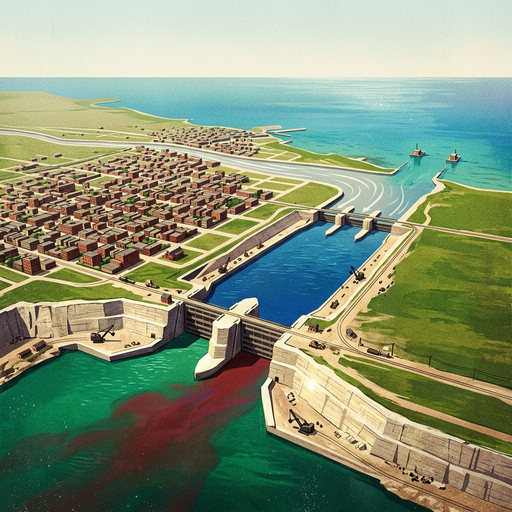
Excavation on the main channel of the Chicago Sanitary and Ship Canal began in September eighteen ninety-two. The project extended roughly twenty-eight miles, tracing a southwest corridor from the South Branch of the Chicago River near Robey Street, now Damen Avenue. From there, it cut through the Des Plaines River valley down to Lockport. Over more than seven years of continuous construction, thousands of laborers cut through millions of cubic yards of glacial clay and solid limestone bedrock.
The canal operated as a vast proving ground for heavy earthmoving technology. Contractors developed specialized steam shovels, rock-channeling machines, conveyor belts, and massive aerial cableways suspended across the trench. Many of the techniques and machines refined in the limestone cuts of Illinois were later shipped south to construct the Panama Canal.
The scale of the finished trench varied across its length. In the rock sections, where vertical walls were sliced directly into limestone, the channel bottom measured roughly one hundred sixty feet wide with a water depth exceeding twenty-two feet. In sections running through softer earth, the bottom measured roughly one hundred ten feet across, with sloping banks that widened the channel to more than two hundred feet at the waterline.
Gravity formed the fundamental mechanism of the entire system. Engineers did not rely on continuous pumping to reverse the flow. Instead, they excavated the canal bed so that it sloped steadily downward from Lake Michigan toward Lockport, creating an artificial hydraulic gradient across the continental divide.
When engineers opened the sluice gates in January nineteen hundred, the physical reversal became reality. Water from Lake Michigan rushed into the mouth of the Chicago River and flowed westward through the city center. It entered the new sanitary canal, then tumbled over the control gates at Lockport into the Des Plaines River. The Des Plaines flowed into the Illinois River, and the Illinois carried the massive mixture of lake water and urban waste straight into the Mississippi.
The physical triumph carried substantial human and environmental costs. Dynamite blasts, cave-ins, and heavy machinery accidents killed and injured dozens of workers. Excavating through the valley disrupted local agriculture, destroyed native wetlands, displaced settlements along the corridor, and altered the natural flood plains of the Des Plaines River. The immediate construction cost reached tens of millions of dollars, funded by local property taxes. Yet opening the canal was merely the first stage of an ongoing intervention that required decades of subsequent locks, bridges, pumping stations, and channel expansions.
As Chicago celebrated its purified lakefront, communities downstream watched the approach of a wall of dark, unpurified sewage. In Saint Louis, Missouri, health officials and civic leaders saw the reversal as an existential threat. Saint Louis drew its municipal drinking water directly from the Mississippi River, just downstream from where the Illinois River empties into the main channel.
The geography made the conflict immediate. The Illinois River converges with the Mississippi approximately forty-three miles upstream of the Saint Louis water intakes. Missouri argued that Chicago had transformed an interstate river system into an open sewer, sending millions of gallons of infectious waste straight toward Missouri taps.
In nineteen hundred, Missouri filed an original suit in the United States Supreme Court against the State of Illinois and the Sanitary District of Chicago. Missouri sought an injunction to stop the canal from discharging Chicago's waste into the Des Plaines and Illinois rivers. Illinois immediately challenged the lawsuit, arguing that the federal courts had no authority to intervene in an internal state drainage project. In nineteen oh one, the Supreme Court rejected Illinois's objection. The justices ruled that when one state uses its waters in a way that inflicts serious injury on another, the federal judiciary has the constitutional power and responsibility to hear the case.
The trial that followed became one of the most exhaustive scientific battles in legal history. Missouri presented data showing a sharp rise in typhoid deaths in Saint Louis following the opening of the canal. Its experts argued that typhoid bacteria could easily survive the several-hundred-mile drift down the Illinois and Mississippi rivers.
Illinois mounted an aggressive defense centered on distance, time, and dilution. The sanitary district sent teams of bacteriologists and chemists to collect thousands of water samples along the riverway. Illinois argued that natural forces—sunlight, sedimentation, aeration, and biological competition—cleansed the water during its journey, killing pathogenic bacteria before the flow ever crossed the state line. Illinois also demonstrated that dozens of other towns, slaughterhouses, and farms along the Missouri, Mississippi, and Illinois rivers were dumping untreated waste into the basin. That meant Missouri could not isolate Chicago as the sole culprit.
In nineteen oh six, the Supreme Court delivered its decision, dismissing Missouri's complaint without prejudice. Writing for the Court, Justice Oliver Wendell Holmes explained that Missouri had failed to meet the demanding burden of proof required to enjoin the public works of a sovereign state. The scientific tools of the era could not definitively trace a specific bacterium from a Chicago sewer to a diseased household in Saint Louis. In a river basin already contaminated by intermediate cities, causation remained elusive.
The legal phrase without prejudice meant the door remained theoretically open if Missouri developed clearer evidence in the future. Crucially, the ruling was not an endorsement of Chicago's sanitation practices, nor was it a declaration that exporting raw sewage was harmless. The Court simply held that the evidence presented did not prove a direct, undeniable injury under the strict legal standards of interstate equity.
The Supreme Court's ruling allowed Chicago to keep its drainage gates open, sealing an unequal trade of benefits and burdens between two great watersheds. For Chicago, the benefits were immediate and profound. Typhoid death rates plunged, municipal tap water cleared, and the city secured an offshore drinking-water source that allowed its population and commerce to surge through the twentieth century.
The canal also achieved an intentional secondary goal: commercial navigation. By creating a deep channel between Lake Michigan and the inland river system, the canal forged a vital commercial artery. It connected the industrial Great Lakes to the Gulf of Mexico, allowing grain, coal, petroleum, and manufactured goods to move cheaply across the continent.
Yet downstream, the reality was grim. The sudden introduction of Chicago's concentrated waste overwhelmed the upper and middle reaches of the Illinois River. Millions of pounds of organic matter rotted in the current, consuming dissolved oxygen and transforming clear waters into anoxic sludge. For dozens of miles below Lockport, native fish suffocated, aquatic plants died, and commercial mussel beds collapsed. Communities along the Illinois River valley suffered foul odors, contaminated local water supplies, and the near-total destruction of a thriving commercial fishery.
Dilution had changed the concentration of the pollutants, but moving wastewater down a canal had done nothing to remove the underlying contaminants. The reversal demonstrated that local public health protection and basin-wide environmental health are entirely different measures of success.
The river's environmental crisis was not caused by the canal alone. Over the decades, agricultural fertilizer runoff, manufacturing discharges from Peoria, wetland drainage, and federal navigation dams compounded the ecological decline. But the reversal formed the initial, artificial baseline that altered the river's ecological chemistry.
The engineering design soon ran into a second legal front. Chicago's system required pulling immense volumes of water out of Lake Michigan to sustain the dilution current—at times exceeding ten thousand cubic feet per second. In the nineteen twenties, neighboring Great Lakes states, led by Wisconsin, Michigan, and Ohio, sued Illinois in the Supreme Court. They argued that Chicago's massive diversion lowered water levels across Lake Michigan and Lake Huron, damaging commercial shipping ports, shoreline infrastructure, and hydroelectric facilities.
Between nineteen twenty-nine and nineteen thirty, the Supreme Court stepped in, placing strict federal limits on the amount of water Chicago could divert from Lake Michigan. The dilution strategy had hit a hard physical and legal wall. Without unlimited lake water to wash the river clean, dilution could no longer serve as the primary solution. The Sanitary District was forced to construct immense wastewater treatment plants, turning at last to modern biological and mechanical processing.
The canal also left a permanent ecological vulnerability. By cutting through the continental divide, engineers erased a natural biogeographic barrier that had separated the Mississippi and Great Lakes basins since the retreat of the glaciers. In recent decades, that artificial connection became a major highway for invasive species, most notably Asian carp advancing up the Mississippi River system. Keeping those species from colonizing the Great Lakes has required hundreds of millions of dollars in federal electric barriers, acoustic deterrents, and continuous monitoring. It has also prompted renewed debates over whether the two basins should be permanently re-separated.
The reversal of the Chicago River endures as a defining case study in the consequences of large-scale infrastructure. It proved that human ingenuity can redraw the hydrology of a continent, but it also revealed the fundamental difference between relocating a problem and solving it. Chicago protected its residents by shifting its environmental footprint beyond its borders, treating an entire river basin as an external disposal mechanism.
Public works projects often outlive their original intentions. What began as a local emergency measure to combat typhoid fever evolved into an interstate shipping route, a long-term water-rights conflict, and an enduring ecological management challenge. The scale of the infrastructure forced an expansion of governance. It pulled municipal boards, downstream towns, multiple state attorneys general, the federal judiciary, and the Army Corps of Engineers into an unending debate over water quality and basin boundaries.
The history leaves us with profound, unsettled questions. How should a society weigh the immediate, concentrated benefit of saving hundreds of thousands of people from epidemic disease against the slow, distributed degradation of a downstream ecosystem? And when an engineered solution crosses political borders, who pays for the long-term consequences?
Whenever you trace the path of water through a modern city, look beyond the engineering triumph and follow the flow downstream. The ultimate measure of any public works project is never just what it builds, but who receives the protection, who carries the burden, and who has a voice in the decision.