Building the Transcontinental Railroad: Labor, Engineering, and the Cost of Connecting America
From Theodore Judah’s Sierra surveys to the meeting of the Central Pacific and Union Pacific at Promontory Summit in 1869, this story traces how immigrant labor, engineering ingenuity, federal backing, and corporate ambition turned a continental vision into a working railroad. The connection transformed travel, commerce, and even timekeeping, but its triumph was inseparable from dangerous and unequal labor, financial corruption, Chinese exclusion, Indigenous dispossession, and ecological devastation.
By MyAudioBooks.ai ·
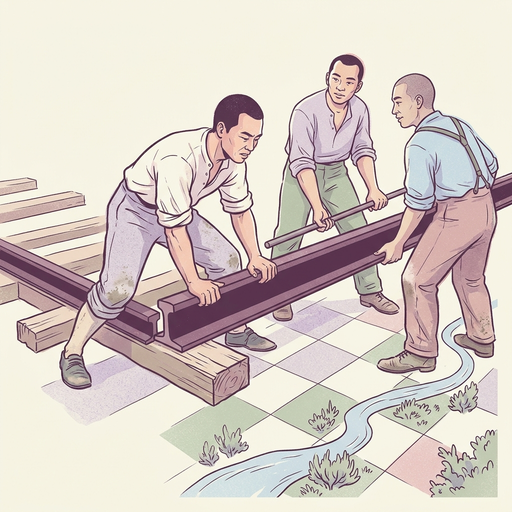
On January 8, 1863, the Central Pacific Railroad broke ground at Sacramento. Its president, Leland Stanford, was also the governor of California, giving the occasion an immediate intersection of state authority and corporate ambition. The ceremony marked the official beginning of construction on a railway intended to reach far beyond the city and the valley floor. Before that promise could become a dependable route, however, the company would have to carry locomotives, freight, and passengers over the formidable barrier of the Sierra Nevada. A ceremonial groundbreaking could establish a public commitment, but it could not lessen a gradient, cut through granite, or deliver heavy rails to an isolated mountain work site. The distance between those two achievements—announcing a railroad and operating one—defines the true scale of the undertaking.
The ground at Sacramento was not the edge of an empty continent. The city and its approaches occupied Indigenous homelands, including those of Nisenan communities, while the foothills ahead contained places of residence, travel, gathering, and exchange that long predated American surveying instruments. Farther into and across the mountains were other Native homelands, including those of the Washoe. Gold mining and settler expansion had already brought profound violence and displacement to California, and the railroad would enter that changing geography backed by the authority of corporations and governments. To designate a route as available for construction was not to establish that it was uninhabited, nor that its inhabitants had agreed to its transformation.
From Sacramento, the Central Pacific would build eastward; from Omaha, on the Missouri River, the Union Pacific would build westward. Between them lay mountain barriers, arid deserts, major river crossings, and the sweeping expanse of the Great Plains. Eventually, their rails would meet at Promontory Summit in Utah, physically connecting the two corporate lines. Yet that joining would not, in a single ceremonial instant, remove every remaining break between the Atlantic and Pacific coasts. Travel beyond their endpoints would still depend on other connecting lines, further construction, and complex transfers of passengers and freight. The achievement would be enormous without being quite the seamless coast-to-coast connection that later popular images often suggest.
At Sacramento, the immediate question was how to reach the other side of the mountains at all. Behind it stood a larger, more demanding inquiry: how could a line imagined across an entire continent become a working railroad, and who would bear the cost of making that connection? Payment meant far more than money. It included human labor and physical risk, public resources committed to private hands, and permanent changes imposed on the people whose country the tracks crossed. But before those costs could accumulate along a railway, an engineer had to demonstrate a route that locomotives could actually use.
California had become part of the United States in 1848 following the war with Mexico and entered the Union as a state in 1850. The gold rush gave the problem of distance a new and urgent character. People, goods, government business, and information moved between California and the eastern states by difficult overland journeys or lengthy maritime routes across the Isthmus of Panama. A Pacific railroad promised a transformed relationship with the rest of the country: faster movement, more predictable commerce, a stronger federal tether to the Pacific coast, and a direct gateway to Asian trade.
Agreement on the value of a railroad did not produce agreement on where to put it. Northern, central, and southern routes offered different advantages, served different cities, and promised to direct future commerce toward different regions, a competition tightly bound to sectional politics and the bitter national struggle over slavery’s expansion. During the 1850s, Congress supported surveys by Army engineers and other specialists to investigate possible crossings, examining passes, gradients, water supplies, and terrain. These investigations made the continent more legible to railroad planners, but a surveyed possibility was not yet an investment that private capital would readily undertake.
The Civil War fundamentally changed that political setting. Secession removed many prominent advocates of a southern route from Congress, while the federal government gained urgent strategic reasons to secure communication with California and maintain its place within the Union. War made resources scarce and expensive, yet it also reinforced the argument that the connection was a national undertaking rather than merely a commercial venture. Engineering evidence and wartime politics began to reinforce one another. A workable route could make legislation more credible, while federal support could make an otherwise daunting route worth attempting.
Theodore Judah supplied a crucial part of that engineering evidence. Born in 1826, he had worked on eastern railroads before coming to California in the 1850s, where he helped build the Sacramento Valley Railroad, the state’s first operating line. That project gave him practical regional experience and a starting point for a much larger ambition. A line across the valley floor was one thing; a railroad capable of climbing the Sierra, carrying useful payloads, and continuing eastward was another. Judah did not discover an unknown mountain landscape—Indigenous people already knew and traveled it, and emigrant roads crossed portions of it—but his contribution was to investigate how a heavy railway might be engineered to fit that demanding terrain.
Daniel Strong, a resident of Dutch Flat, helped direct Judah’s attention toward the Dutch Flat–Donner route. Strong’s local knowledge mattered because a mountain pass alone was insufficient; an engineer needed to know how to approach it, where a line could gain elevation gradually, and how ridges and valleys might permit a continuous ascent. Judah’s surveys turned that geographic possibility into measured evidence. The problem was not simply to reach a summit, as wagons could negotiate slopes that would stall a heavily loaded train. A locomotive’s wheels depended on adhesion to smooth iron rails, and a steep climb consumed pulling power that might otherwise move freight. An economical railroad required an alignment that locomotives could repeatedly climb with paying loads, balancing gradients, curves, and earthwork maintenance.
That technical distinction was decisive. A mountain barrier could discourage investors when described only by its height and severity, but an alignment supported by precise measurements allowed planners to calculate where cuts, embankments, and tunnels would be required. Surveying did not remove those physical obstacles, but it gave the undertaking a definitive shape, allowing the railroad to be defended as something more substantial than a line drawn across a map.
In Sacramento, Judah found businessmen prepared to organize around that proposition. They would become known as the Big Four, though their responsibilities within the enterprise were distinct. Leland Stanford brought commercial experience and political standing, serving as company president and governor concurrently. Collis Huntington managed purchasing, financing, and lobbying, securing equipment and credit far from the construction front. Mark Hopkins concentrated on financial administration, managing the accounts and obligations that kept a large enterprise functioning. Charles Crocker took a leading role in construction management, translating plans into organized work on the ground.
Incorporated under California law in 1861, the Central Pacific already existed before Congress passed the legislation most closely associated with its creation. The company joined Judah’s technical work to the merchants’ organizing capacity, but it did not yet possess everything needed to build across the Sierra. California was distant from eastern manufacturers, and expenses mounted long before a mountain line could earn revenue. Judah carried the project to Washington, where his maps and engineering reports gave legislators a concrete western route whose difficulties had been investigated. His lobbying connected the Sierra surveys to the broader national demand for a Pacific railroad.
On July 1, 1862, President Abraham Lincoln signed the Pacific Railroad Act, which federally chartered the Union Pacific and authorized its role in building westward from the Missouri River, while also authorizing the Central Pacific to build eastward from Sacramento. Railroad and telegraph were linked in the undertaking as tools of federal consolidation. By the Sacramento groundbreaking the following January, several essential elements had converged: Judah had demonstrated a practicable route, a California corporation had assumed responsibility, and federal legislation had placed the line within a national scheme. Yet the company still needed workers, supplies, credit, and endurance.
Within the company, another uncertainty concerned authority. Judah’s relationship with his associates deteriorated over financial control and construction arrangements. Remaining chief engineer, he lacked command of the treasury and business decisions. These disputes reflected conflicting views on corporate control, construction contracts, and capital management. Seeking new financial backing to alter control of the company, Judah traveled east in 1863, contracted yellow fever while crossing the Isthmus of Panama, and died in New York on November 2 at age thirty-seven. He did not live to see the railway cross the Sierra or meet the Union Pacific, and his death removed his voice while construction was still in its infancy.
His departure did not erase his work. The Central Pacific’s mountain alignment followed the route he surveyed, and his measurements remained foundational. Strong’s local guidance, Judah’s engineering, the Sacramento merchants’ organization, and congressional action had together made the beginning possible. With Judah gone, control rested firmly with his surviving associates as the landscape continued to impose the conditions his surveys had identified.
On December 2, 1863, the Union Pacific held its groundbreaking in Omaha, giving the eastern company its own starting problem to match the Sierra’s shadow. Two ceremonies now marked opposite ends of an enterprise that possessed legal standing and a surveyed direction but still lacked the means for sustained advance. From Sacramento the work would move east; from Omaha it would move west. Between them, the promised connection remained to be built, facing the immediate test of turning authorization into capital, capital into supplies, and supplies into working track.
The two groundbreakings did not set two equally active railroads racing toward each other across the interior. While the ceremonies of 1863 provided legal momentum, they could not conjure track out of barren riverbanks or mountain foothills. Throughout 1864, the Central Pacific pushed slowly into the Sierra foothills, while the Union Pacific struggled to turn its Omaha celebration into sustained construction, laying virtually no commercial track until the summer of 1865. The eventual contest between the advancing railheads grew out of this uneven start, when both companies confronted a problem less spectacular than crossing granite passes, yet every bit as decisive: paying for miles of difficult work long before a single revenue-producing train could run.
Every foot of progress devoured cash. A shipment of rolled iron rails demanded hard payment before it left an eastern mill. Laborers required regular wages while shoveling cuts and raising earth embankments. Timber trestles and stone culverts consumed hardware, lumber, and skilled masonry before a locomotive could test their strength. Even when the Central Pacific opened modest service to early stations such as Newcastle, local passenger and freight receipts could not begin to finance an assault on the high Sierra. The enterprise required immense purchasing power in the present, secured only by the uncertain promise of future transcontinental traffic.
For Collis Huntington, who managed the Central Pacific’s financial and purchasing operations from New York, that gap between present expenditure and future earning defined daily business. California lacked the heavy industrial capacity necessary to support a railway. The foundries of the Northeast and Mid-Atlantic produced the spikes, fishplates, locomotives, and rails; getting them to Sacramento required an ocean voyage of fifteen thousand miles around Cape Horn, or an expensive, bottlenecked transshipment across the Isthmus of Panama. A cargo could spend four to six months at sea, during which the capital committed to its purchase remained immobilized on the water while bills for grading crews mounted along the American River.
Federal legislation offered a way through this financial labyrinth, but the Pacific Railroad Act of 1862 was never an open treasury from which managers could draw at will. It established a complex architecture of public assistance, blending real property grants, federal bond loans, and operating privileges. Each form of support carried its own legal conditions, its own timeline, and its own commercial liabilities. Misunderstanding those statutory distinctions obscures how the companies actually functioned—and why their treasuries were constantly threatened with collapse.
The first grant was deceptively simple: a continuous right of way. The 1862 statute set aside a four-hundred-foot corridor through the public domain for tracks, sidings, and telegraph lines, alongside additional parcels for stations, machine shops, and water tanks. It also granted the right to take timber, stone, and earth from adjacent federal lands for construction. Yet a right-of-way corridor was merely permission to occupy a path; it could not be sold to pay wages, nor did it constitute ownership of the vast regions flanking the survey.
To generate long-term capital, Congress added a separate endowment of public land. The government granted the railroads alternating, square-mile sections across a belt flanking the track—initially five sections per mile on either side, creating a checkerboard pattern where company land sat beside parcels retained by the United States. Under this arrangement, the railroad was not handed an unbroken private empire. Planners envisioned that the railway’s arrival would raise the value of the surrounding country, allowing the companies to sell their holdings to arriving settlers while the federal government sold its retained sections at doubled prices. The railway and the agrarian settlement of the West were designed to finance and feed one another.
In the short term, however, a grid of raw land could not satisfy an overdue bill for iron. Real estate carried value only when surveyed, patented, and settled, processes that moved far slower than the pace of track laying. Furthermore, the grants were constrained by statutory exclusions. Land already claimed under preemption or homestead laws, reserved for military or civil purposes, or identified as mineral ground was withheld from the railroads, subject to specific legislative definitions. The gross acreage described in congressional debate was therefore vastly larger than the territory companies could immediately market.
Underlying the entire land system was a profound legal fiction: that these territories were empty tracts awaiting orderly American disposal. The checkerboard was superimposed across sovereign Indigenous homelands, whose residents had governed, hunted, and gathered upon them for generations. By translating valleys, waterways, and winter pastures into numbered sections on a Cartesian grid, the federal government asserted authority over peoples who had ceded neither their title nor their independence. The land grant was an ingenious instrument of corporate finance, but it was equally an instrument of state territorial expansion that ignored Native sovereignty long before the track layers arrived.
Because land sales were too slow to meet current payrolls, the 1862 Act provided a more immediate financial mechanism: government bond loans. For every qualifying mile constructed, the Treasury would issue thirty-year, six percent federal bonds. To reflect varying construction difficulties, the subsidy was graduated into three tiers. Across the flat valleys and prairie, the government offered sixteen thousand dollars per mile. In the intermediate high plains and Great Basin plateaus, the rate rose to thirty-two thousand dollars. In designated mountain segments—the Sierra Nevada for the Central Pacific and the Rocky Mountains for the Union Pacific—the loan climbed to forty-eight thousand dollars per mile.
These bond issues were loans, not outright gifts. The legislation required the railroads to repay the principal at maturity and service the interest, while granting the federal government a first mortgage on the lines as collateral. Moreover, receiving a government bond was not identical to receiving hard currency. When the companies sold these federal securities on Wall Street, the proceeds fluctuated with the wartime bond market and investor confidence. A forty-eight-thousand-dollar bond allocation might yield substantially less in spendable cash during the darkest months of the Civil War, even as the price of blasting powder and foundry iron soared.
Crucially, the federal government did not advance funds before the work was accomplished. The 1862 law required each railroad to complete a continuous forty-mile section, fully graded, bridged, tied, and ironed, alongside an operational telegraph line, before a presidential commission would inspect the work. Only upon their formal certification would the Secretary of the Treasury release the bonds and land patents for that segment. This created a relentless financing trap. A company had to secure enough interim capital to build forty complete miles of mountain or desert track before receiving the federal assistance intended to pay for them. If funds ran dry at mile thirty-nine, the entire investment remained locked away.
By early 1864, with construction stalling in the West and paralyzed in Omaha, both companies successfully petitioned Congress for relief. The Pacific Railroad Act of July 2, 1864, fundamentally altered the economics of the enterprise. It doubled the land grant to ten alternating sections per mile on each side of the track—twenty sections total—and widened the overall corridor within which the railroads could select indemnity lands for parcels already occupied. It also cut the qualifying threshold for land patents in half, allowing companies to receive patents after completing twenty consecutive miles instead of forty.
The most consequential provision of the 1864 legislation concerned corporate debt. Congress authorized the railroads to issue their own private first-mortgage bonds in amounts equal to the government bonds, while subordinating the federal claim to a second-mortgage position. This legislative retreat was a decisive victory for corporate lobbyists. Private capitalists, previously wary of lending to an enterprise where the government held the primary lien, could now purchase railroad bonds with the assurance that their claims stood ahead of the United States in the event of default. By accepting a subordinate financial position, the federal government absorbed the primary investment risk, transforming transcontinental railroad securities into attractive assets on eastern exchanges.
Private stock subscriptions rounded out the corporate balance sheets, though they were slow to materialize. Under the law, shares had to be offered to the public, but few individual investors wished to sink hard cash into an unfinished railroad crossing hostile or uninhabited country. Stanford, Huntington, Hopkins, and Crocker in California, along with eastern financiers, subscribed for stock partly to retain control and partly to meet statutory requirements. Yet share capital remained limited. The true financial engine of the transcontinental railroad was the ability to float company mortgage bonds against the security of certified track.
In New York, Huntington exploited these new terms with relentless focus. Moving between bank parlors, congressional corridors, and metal brokers, he pledged company bonds as collateral, negotiated credit lines, and drove hard bargains for rail deliveries. The Civil War was consuming vast amounts of northern industrial production, inflating prices for iron and coastal shipping. Even after contracts were signed, Huntington had to arrange marine insurance, coordinate rail transport from inland mills to eastern docks, and ensure that schooners and clippers were loaded with the precise assortments of locomotives, wheels, and track fasteners needed at Sacramento.
At the Union Pacific’s headquarters, the geographic challenge was entirely different, but the financial strain was just as intense. Omaha was not yet connected to the eastern railroad network; the lines pushing across Iowa would not reach Council Bluffs until 1867. Everything the Union Pacific needed had to be brought up the shallow, shifting waters of the Missouri River by steamboat or hauled over unpaved prairie roads by wagon train. Timber for ties was nearly non-existent on the open plains of the Platte Valley, forcing the company to buy cottonwood logs along river bottoms and treat them with chemical preservatives or haul hardwood ties from eastern forests at staggering expense.
The guiding figure behind the early Union Pacific was Thomas Durant, the company’s vice president and dominant executive. Durant was a veteran railroad promoter whose talent lay in speculative finance rather than engineering precision. Charismatic, aggressive, and adept at corporate maneuver, he recognized that an operating transcontinental railroad might take decades to generate dependable dividends, but building the line offered immediate fortunes if construction contracts could be controlled from within.
To stabilize the Union Pacific’s precarious treasury and draw in eastern capital, Durant recruited influential northeastern investors, chief among them Oakes Ames and his brother Oliver. Oakes Ames was a wealthy shovel manufacturer from Massachusetts and an influential member of the United States House of Representatives, sitting on its Committee on the Pacific Railroad. Oliver Ames possessed strong organizational acumen, stepping into the Union Pacific’s presidency to provide administrative credibility. Oakes Ames poured hundreds of thousands of dollars of his own family fortune into the project, using his commercial reputation and political standing to attract crucial New England capital to a venture many considered reckless.
Construction discipline finally arrived in the spring of 1866 with the appointment of Grenville Dodge as chief engineer. Dodge was a seasoned railroad builder and former Union major general who had mastered the logistics of military engineering and supply during the Civil War. His dual background proved invaluable. He understood how to organize surveys across uncharted country, command large bodies of men with quasi-military hierarchy, and coordinate the delivery of materials along a single advancing line of iron. Dodge also cultivated close ties with his former wartime commanders, including Ulysses S. Grant and William Tecumseh Sherman, ensuring that the United States Army would actively protect construction parties in territories contested by Plains tribes.
The vehicle that made this massive mobilization profitable for insiders was Crédit Mobilier of America. In 1864, Durant and his associates purchased the charter of the Pennsylvania Fiscal Agency, an existing corporation with broad financing powers, and renamed it after the famous French investment bank. Although legally distinct from the Union Pacific, Crédit Mobilier was controlled by an overlapping syndicate of the railroad’s major directors and financial backers, including Durant and the Ames brothers. It was not a bank, but a private construction company designed to act as the primary contractor for the line.
In theory, a railroad hired an independent contractor to absorb the logistical hazards and price fluctuations of construction. In practice, the Union Pacific directors awarded contracts to Crédit Mobilier at inflated, non-competitive rates per mile—effectively sitting on both sides of the negotiating table. The Union Pacific paid the contractor in cash, federal bonds, and its own first-mortgage bonds and capital stock. When construction costs proved lower than the contracted prices, the surplus flowed straight to Crédit Mobilier’s shareholders as exorbitant dividends. The railroad corporation was burdened with vast funded debts and mortgaged assets, while the inner ring of investors pocketed cash and secure securities.
To protect this lucrative arrangement and ensure favorable federal oversight, Oakes Ames later placed shares of Crédit Mobilier stock with key members of Congress, selling them below their market value or allowing buyers to pay for them out of accumulated dividends. These transactions, concentrated primarily in 1867 and 1868, were intended, as Ames bluntly noted, to place the stock where it would do the most good for the railroad’s legislative interests. The subsequent public revelation of this arrangement in the autumn of 1872 would trigger congressional investigations, national outrage, and formal censures in 1873. Yet during 1865 and 1866, the mechanism served its immediate, cynical purpose: it supplied the Union Pacific with the liquidity necessary to break out of Omaha.
By late 1865 and early 1866, the twin engines of federal subsidy and insider contracting had turned an abstract legal franchise into an operating industrial front. At Omaha, rail shipments landed regularly at the river docks, and track gangs began pushing across the Nebraska prairie, mastering the rhythmic choreography of ties, rails, and spikes. At Sacramento, ocean clippers disgorged mountain locomotives, kegs of black powder, and tons of English and American iron, which were immediately loaded onto flatcars bound for the Sierra foothills.
Yet as money, supplies, and organizational systems fell into place, the nature of the obstacle changed. The plains offered gentle grades and wide horizons, but the Central Pacific was running out of foothills. Beyond Dutch Flat rose the sheer, granite spine of the Sierra Nevada, where Theodore Judah’s surveyed alignment pointed toward cold elevations and vertical precipices. To carve a continuous line through that frozen rock, Huntington’s credit, Stanford’s politics, and Crocker’s management would have to depend on thousands of Chinese laborers who were turning a mountain frontier into a testing ground of skill, discipline, and endurance.
Money could bring rails to Sacramento. It could not make a passage through granite. By 1865, the Central Pacific needed people who could turn a surveyed mountain route into a roadbed, and California’s labor market was offering too few of them. Mining and agriculture competed for workers; railroad employment meant hard exertion, uncertain surroundings, and movement farther into the Sierra. Recruiting enough men was becoming as urgent as obtaining iron or credit.
The company began hiring Chinese workers already in California, many through connections developed in mining communities. Their employment initially met racist doubts about their strength and ability to perform heavy construction. Company accounts preserve those doubts, followed by admissions that Chinese crews could do the work. Such testimony records the changing calculations of employers, not the discovery of some previously absent capacity. The workers brought experience, learned new tasks, and organized themselves to meet demanding conditions.
Recruitment soon extended through Chinese merchants and labor intermediaries to southern China, especially Guangdong and the Pearl River delta. Existing migration networks connected villages, ports, and California communities. Economic hardship and upheaval encouraged departure; overseas earnings offered opportunities to support households at home. Crossing the Pacific required money and arrangements, sometimes involving debt. Railroad employment was therefore part of a larger migration, not the beginning of Chinese life in California.
By the summer of 1865, several thousand Chinese workers—roughly three to four thousand—were employed on Central Pacific construction. Estimates for 1866 rise toward ten or eleven thousand across tunneling, grading, and other work. These are approximate counts employed during particular periods, not a cumulative total of everyone hired. As recruitment expanded, Chinese workers became about nine-tenths of the Central Pacific’s construction workforce. They were the great majority on this western railroad, not on the Central Pacific and Union Pacific combined.
Their labor carried Judah’s alignment upward, through cuts, embankments, bridges, and tunnels. Meanwhile, during 1866, the Union Pacific was extending its rails westward across Nebraska. Both companies were advancing, but mileage measured very different achievements. On the plains, a prepared roadbed could receive rails in a rapid sequence. At Donner Pass, a short distance through rock could hold up everything behind it.
The clearest example was Tunnel No. 6, the Summit Tunnel. Roughly a third of a mile long, it was small beside the continental route, yet indispensable to the mountain crossing. A railroad could not climb like a wagon or follow any convenient footpath. Its gradients and curves had to remain within limits that locomotives could manage. The chosen line passed through a granite barrier, and until that barrier was opened, the rails could not continue along their intended course.
Attempts to begin the tunnel in 1865 ran into early snow. Sustained excavation followed in 1866. At the working face, progress began with steel and hammers. One worker held and turned a drill while another struck it, gradually cutting a hole into the granite. The drill had to be repositioned and maintained; the holes had to be placed so that an explosion would loosen useful rock rather than merely scar the face.
Crews charged the holes with blasting powder, withdrew, and fired the charges. Afterward came another kind of labor: waiting for smoke to clear, checking the newly exposed surface, and removing broken stone. Only then could drilling begin again. Blasting was a moment within a much longer cycle. The speed of excavation depended as much on clearing debris and preparing the next round as on the force of the explosion.
This was skilled, coordinated work. A poorly placed hole could waste effort or increase danger. Loose rock had to be recognized; tools, charges, and evacuation had to be managed under confined conditions. Engineers established the line and grade, foremen coordinated operations, and crews made those plans effective through repeated judgments at the face. Neither surveying alone nor physical effort alone could produce a usable tunnel.
Working only inward from the two portals would have left the company with two places to attack the rock. A vertical shaft sunk near the middle provided access to the tunnel level from above. From its bottom, crews could excavate outward in opposite directions. Together with the portal workings, these created four advancing faces: two from outside and two underground.
The shaft increased opportunities to excavate without removing the difficulties of excavation. Men, equipment, and broken rock had to move through a narrow vertical opening. Steam-powered hoisting helped lift material, but the machinery and its supplies also had to function in mountain conditions. Smoke and dust could collect below. More faces meant more activity to coordinate, not an automatic multiplication of progress.
Alignment was equally unforgiving. The crews could not see through the remaining granite to one another. Surveyors had to carry the intended position and elevation into separate workings, including down the shaft, and check them as excavation advanced. Each face was being shaped toward a meeting that remained invisible. Small errors, allowed to accumulate, could turn months of successful digging into a difficult correction.
Then winter made the approach to the work almost as formidable as the rock itself. During 1866–67, deep snow blocked roads and buried familiar features of the landscape. Delivering food, fuel, tools, and powder became an undertaking in its own right. Workers cleared routes and dug passages through snow to connect places that could no longer be reached easily over the surface.
Those passages should not be confused with the claim that every worker lived in an ice cave. Their importance was practical: they helped link shelter, supplies, and work sites beneath or through deep accumulations. Camps differed, and shelter did not eliminate vulnerability. A connection dug through snow could preserve access while the surrounding slopes remained dangerous.
Avalanches struck camps and work areas. Men were killed by moving snow, and construction also brought fatal accidents involving explosions and falling rock. Cold and exposure added further hazards. The same weather that endangered workers could obstruct rescue and the recovery of bodies. Keeping construction going meant sustaining an entire network of supply and shelter, not simply ordering another shift into the tunnel.
Later recollections by company engineers and managers describe extraordinary snow conditions and persistent work beneath them. Those accounts are valuable, but their perspective matters. They often emphasize the success of keeping the railroad moving. They cannot stand in for the workers’ own descriptions of danger, bereavement, or fear.
Nor can surviving records establish a comprehensive Chinese death toll for construction. Fatal incidents are documented, but the evidence is incomplete, and widely repeated totals remain disputed. Uncertainty about the total is not uncertainty about whether men died. Death belongs plainly in the history, without a confident number the record cannot sustain.
The crews were not only enduring conditions set by others. In late June 1867, several thousand Chinese workers stopped work along the mountain construction front. Their strike interrupted tunneling and grading at a moment when the company urgently needed progress. Across dispersed sites, workers made a shared withdrawal of labor effective.
Their demands included better pay and shorter hours. Accounts describe a request for monthly wages of about forty dollars, a ten-hour day on open construction work, and shorter shifts in the tunnels. They also sought limits on employers’ coercive treatment. These demands connected earnings to the time, danger, and authority involved in earning them.
The wage comparison requires more than two cash figures. By the strike, Chinese workers commonly received monthly cash pay in the mid-thirties of dollars and paid for their own food and lodging. White workers could receive comparable or higher cash wages with board supplied. Employer-provided meals and accommodation had value. Equal-looking wages could therefore conceal unequal compensation, because one worker still had to buy necessities that another received alongside his pay.
Chinese crews maintained arrangements for cooking, provisions, and group life, often through merchants and intermediaries. Such organization helped support construction and make collective action possible. The strike shows workers communicating demands and using the company’s dependence on their labor. They were not simply a workforce upon which decisions acted.
Management used that same dependence in reverse. Accounts of the stoppage, including Charles Crocker’s later recollection, describe the interruption of food supplies as a means of pressuring the strikers back to work. In mountain camps, access to provisions was a source of power. This was not merely a disagreement over a wage rate: the company could exert pressure through necessities while workers tried to exert it through withheld labor.
The strike ended after about a week without securing the full set of demands. That outcome should neither be disguised as a complete victory nor treated as proof that the action meant nothing. Several thousand workers had demonstrated their ability to organize across construction sites and bring essential operations to a halt. The episode also exposed how much stronger management’s position became when employment, isolation, and supplies overlapped.
Legal discrimination compounded the imbalance. Federal naturalization law reserved eligibility to white immigrants, excluding Chinese migrants from that route to citizenship. Residence, work, and contributions to the railroad did not give them an equal path to political membership. This barrier was already operating in the 1860s; the Chinese Exclusion Act belonged to a later era, in 1882, and should not be moved backward to explain these construction years.
Through the summer of 1867, drilling, blasting, clearing, and surveying continued. Meanwhile, the Union Pacific was crossing Nebraska and advancing into Wyoming. Its growing distance from Omaha sharpened the contrast with the Central Pacific’s mountain struggle. The western company was still spending immense effort to gain a passage measured in fractions of a mile.
In August 1867, the Summit Tunnel excavations broke through. Separate workings had become a connected opening. Yet breakthrough was not the same as a finished railway tunnel. Rock still had to be removed, the opening brought to its required dimensions, and the floor prepared for drainage and track. Finishing continued into the autumn.
Beyond the tunnel lay further work: neighboring tunnels, exposed grades, and the eastern descent. Snow protection was essential to making the route usable rather than merely passable in favorable weather. Timber snow sheds covered vulnerable stretches, helping carry snow over the railway instead of allowing it to bury the track. The mountain demanded protection as well as penetration.
During 1868, the separate accomplishments were assembled into a working crossing. Rails reached Truckee in the spring, while completion of the remaining connections and protective works continued. Materials and equipment had been carried around unfinished sections so that construction beyond them need not wait. Track at Truckee therefore did not, by itself, prove that uninterrupted rail access from Sacramento was already complete.
Nevertheless, Truckee marked a decisive release. The Summit Tunnel had opened the granite barrier, and Chinese crews had made the surrounding mountain route possible through skilled excavation, organized labor, and work under lethal conditions. The Central Pacific could now extend its construction front across Nevada, where different terrain would permit a different pace. Beyond Truckee, distance could begin accumulating faster than it had beneath Donner Summit.
But while this company had fought for inches through rock, the other had covered hundreds of miles. How had the Union Pacific moved so far, and what people, supplies, and uses of power had made that speed possible?
The question of how the Union Pacific covered hundreds of miles while its western counterpart fought for inches through granite leads directly back to 1866–68. This was the other side of the continental race, advancing simultaneously from Omaha. Its growing mileage did not mean that the plains had built themselves; rather, it reflected an industrial choreography where surveying, earthwork, bridge construction, and supply were systematically organized far ahead of the men placing the rails.
From Omaha, the original route crossed eastern Nebraska and entered the Platte corridor, following the broad valley westward past the vicinity of Fort Kearny, through Plum Creek, and toward North Platte. The river offered a comparatively gentle path across the Great Plains, already familiar to Indigenous communities, emigrants, traders, and soldiers. Yet following a valley was not the same as laying track beside every bend. Engineers needed an alignment that balanced distance, gradients, river crossings, and the behavior of the ground.
Grenville Dodge became the Union Pacific’s chief engineer in 1866, bringing pre-war experience on western surveys and wartime command of military transport and railroad reconstruction. Those qualifications suited a project whose engineering front extended far beyond its operating track. Dodge’s responsibility was not merely to point west, but to turn a continental intention into a succession of locations where a railway could actually be built and supplied.
Survey parties measured elevations, established curves, and marked the proposed line, governing work that would follow weeks or months later. A seemingly convenient stretch of low ground might become troublesome after rain, an embankment could obstruct natural drainage without culverts, and a modest-looking stream could swell into a hazard requiring a substantial opening for seasonal floods. Bridge sites demanded workable approaches as well as foundations capable of carrying heavy, moving trains.
The plains removed some obstacles while introducing others. There was less granite to tunnel through than in the Sierra, but soft ground, shifting river channels, and long timberless stretches demanded constant judgment. Locomotives required usable water rather than mere moisture in the landscape, meaning watering facilities, fuel supplies, sidings, and bridges had to accompany the track. A completed mile was part of an operating system, not just two rails laid across grass.
Behind the surveyors came grading crews, cutting through rises and building up hollows with shovels, picks, carts, and animal-drawn equipment. Bridge crews worked at separate sites, where the approach of the track gang depended on foundations and timbers already being in place. Because materials could be hauled forward by wagon before trains reached them, the construction front possessed significant depth, with several kinds of work proceeding at varying distances from the last usable rail.
Construction contractors Jack and Dan Casement helped make that dispersed effort function as a moving industrial operation. Jack, a former Union commander, brought military organization to the management of large crews, coordinating track laying alongside the supplies and accommodations necessary to sustain it. Their true significance lay in keeping repeated tasks from falling out of sequence.
Supply trains carried rails, ties, tools, food, and equipment along the completed portion of the line. At the advancing end, materials had to be unloaded and distributed in the precise order workers needed them. Timber scarcity along much of the plains route made ties and bridge lumber a continuing procurement challenge, while iron arrived from distant manufacturers, and Omaha itself lacked a permanent railroad bridge across the Missouri River, leaving the waterway as a transfer point.
At the railhead, coordination became visible. Ties were distributed and positioned, rails moved forward and set upon them, and workers joined the components, checked the gauge, and drove spikes. Other hands adjusted and secured the newly laid track so that construction trains could advance. Each operation depended on the one before it; a single missing shipment of fastenings or an unfinished bridge could halt men whose tools and strength were otherwise ready.
This dynamic explains the apparently astonishing pace of construction. The track gang was completing work prepared by crews an observer at the railhead might never see, drawing upon weeks of prior surveying, grading, hauling, and bridge building. It also created new obligations, as fresh track required constant attention, embankments settled, and drainage failures threatened what had just been built. Speed was a genuine achievement, but it did not mean every newly completed stretch was immune to repair.
The workforce itself was far from uniform. Irish immigrants formed a substantial part of the construction crews alongside other foreign-born and American-born workers, including many Civil War veterans. Some brought prior railroad experience, while others learned specific operations on the job, mastering tool handling, safety in hazardous conditions, and the rhythm of coordinated heavy lifting.
While military service provided useful experience with transport, provisioning, and organized movement, it did not define an individual's personal motivations or burdens. The public record supports a workforce containing veterans without supplying a single psychological portrait of them.
The labor was intensely strenuous and dangerous. Rails and timbers crushed limbs, moving equipment threatened nearby workers, and excavations, bridge work, and machinery brought constant risks. Summer heat, winter cold, wind, and dust compounded the strain of long working days, while accidents inflicted injuries far from established medical services.
Wages mattered, but cash rates alone could not capture the economic bargain. Earnings varied by task and arrangement, and the cost of board and provisions directly affected what a worker retained. Men needed regular meals, lodging, clothing, and supplies, while foremen imposed strict schedules and contractors faced the recurring challenge of high turnover as workers departed, fell injured, or sought better conditions elsewhere.
Some laborers slept in camps or railroad boarding cars, while others utilized accommodations in the mobile settlements that gathered near the advancing line. Known popularly as Hell on Wheels, these communities were practical answers to the demands of thousands of wage earners living far from settled towns, generating a thriving local economy for food, lodging, laundry, and repairs.
Merchants, saloon keepers, gamblers, and sex workers followed that demand. Women worked in lodging houses, kitchens, laundries, and commercial sex under varying conditions of security. While contemporary reports emphasized disorder, violence, and the consumption of earnings, these settlements could not be reduced to simple caricatures of universal vice.
These moving towns also occupied lands with deep Indigenous histories. In Nebraska, the Pawnee maintained longstanding ties to the Platte and Loup country, combining village agriculture with bison hunting. Disease, treaty cessions, settler pressure, and conflict with other Native nations had already eroded their security when the railroad arrived.
In 1867, Pawnee scouts under Frank North served with the United States Army in protecting the construction corridor, drawing upon their knowledge of the terrain and military skills. Pawnee participation also served strategic interests of their own, as conflict with Lakota and Cheyenne groups made an alliance with the army potentially useful for community defense. Such service was a choice made within difficult circumstances rather than an endorsement of every consequence of federal expansion.
Nor did Indigenous experiences fall into a simple binary. Cheyenne and Lakota resistance reflected diverse histories, alliances, and immediate threats, with bands and leaders acting independently amid ongoing warfare over land, travel routes, and military occupation. The 1864 massacre of Cheyenne and Arapaho people at Sand Creek and subsequent plains conflicts formed the recent backdrop against which the railroad advanced.
Army posts and patrols, including Fort Kearny, Fort McPherson, and Fort Sedgwick, helped secure surveyors, workers, trains, and supplies. From the company's perspective, this protection sustained construction; from Indigenous perspectives, soldiers guarding the railway secured a corridor for further settlement and military dominance. The army was defending an enterprise that would ultimately expand its own operational reach across the West.
The August 1867 attack at Plum Creek exposed the vulnerability of the line. A Cheyenne party disrupted the track and wrecked a Union Pacific train in a fatal encounter that underscored how a small interruption could paralyze equipment and supply flows. Track was simultaneously the company’s greatest achievement and its narrowest point of dependence.
Protection thus became a core logistical requirement. Patrols, guards, repairs, and communication determined whether the moving system could function, placing worker danger within an active conflict rather than treating attacks as isolated events. Building and military power were inextricably linked.
Bison also formed part of the route's everyday economy, supplying meat to construction crews and others along the line. Provisioning thousands required dependable food sources, but hunting for daily sustenance was only a prelude to the larger transformation the railway would introduce by carrying commercial hunters into the plains and transporting animal products to distant markets.
William F. Cody’s later fame often blurs this geography; his celebrated bison-hunting employment was with the Kansas Pacific rather than the Union Pacific main line advancing from Omaha, and his large kill tallies stem from later accounts rather than verified censuses. His story illustrates general railroad provisioning but cannot be transposed wholesale onto this specific corridor.
The later peak of commercial hide hunting lay largely ahead, following the meeting at Promontory. It emerged from commercial incentives, transportation networks, individual hunters, military practices, and policies hostile to Native independence rather than a centrally administered state program. During these construction years, the vital development was an expanding logistical capacity that linked distant markets directly to the bison range.
By late 1866, Union Pacific rails reached North Platte, and during 1867, construction pressed toward southwestern Nebraska, passing briefly through northeastern Colorado near Julesburg before turning toward the Lodgepole Creek corridor, Sidney, and Cheyenne. This route bypassed Kansas and Denver entirely, directing its mountain crossing much farther north into Wyoming.
Cheyenne received the rails late in 1867, beyond which the gentle plains gave way to the climb into the Laramie Mountains. Surveyors had to fit the railway to rugged upland terrain while managing grades and curves, crossing the high ground at Sherman and continuing toward the Laramie basin in Wyoming rather than Colorado's high ranges.
Dale Creek illustrated the gap between a surveyed line and a usable railway. In 1868, builders erected a high timber trestle across its deep ravine, where wind complicated both construction and operation. The first trains could not cross merely because track gangs had reached the edge; conspicuous forward movement continued to rely on intricate preparatory engineering.
By the spring of 1868, the line extended into the Laramie basin, preparing to cross southern Wyoming. Distance altered the supply problem without changing its essence, as workers still required food and wages, locomotives needed fuel and water, and roadbeds demanded maintenance amid ongoing military and Indigenous realities.
As 1868 progressed, the Union Pacific pressed westward toward Utah while the Central Pacific advanced across Nevada. The remaining gap narrowed rapidly, driven by a moving concentration of labor, commerce, engineering, and federal power that was reshaping the continent and irrevocably altering the lives and claims of the people whose homelands it traversed.
Emerging from the Sierra Nevada, the Central Pacific entered a landscape that transformed the terms of the competition. The Union Pacific had already constructed hundreds of miles across the plains, but its western counterpart was no longer pinned to granite ledges and frozen summit tunnels. Across Nevada, distance could finally be won in strides rather than inches. During 1868, both advancing fronts accelerated, turning the remaining unbuilt space into a moving corridor where every supply train brought the two companies closer to an unavoidable convergence.
Yet leaving the mountains did not relieve the Central Pacific of severe logistical hazards. East of Truckee, the road descended into the Great Basin, an arid expanse where interior rivers drained into enclosed sinks and desert lakes rather than reaching the sea. The route picked up the Humboldt River, following its winding valley eastward and upstream through successive north-south mountain ranges. While the river provided a natural passage through broken country, it ran through terrain where timber was nearly non-existent and usable water was exceptionally scarce. Locomotives could not operate on alkaline water, forcing builders to drill deep artesian wells, establish distant supply lines for cordwood and coal, and haul water tank cars along the advancing track. The primary engineering obstacle had shifted from hard rock to environmental austerity.
This dry interior was not vacant territory awaiting discovery. The Sierra descent had skirted Washoe country, while western Nevada had long sustained Northern Paiute communities along river systems, marshes, and desert basins. Farther east along the Humboldt, the railway penetrated Newe homelands—the Western Shoshone country. For generations, these nations had maintained interconnected ways of life built around seasonal cycles of pinyon nut harvesting, seed gathering, fishing, and hunting across valleys and ranges. The surveyors’ straight lines and rights-of-way cut across places where life depended on communal movement between seasonal food sources. When construction crews chopped sparse juniper stands for fuel and railroad ties, diverted limited springs, and pastured thousands of draft animals on fragile desert grasses, they struck directly at the resources that sustained Indigenous families.
Federal officials had anticipated this infrastructure corridor years earlier. In October 1863, government representatives and Western Shoshone leaders concluded the Treaty of Ruby Valley, an agreement framed specifically around transit and development. The treaty permitted the construction of telegraph lines, overland mail routes, and railways through Shoshone country. It opened the territory to mineral exploration, agricultural settlements, and military posts, while providing for annual compensation to mitigate the disruption of game and land. But this accord did not contain a comprehensive cession of title. Permitting trains and telegraph poles to cross a territory was fundamentally different from surrendering the homeland itself. As railroad surveys paved the way for checkerboard land grants and commercial development, federal administrators and corporate managers acted as though the ground had been wholly absorbed into the public domain, initiating a legal and territorial ambiguity that would persist for generations.
The physical exertion of laying that corridor fell once more to the Central Pacific’s Chinese workforce. The veteran crews who had conquered the Summit Tunnel now endured searing desert summers and bitter basin winds, trading picks and drills for scrapers, shovels, and ballast carts. Their status, however, remained tightly constrained. While railroad executives praised their efficiency, Chinese workers still received lower compensation than their white counterparts and continued to purchase their own food and camp provisions through labor contractors. Their achievement across Nevada was not a passive endurance of hardship; it was an exercise of disciplined, collective organization. Moving with remarkable coordination, grading gangs smoothed roadbeds miles ahead, bridge builders crossed the Humboldt’s meandering channels, and tracklayers pushed the rails through the sagebrush at a pace that began to rival the Union Pacific’s most rapid days on the plains.
Milestones fell in rapid succession. Central Pacific rails reached the settlement of Winnemucca by the autumn of 1868. By the start of 1869, construction trains were steaming through northeastern Nevada to Elko, pushing eastward toward Wells and the desert passes leading to Utah. Every mile completed shifted the logistics forward: finished track carried fresh iron, ties, and provisions directly to the railhead, eliminating long wagon hauls across the desert. But each advance also created an ongoing maintenance burden. Soft roadbeds had to be reinforced against seasonal desert runoffs, sidings installed to let supply trains pass, and water stations maintained in an unforgiving climate.
Simultaneously, the Union Pacific was fighting its own battle across southern Wyoming. Having crossed the Laramie Mountains in early 1868, the eastern company pushed through the high, windswept plateau toward Rawlins, the Green River crossing, and the western borderlands. This was not a traverse of the Rockies' highest peaks, but rather a crossing of elevated basins where winter blizzards, sub-zero cold, and desolate terrain severely punished men and animals. The region held vast deposits of coal, which promised an abundant supply of locomotive fuel, but extracting and transporting that coal required infrastructure that was still being built. Sickness, freezing temperatures, and water shortages harassed the crews through late 1868, while the railhead pushed relentlessly toward the Wasatch Range.
By late autumn, the Union Pacific confronted the western descent into Utah. To reach the Great Salt Lake Valley, engineers had to guide the railway down Echo and Weber canyons, narrow defiles carved between towering red sandstone cliffs. The open grading of the plains vanished. In its place came steep descents, sharp curves, deep rock cuts, and timber bridges suspended over rushing mountain streams. Working in the depths of winter, crews blasted through frozen shale and laid track over icy, shifting embankments. Speed mattered more than permanence, for behind the eastern builders lay the Central Pacific, now rushing across the Nevada line with Utah firmly in its sights.
While the Union Pacific advanced across Wyoming, the military and diplomatic landscape to the north was shifting under the weight of Indigenous armed defense. The 1851 Fort Laramie Treaty had defined tribal territories and granted the federal government limited rights to build roads and posts across the northern plains, while promising peace and security in return. Yet when the United States established military posts along the Bozeman Trail to protect gold seekers traveling through Lakota, Northern Cheyenne, and Arapaho lands toward Montana, war erupted. Led by figures like the Oglala Lakota leader Red Cloud, Native fighters repeatedly challenged military patrols and supply trains, effectively shutting down the route.
The resulting 1868 Treaty of Fort Laramie marked a rare instance of the United States yielding military posts under tribal pressure. The agreement established the Great Sioux Reservation in what is now western South Dakota, encompassing the Black Hills, and set aside expansive unceded territory farther west where Native people retained rights to hunt so long as bison populations endured. The reservation lay well north of the Union Pacific's corridor across southern Wyoming, never bisected by its rails. Yet the railway cast a long shadow over the proceedings. The treaty specifically required the signatory nations to withdraw opposition to the construction of railroads being built across the plains. Red Cloud himself demonstrated the strategic leverage of his coalition by refusing to sign the treaty until late autumn of 1868, after federal soldiers had burned and abandoned the contested Bozeman Trail garrisons. The peace brought borders and paper promises of supplies, but it also sought to neutralize resistance along the rail corridors that were remaking the continent.
The transformative power of the railroad reached far beyond the nations whose homelands lay beside its tracks. Far to the south, Kiowa and Comanche communities lived in regions where other transportation routes were advancing. Their struggles were shaped by different rivers, forts, and treaties. Yet the transcontinental railroad set a precedent that altered the entire West. It gave the United States Army the capacity to transport troops, cavalry, and artillery across immense distances in days rather than months, fundamentally tipping the balance of military force against independent Native nations everywhere. Even communities that had never seen a locomotive soon felt the pressure of a nation unified by steam.
Entering Utah Territory in early 1869, the competing railheads intersected with another distinct society. Since 1847, members of the Church of Jesus Christ of Latter-day Saints had built an agricultural commonwealth in the Great Salt Lake Basin under the leadership of Brigham Young. Recognizing that the railroad was inevitable and eager to keep church members employed while protecting local communities from outside disruption, Young negotiated grading contracts with both companies. In 1868, local contractors mobilized thousands of Latter-day Saint farmers and laborers, using their own teams of oxen, scrapers, and tools to prepare roadbeds through Echo and Weber canyons for the Union Pacific, while other crews graded lines west of Ogden for the Central Pacific.
This local labor proved critical to the final sprint, yet the arrangement created profound tensions. To Young's disappointment, engineers chose a northern route that bypassed Salt Lake City, running the main line through Ogden to skirt the northern edge of the Great Salt Lake. Furthermore, corporate financial distress meant that the companies, especially the cash-starved Union Pacific, frequently failed to pay the contractors on time. Mormon workers finished grueling earthworks in frozen canyons, only to find the railroad delaying wage payments and leaving subcontractors buried in debt. The settlers had built the grades that made the meeting possible, but the strategic and economic authority remained entirely in the hands of distant directors in Boston, New York, and Sacramento.
The approaches north of Great Salt Lake also traversed the ancestral home of the Northwestern Shoshone, whose territory spanned northern Utah and southeastern Idaho. This country bore the recent memory of catastrophic violence. Just six years earlier, in January 1863, federal troops under Patrick Edward Connor had attacked a Shoshone encampment along the Bear River, killing hundreds of men, women, and children in what became known as the Bear River massacre. Although the railroad tracks did not cross the precise site of the slaughter, they advanced through valleys already cowed by military dominance and rapidly occupied by settler agriculture. The steel rails did not initiate conquest in northern Utah; they solidified a process already carved by violence and displacement.
By March 1869, the two advancing fronts were close enough that their grading crews worked within earshot of each other. Instead of stopping when their paths met, both companies continued grading past one another, carving parallel roadbeds that stretched side by side for miles through the sagebrush of northern Utah. Under the provisions of the Pacific Railroad Acts, each completed mile brought thousands of dollars in government loan bonds—rising to thirty-two thousand and forty-eight thousand dollars per mile in mountainous and difficult terrain—as well as generous land grants. Because neither company wanted to forfeit potential mileage subsidies, grader gangs threw up duplicate embankments, blasted adjacent cuts, and occasionally hurled stones and debris at their rivals. Capital and human labor were squandered building roadbeds that would never carry a single locomotive.
The absurdity of parallel lines forced federal intervention. The government was underwriting the enterprise and could not permit public resources to be burned in a corporate duel. In early April 1869, officials in Washington stepped in alongside company representatives to forge a settlement. Congress established that the official common terminus of the two roads would be at or near Ogden. Although the Union Pacific was advancing toward Ogden and the Central Pacific was still miles away to the west, the companies agreed that the actual physical juncture would take place at Promontory Summit, a high saddle in the Promontory Mountains north of Great Salt Lake. The Central Pacific would then buy out the Union Pacific’s track between Promontory and Ogden, giving the western company its sought-after connection while establishing an orderly dividing line for operations. The meeting point was not an inevitable geographic destination; it was a negotiated compromise brokered by federal power.
Before the tracks could touch, corporate pride demanded a final spectacle. With less than twenty miles separating the railheads, Central Pacific officials determined to set a record that their eastern rivals could not surpass. On April 28, 1869, construction superintendent James Strobridge orchestrated an extraordinary demonstration of industrial logistics, laying more than ten miles of track between dawn and dusk on the western approach to Promontory. Popular accounts frequently celebrated eight Irish rail handlers who hoisted and positioned every iron rail, but the accomplishment was fundamentally an achievement of collective organization. Behind those handlers worked hundreds of Chinese laborers who unloaded iron, distributed and tamped thousands of wooden ties, aligned the track, and drove tens of thousands of spikes, while horse teams pulled supply carts continuously forward along the newly spiked iron. The feat was astonishing, but it relied entirely on weeks of preparatory grading, stockpiling, and operational timing.
This display demonstrated what coordinated labor and concentrated supplies could achieve under intense pressure, but it was not an ordinary pace that could be sustained indefinitely. Nor did a single record day capture the immense, mundane labor required to turn raw iron into a safe and durable railway. Behind both construction fronts, workers continued ballasting unstable roadbeds, reinforcing timber bridges, and repairing track that had settled unevenly under the weight of advancing locomotives. Ahead lay only the final yards of earth that would turn two expanding construction systems into an unbroken continental artery.
By the first week of May 1869, the remaining gap had narrowed to mere feet. The parallel grading had ceased, the congressional compromise was signed, and the final rails lay waiting on the dusty plateau of Promontory Summit. Six years of relentless labor, corporate intrigue, and federal investment had compressed a continent into a single focal point. Yet as workers prepared the ties for the ceremonial spikes, the completion of the line stood as a profound paradox. The transcontinental railway would bind distant coasts, open global commerce, and revolutionize national transport, but it had been built upon contested treaties, exploited labor, and the displacement of sovereign peoples. The rails were about to meet, but the deep divisions and unresolved costs of their creation remained embedded in every foot of iron.
On the windswept plateau of Promontory Summit in Utah Territory, on May 10, 1869, the long race between the two railheads came to its coordinated close. It was Promontory Summit—a high, sagebrush-covered saddle in the Promontory Mountains north of the Great Salt Lake—and not Promontory Point, the rugged peninsula projecting thirty miles into the waters to the south, that served as the junction. Shortly before noon, two locomotives edged forward across the newly laid rails until their cowcatchers stood nearly pilot to pilot before a crowd of several hundred onlookers: mechanics, teamsters, soldiers from nearby Camp Douglas, politicians, and camp followers. Facing west stood the Union Pacific’s Locomotive No. 119, a coal-burning engine built in New Jersey; facing east stood the Central Pacific’s Jupiter, a wood-burning engine whose sweeping bonnet smokestack gleamed in the high desert sunlight.
Before rhetoric could claim the occasion, the final gap in the grade had to be closed by the manual laborers who had built it. A hand-picked squad of Chinese tracklayers stepped forward for the Central Pacific to carry the final western rail into place, aligning it along the roadbed and tamping the gravel ballast beneath the ties, while an opposing crew of Irish laborers brought forward the last rail from the east. The formal ceremonies that followed laid an elaborate veneer of public spectacle over this unvarnished manual work. Dignitaries displayed four ceremonial spikes wrought from precious metals: a spike of Nevada silver, an alloy of gold and silver from Arizona, and two gold spikes from California, the most celebrated of which had been cast from private gold coins and jewelry and inscribed with hopes for national unity. A ceremonial tie carved from polished California laurel wood was slipped beneath the joint to receive the ceremonial metal.
Yet national memory quickly smoothed the actual episode into an effortless ritual. In reality, the precious spikes were never hammered into the working track. They were tapped delicately into pre-drilled holes in the laurel timber, immediately withdrawn, and boxed for preservation. As soon as the presentations ended, laborers removed the fragile laurel wood, slid an ordinary tie of untreated mountain pine beneath the rails, and secured the iron with standard steel spikes. Even the much-heralded telegraph demonstration—intended to broadcast the blows of the hammer across the continent in real time—stumbled in practice. Wires had been connected to a ceremonial silver-plated mallet and an iron spike, but when Leland Stanford swung at the rail, he missed the mark, striking only the wood, and Union Pacific vice president Thomas Durant likewise failed to land a clean blow. A quick-witted telegrapher in the trackside tent bypassed the erratic apparatus and manually keyed three letters across the national wire: D-O-N-E. Across the country, the message ignited jubilation. Fire bells clanged across San Francisco, artillery fired celebratory salvos in New York and Chicago, and civic leaders praised the achievement as the binding of an unbroken republic.
To capture the gathering for history, Andrew J. Russell set his wet-plate camera on the roof of a passenger car, composing his celebrated photograph, "East and West Shaking Hands." The image shows the two chief engineers, Grenville Dodge of the Union Pacific and Samuel Montague of the Central Pacific, standing center frame to clasp hands while men behind them clambered over the cowcatchers and toasted the junction with champagne. Yet the picture contained a conspicuous omission. The Chinese workers who had conquered the granite heights of the Sierra Nevada and laid that morning’s final rail were excluded from the central frame of Russell’s most widely circulated image. Their absence was not the result of a total ban from the grounds—railroad accounts and secondary photographs document Chinese crews working on the track that day and dining with company superintendents in private coaches—but Russell’s framed tableau fixed an exclusively white narrative of industrial achievement in the popular consciousness, establishing an enduring pattern of selective historical memory.
The ceremony was also haunted by the absence of Theodore Judah, the surveyor whose stubborn genius had made the Central Pacific possible. Six years earlier, having drafted the mountain profile that the track had just traced, Judah had contracted yellow fever while crossing the Isthmus of Panama on his way to New York to seek financial backers who might buy out the Sacramento merchants. He died at thirty-seven, never seeing the tracks reach the crest of Donner Pass or the high desert of Utah. The line running through Promontory Summit had proven that Judah’s calculations were sound and that mountain ranges could be conquered by steam. But the junction marked an end to engineering uncertainty, not the settling of the corporate and ethical struggles that Judah’s partners had set in motion.
Nor did May 10, 1869, create an instantly seamless coast-to-coast railway. What met at Promontory Summit was the main line connecting Omaha, Nebraska, with Sacramento, California, leaving critical gaps on both margins. In the east, passengers arriving at Omaha faced an unbridged Missouri River; travelers had to cross by ferry boat in the summer or over precarious temporary tracks laid across winter ice to reach the railheads in Council Bluffs, Iowa. The Union Pacific’s permanent bridge across the Missouri would not open until 1872. At the western terminus, passengers reaching Sacramento had to transfer to paddlewheel steamers on the Sacramento River or stagecoaches to reach San Francisco Bay. Direct rail service did not reach Alameda until September 1869, and the deep-water terminus at the Oakland Long Wharf did not open until November. The initial reality of transcontinental transit was an intricate network of transfers, ferries, and ongoing construction, even as it decisively collapsed travel time. Journeys that had previously consumed four to six agonizing months by ox-drawn wagon, or a month of miserable sailing around Cape Horn or across Panama, could now be completed from New York to San Francisco in roughly seven days.
This dramatic compression of distance created a radically stratified social and commercial environment. Wealthy travelers purchased passage in luxurious Pullman Palace cars, which featured velvet upholstery, private sleeping berths, mahogany trim, and elaborately catered dining saloons. Poorer travelers and immigrant families paid lower fares to sit on hard wooden benches in drafty emigrant cars, shunted onto desert sidings for hours at a time to let lucrative express trains and fast freight barrel past. The railroad fundamentally rewired the continental economy: boxcars moved California wheat and Nevada silver east to metropolitan markets, while finished manufactured goods and industrial machinery traveled west, turning frontier outposts into boomtowns and granting the railroad companies immense monopolistic leverage over trade, shipping rates, and municipal development.
The immense profits generated by this corporate expansion soon triggered an explosive public reckoning. The ingenious corporate architecture conceived during the Civil War—under which public loans and land grants were channeled directly into private pockets—began to unravel in the autumn of 1872. The New York Sun published a series of damaging exposés detailing the inner workings of Crédit Mobilier of America, relying on letters and records unearthed in a bitter lawsuit between investor Henry S. McComb and the firm’s managers. Congressional inquiries quickly revealed that Union Pacific directors had created Crédit Mobilier as a captive construction subsidiary, awarding it contracts at massively inflated rates and pocketing the resulting corporate profits in the form of huge stock dividends and government bonds.
To insulate this arrangement from legislative scrutiny and ensure the continued flow of federal aid, Representative Oakes Ames of Massachusetts, himself one of the Union Pacific's primary backers, had distributed shares of Crédit Mobilier stock to influential members of Congress. Ames sold the shares at par value, well below their inflated market price, allowing politicians to pay for the stock using the very dividends the company generated. The resulting scandal tarnished prominent figures, including outgoing Vice President Schuyler Colfax and future president James A. Garfield, though individual involvement ranged from corrupt complicity to naive acceptance. In February 1873, the House of Representatives formally censured Ames and New York Representative James Brooks for corrupting public trust. While investigators avoided affixing a single, clean figure to the total sum diverted from public coffers, the Crédit Mobilier hearings shattered the romantic veneer of corporate benevolence, exposing the dark collusion between state power, speculative finance, and legislative bribery that had bankrolled the road.
For the Indigenous nations of the West, the consequences of the completed line were far more immediate, devastating, and permanent. The railway gave the United States Army unmatched strategic mobility, allowing military commanders to transport infantry, cavalry, and heavy field artillery across hundreds of miles in days rather than weeks. This logistical leap stripped Native nations of the seasonal sanctuary and defensive depth they had long maintained across the Great Plains and the Great Basin. Furthermore, the steel corridor became the primary commercial pipeline for the destruction of the North American bison. While the railroad was not the sole factor in the species’ catastrophic collapse, and the decimation was not carried out as a single, centrally directed government plot, the line provided cheap, high-volume freight shipping that linked hide hunters directly to voracious leather markets in the East and Europe. In the years immediately following the meeting at Promontory, commercial hunters slaughtered millions of bison, stripping the Lakota, Cheyenne, Arapaho, Kiowa, and Comanche of their sovereign food supply and ecological independence.
The transcontinental line also laid the groundwork for subsequent violations of federal treaties. Although the Great Sioux Reservation established by the 1868 Fort Laramie Treaty lay to the north of the Union Pacific corridor, the military garrisons and rail lines established in southern Wyoming and Nebraska provided the logistical platform for the United States Army’s expansion. In 1874, Lieutenant Colonel George Armstrong Custer led a military expedition into the Black Hills, confirmed the presence of gold, and touched off a miner invasion that overran treaty lands. When the Lakota and their allies refused to surrender the sacred territory, the federal government unilaterally seized the Black Hills in 1877. The iron road across the plains did not stand in isolation; it served as the technological backbone for an aggressive wave of national expansion that dismantled tribal borders.
For the Chinese laborers who had carved the Central Pacific’s grade through solid rock, the completion of the line brought neither social security nor lasting gratitude. As track construction concluded, thousands of Chinese workers dispersed across the American West. They cleared irrigation ditches in California’s Central Valley, built regional feeder railways across the Pacific Northwest, worked in silver and copper mines, and formed durable enclaves in San Francisco and other urban centers. Yet when the economic panic of 1873 plunged the country into a severe depression, white labor organizations, politicians, and newspapers scapegoated Chinese immigrants, portraying them as an existential threat to white wages and social order. This rising tide of anti-Asian violence and legislative harassment culminated in the passage of the Chinese Exclusion Act of 1882. The act suspended the immigration of Chinese laborers and explicitly barred them from naturalized citizenship, establishing the first major federal immigration law based explicitly on race and nationality, with only narrow exemptions for merchants, teachers, students, and diplomats. The very men who had blasted the tunnels that tied the continent together were systematically cast out from the rights of the republic.
Beyond politics and migration, the transcontinental railway permanently altered how human beings measured the passage of time. Before the completion of the line, communities across North America regulated their clocks according to local solar noon, creating an erratic patchwork of hundreds of conflicting local times across the continent. A passenger boarding trains across multiple states had to adjust a pocket watch repeatedly, and dispatchers attempting to schedule two-way traffic on single tracks faced constant hazards from mismatched timepieces. To impose order and prevent catastrophic head-on collisions, the railway companies acted unilaterally. On November 18, 1883, an event known across the country as the Day of Two Noons, the railroads adopted a system of four standardized time zones. It was a staggering assertion of private corporate power over civic life, establishing a rhythm that transformed schools, churches, and factories, and one that the federal government would not officially write into law until the passage of the Standard Time Act in 1918.
Looking back along the surveyed line that Theodore Judah had envisioned and an army of forgotten laborers had laid across the continent, the completion of the transcontinental railroad stands as an astounding feat of engineering courage and logistical mastery. It bridged jagged granite passes, crossed waterless deserts, and conquered distances that contemporaries had thought impassable, binding the continent in a web of iron and steam. Yet that technical triumph remains inseparable from the profound human and ecological costs of its creation. The railway was not a peaceful gift of corporate enterprise or national destiny; it was forged by exploited immigrant and working-class labor, underwritten by speculative corruption, and driven through the violent displacement of Indigenous nations. The rails that met at Promontory Summit bound an ocean-to-ocean empire together, leaving an infrastructure of immense continental power that carried the deep, unresolved reckonings of its birth into the modern era.