Blue Ghost on the Moon: Commercial Landing and Lunar Science in Twenty Twenty-Five
Firefly Aerospace’s Blue Ghost landed softly and upright on the Moon in March 2025, completing a two-week campaign with ten NASA-sponsored payloads that tested new technologies and returned valuable scientific data. From autonomous descent to lunar eclipse imagery and a final transmission after sunset, the mission demonstrated that commercial lunar exploration can deliver more than a survivable touchdown. Its lasting significance, however, depends on making that success repeatable while overcoming harsher terrain, persistent dust, and the brutal lunar night.
By MyAudioBooks.ai ·
Listen free: Blue Ghost on the Moon: Commercial Landing and Lunar Science in Twenty Twenty-Five
In February two thousand twenty-four, a commercial lander named Odysseus reached the Moon and transmitted engineering data back to Earth, but it came to rest tilted on its side. Just over a year later, another commercial spacecraft named Blue Ghost descended toward the lunar regolith with a sharper standard to meet. The question facing this second venture was straightforward: could a private team land softly, remain standing vertically on its landing legs, and run a complete, multi-instrument science campaign across two weeks of direct lunar sunlight?
At My Audio Books dot A I, you can create your own audiobooks from prompts, turn your documents into audio, all with one subscription, and store your items in your own personal library.
The expedition was directed from Cedar Park, Texas, a suburb north of Austin. There, inside the flight operations room of Firefly Aerospace, engineers managed Blue Ghost Mission One through every orbital maneuver and surface operation. The flight represented a structural shift in how lunar exploration is organized, funded, and executed.
Under the Commercial Lunar Payload Services initiative, commonly known as CLPS, the United States space agency does not design, build, or operate the spacecraft. Instead, NASA purchases lunar transportation and delivery services through fixed-price commercial contracts. NASA supplies the scientific instruments and defines the research goals. The commercial contractor supplies the vehicle, purchases the commercial rocket launch, operates the communications network, and shoulders the operational risk of delivering those instruments safely to the lunar surface.
Blue Ghost began its journey on January fifteenth, two thousand twenty-five, lifting off from Cape Canaveral aboard a SpaceX Falcon Nine rocket. The launch vehicle carried Blue Ghost as part of a commercial rideshare arrangement alongside ispace's Resilience lander, releasing both spacecraft into space on independent trajectories.
Rather than firing its propulsion system for an aggressive, direct flight to the Moon, Blue Ghost embarked on a multi-week transit through high Earth orbits and cislunar space. This fuel-conserving pathway allowed mission controllers in Texas to conduct thorough health checks on every subsystem, calibrate navigation sensors, and refine the spacecraft's orbital path before committing to lunar orbit insertion.
Once a solar-powered spacecraft arrives on the lunar surface, it faces a relentless environmental clock. Because the Moon takes roughly twenty-seven Earth days to complete a single rotation on its axis, sunlight at any equatorial or mid-latitude site lasts about fourteen Earth days. That prolonged daytime is followed immediately by two weeks of frigid darkness, during which temperatures plunge past minus one hundred fifty degrees Celsius.
For a solar-powered lander carrying no internal radioactive heating source, those two weeks of continuous daylight define the primary mission lifespan. Every robotic operation, soil collection, and data transmission must be completed before the sun dips below the horizon.
Within that tight operating window, the physical posture of the lander dictates whether the mission succeeds or falters. In aerospace terminology, a soft landing and an upright landing describe two fundamentally different mechanical outcomes. A soft landing means the descent engines slowed the spacecraft sufficiently to prevent structural failure, allowing internal electronics and computers to survive touchdown. An upright landing means the vehicle remains standing vertically on its landing pads once the dust settles.
That upright posture controls every operational capability. An upright attitude keeps body-mounted solar panels angled properly toward the moving sun, maintains an unobstructed line of sight for steerable antennas communicating with Earth, and ensures that science cameras and robotic instruments retain their intended reach and field of view.
When Odysseus touched down on its side in two thousand twenty-four, its operational team salvaged valuable measurements, but tilted solar panels and misaligned antennas restricted power and communication bandwidth. For Blue Ghost, mere structural survival would not validate the commercial delivery model. The vehicle had to land on its feet.
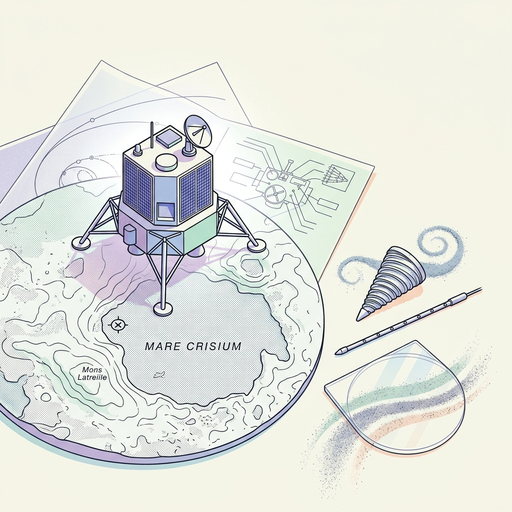
On March second, two thousand twenty-five, Blue Ghost initiated its descent-orbit-insertion burn, dropping out of lunar orbit toward Mare Crisium, an expansive basalt impact basin on the near side of the Moon. The target touchdown area lay adjacent to Mons Latreille, a prominent volcanic mountain feature rising above the dark volcanic plains.
During the final minutes of descent, the spacecraft had to fly entirely without human intervention. Radio signals traveling between the Moon and Earth take approximately one point three seconds in each direction, resulting in an unavoidable round-trip communication delay of nearly two point six seconds. At terminal descent velocities, terrain hazards appear and pass far too quickly for a flight controller in Texas to intervene.
Blue Ghost relied on autonomous hazard detection and avoidance systems. Optical cameras and range sensors continuously mapped the approaching ground, measured local slopes, and identified dangerous boulders. The flight computer evaluated candidate touchdown points in real time, adjusted the throttle of the main descent engine to steer clear of surface obstacles, and guided the vehicle down toward a safe, level patch of regolith.
Telemetry received at mission control in Cedar Park confirmed touchdown. Contact switches on three of the four landing-leg footpads registered ground pressure, confirming that the lander had come to rest in a stable, vertical orientation on the volcanic plain. The descent was soft, controlled, and upright.
By standing vertically on its four landing legs, Blue Ghost kept its primary solar arrays facing the sun and its high-gain antenna oriented cleanly across three hundred eighty thousand kilometers of space toward the antennas of the Deep Space Network. Instruments positioned around the spacecraft deck commanded an open view of the lunar horizon, the basalt soil beneath the footpads, and the sky above. The platform was intact, fully powered, and ready to begin its scientific campaign.
Secured to Blue Ghost's exterior deck and internal compartments were ten distinct scientific and technology payloads sponsored by NASA. The suite encompassed lunar soil mechanics, internal geophysics, electrostatic dust behavior, cislunar satellite navigation, radiation-tolerant computing, and heliophysics. Within hours of touchdown, engineering telemetry confirmed that all ten payloads powered up on the surface and began transmitting operational data.
Distinguishing operational success from scientific conclusion is essential when evaluating planetary exploration. Operational success means an instrument survived launch, transit, and touchdown, powered on correctly, executed its preprogrammed commands, and returned valid data packets to Earth. The ultimate scientific interpretation of those data packets, ranging from subsurface temperature profiles to magnetospheric boundary maps, requires extensive laboratory calibration and peer-reviewed analysis.
By March sixth, just four days into the surface mission, NASA and Firefly reported that at least eight of the ten payloads had satisfied their core operational milestones, proving that the lander's electrical power and communications architecture could manage multiple high-demand experiments simultaneously.
Five of these instruments demonstrated novel operating mechanisms designed to overcome longstanding technical hurdles on the lunar surface. The first was Lunar PlanetVac, a regolith-sampling system developed by Honeybee Robotics. Conventional planetary soil collection relies on heavy articulated robotic arms, mechanical wrist joints, and motorized scoops that consume substantial spacecraft mass and electrical power.
PlanetVac introduced a pneumatic alternative. The system pressed an open sampling cone against the lunar ground and fired short, controlled pulses of compressed nitrogen gas. The gas agitated and lofted loose dust and gravel upward into internal cyclone chambers, where the material was separated from the gas flow and funneled into collection containers for analysis. PlanetVac successfully gathered, transferred, and sorted surface regolith without requiring a mechanical digging arm, establishing an efficient blueprint for future sample collection hardware.
A short distance away on the vehicle deck, a subsurface thermal probe named LISTER began penetrating the basalt crust. Short for Lunar Instrumentation for Subsurface Thermal Exploration with Rapidity, the instrument utilized a pneumatic hammer drill that drove a sensor-laden probe approximately one meter, or about three feet, into the lunar regolith.
Along the length of this slender probe, eight separate temperature sensors recorded thermal measurements at varying depths below the surface. Because the powdery top layer of lunar regolith serves as an exceptional thermal insulator, these multi-depth measurements allow planetary geophysicists to measure the faint heat flowing outward from the lunar interior, providing empirical constraints on the thermal history and internal composition of the Moon.
Looking away from the ground and toward the sky, an instrument named LEXI observed the complex magnetic boundary between the Sun and Earth. The Lunar Environment Heliospheric X-ray Imager carried a wide-field soft X-ray telescope pointed directly at the terrestrial magnetosphere.
When the solar wind, a supersonic stream of charged plasma emanating from the Sun, collides with the outer boundary of Earth's protective magnetic field, it produces diffuse X-ray emissions through a process known as solar wind charge exchange. Operating from its stable viewpoint on Mare Crisium, LEXI captured global X-ray observations of this collision zone, documenting how the terrestrial magnetic shield flexes in response to fluctuating solar activity.
On the vehicle's exterior panels, the Electrodynamic Dust Shield addressed one of the most abrasive hazards of lunar exploration. Lunar dust consists of fine, jagged, electrostatically charged silicate particles that cling stubbornly to spacesuits, erode mechanical seals, and degrade solar cell performance.
The dust shield system applied dynamic, multi-phase high-voltage electrical fields across specialized transparent electrode tracks embedded on optical windows and thermal radiators. The traveling electrical waves lifted the charged dust particles and transported them across the surface, sweeping the panels clear of debris without requiring mechanical wipers or liquid wash systems. Mission managers reported that the dust shield achieved its primary demonstration goals within the first three days on the surface.
The fifth notable technology demonstration was LuGRE, the Lunar GNSS Receiver Experiment. Global navigation satellite systems such as the American GPS and European Galileo networks broadcast their primary radio signals downward toward users on Earth. However, a minute fraction of that radio energy spills past the edge of the planet and travels out into deep space.
LuGRE utilized a specialized, high-sensitivity radio receiver to capture these weak signal sidelobes across cislunar distances. The instrument successfully locked onto navigation signals during the outbound transit, within lunar orbit, and while operating on the surface at Mare Crisium, calculating independent position fixes throughout the flight. The demonstration confirmed that existing terrestrial navigation constellations can augment cislunar navigation, although dedicated lunar orbital satellites will still be necessary for comprehensive navigation networks.
The remaining payloads rounded out a wide-ranging scientific survey. An experiment known as SCALPSS used four downward-aimed cameras to film how the descent engine exhaust plume eroded and scoured the regolith during the final moments of landing. A passive laser retroreflector array provided a permanent, glass-prism target on the surface, allowing Earth-based observatories to bounce laser pulses off the lander to measure Earth-Moon distances with sub-centimeter accuracy.
The Regolith Adherence Characterization experiment exposed various aerospace materials to the lunar environment to measure how strongly dust adhered to different coatings. An experimental computer architecture named RadPC evaluated whether reconfigurable field-programmable gate arrays could autonomously detect and correct radiation-induced memory upsets in space. Finally, the Lunar Magnetotelluric Sounder recorded electric and magnetic fields to map the electrical conductivity of the lunar mantle.
Over the course of its primary mission, Blue Ghost operated continuously on the surface for more than fourteen days, logging roughly three hundred forty-six hours of daylight activity. In total, the spacecraft transmitted more than one hundred nineteen gigabytes of data back to Earth, including fifty-one gigabytes dedicated specifically to science and technology payload operations. Firefly subsequently reported that the mission had fulfilled one hundred percent of its core contractual objectives.
On March fourteenth, twelve days into the surface campaign, the orbital mechanics of the Earth-Moon system produced a rare visual alignment. As viewed from Mare Crisium, Earth moved directly across the face of the Sun, plunging the landing site into deep shadow during a total solar eclipse.
For observers on Earth, this astronomical alignment appeared as a penumbral lunar eclipse. But for Blue Ghost on the lunar plains, the geometry was inverted: the dark silhouette of Earth completely covered the solar disk.
The lander pointed its optical cameras toward the sky and recorded high-definition imagery of the eclipse. The dark sphere of Earth was rimmed by a vivid ring of sunlight refracted through the terrestrial atmosphere, creating an intense, concentrated illumination feature that mission controllers described as a diamond-ring effect. Firefly documented the sequence as the first high-definition recording of a solar eclipse captured by a commercial spacecraft operating on the surface of the Moon.
Two days after the eclipse, the inevitable sunset crept across Mare Crisium. As the solar panels lost access to direct sunlight, Blue Ghost transferred its electrical loads entirely to its internal batteries.
The spacecraft continued operating for slightly more than five hours into the lunar night, gathering engineering data on thermal cooling rates as the surrounding basalt plain began its steep descent into cryogenic temperatures.
At approximately six fifteen PM Central Daylight Time on March sixteenth, two thousand twenty-five, the spacecraft broadcast its final telemetry packet and fell silent. Operating five hours into the night demonstrated robust power management, but it was not designed to survive the full fourteen-day lunar night. As the severe cold penetrated the vehicle's battery compartments and electronic enclosures, Blue Ghost completed its operational life, leaving its returned scientific data behind for global analysis.
Blue Ghost's two-week campaign validated the core premise of NASA's commercial purchasing strategy. A commercial company engineered a transit, landing, and surface operations architecture that delivered ten research payloads to the Moon, maintained their power throughout the lunar day, and returned tens of gigabytes of experimental data to research institutions.
Yet a single successful expedition remains one data point. It does not establish that commercial lunar flights have become routine, nor does it guarantee that mission costs will remain predictable over time. Furthermore, touching down on a flat, low-latitude basalt plain during full sunlight is vastly less hazardous than navigating the permanently shadowed, rugged terrain of the lunar south pole, where long-term international exploration is focused.
In corporate mission announcements, commercial space companies often describe their milestones with broad assertions, declaring an expedition to be the first fully successful private lunar landing. To evaluate these claims objectively, observers can apply a four-question framework to every lunar landing attempt.
First, did the spacecraft reach the lunar surface? Second, did it touch down softly enough for its core systems to survive? Third, did it remain upright in its intended orientation? Fourth, did it complete its planned payload objectives?
Applying this framework clarifies the historical record. In February two thousand twenty-four, Odysseus answered yes to reaching the surface, yes to surviving softly, and yes to completing a significant portion of its scientific tasks, but no to remaining upright. Its tilted position constrained its communications bandwidth and complicated surface operations.
In March two thousand twenty-five, Blue Ghost answered yes to all four criteria: it arrived at Mare Crisium, survived touchdown softly, remained standing vertically on its landing legs, and completed its full lunar-day payload timeline.
Significant engineering challenges lie ahead before commercial lunar transportation can be considered mature. Spacecraft must eventually survive the fourteen-day cryogenic lunar night, an objective that requires either heavy radioisotope heating sources or regenerative fuel cell systems.
Dust mitigation systems such as the electrodynamic shield must be scaled up from experimental patches to large solar arrays and habitat docking mechanisms. Furthermore, cislunar navigation will ultimately require dedicated orbital satellite constellations rather than opportunistic tracking of faint radio signals originating from Earth.
Blue Ghost demonstrated that commercial spaceflight can achieve more than a survivable touchdown; it can land standing upright and execute a rigorous scientific campaign. As future commercial landers attempt their own descents, keep the four questions in mind: reaching the ground, landing softly, staying upright, and completing the science. The true test of commercial space exploration will be whether these four answers become a consistent standard rather than an occasional triumph.