Birdsong and Night Migration: Listening to a Changing Northeast
The birds singing outside northeastern windows at dawn are part of a larger world: year-round residents, seasonal breeders, and millions of migrants crossing the night sky. Their voices and journeys, studied through listening, radar, and long-term counts, reveal mounting pressures from habitat loss, climate change, and artificial light—but also show that conservation can work. Learning to hear the chorus and protecting dark skies and stopover habitat can help keep it alive.
By MyAudioBooks.ai ·
Listen free: Birdsong and Night Migration: Listening to a Changing Northeast
On a favorable night in the middle of May or late September, millions of migrating songbirds pass across the northeastern United States while most people sleep. Moving thousands of feet in the air, this immense river of life travels silently through the dark, unseen and largely unheard from the ground. A few hours later, first light breaks, and our backyards, hedgerows, and woodlots fill with an intense burst of sound. The birds we notice at dawn belong to a larger system of year-round residents, seasonal breeders, and travelers passing through on journeys that stretch across continents. What is happening overhead in the darkness, how does modern science measure it, and what do these changing voices reveal about the world outside our windows?
At My Audio Books dot A I, you can create your own audiobooks from prompts, turn your documents into audio, all with one subscription, and store your items in your own personal library.
The dawn chorus is one of the most reliable biological events of the spring calendar. Across the northeastern states, singing begins well before sunrise, swelling into a concentrated wave of sound that peaks between April and June. This morning surge is an intricate communication network driven by distinct physical and biological factors.
Early morning air offers ideal acoustic conditions. As the ground cools overnight, a layer of cold air often settles beneath warmer air above, creating a natural temperature inversion. This atmospheric layering bends sound waves downward toward the earth rather than letting them disperse upward into the atmosphere. Dawn also brings calm winds, minimizing air turbulence that would otherwise scatter acoustic signals. Human noise is at its lowest point of the day. For a songbird weighing less than an ounce, broadcasting during this quiet window maximizes the geographic reach and clarity of every note.
The timing also fits an energetic routine. Before sunrise, it is generally too dim to forage efficiently for insects or seeds. Singing requires metabolic energy, but holding territory and advertising social presence before breakfast allows birds to claim space before feeding takes priority for the rest of the day. No single explanation applies to every bird, but together these pressures shape a widespread morning ritual.
To understand the soundscape, it helps to distinguish between songs and calls. The distinction is not absolute, but the two vocal categories perform different jobs. Songs are typically longer, more complex acoustic patterns produced primarily during the breeding season. They serve to advertise territory boundaries and attract or maintain a mate. Calls, by contrast, are shorter, simpler vocalizations used throughout the entire year by both sexes. They function as day-to-day coordination signals, maintaining contact within a flock, keeping family groups together, or sounding an alarm.
The black-capped chickadee makes this division easy to hear. Its familiar vocalization, the raspy chick-a-dee-dee-dee, is a social call rather than its true song. Researchers have found that chickadees encode precise information into these notes. When spotting a perched predator, a chickadee varies the number of trailing dee notes depending on the level of threat. A small, agile owl that presents an immediate hazard triggers a call with far more dee notes than a large, slow-moving hawk. The bird's true song is an entirely different sound: a clear, two-note whistle often described as fee-bee, used almost exclusively to define breeding boundaries and communicate with mates.
Many songbirds learn these vocalizations from adult tutors rather than inheriting them as hardwired instincts. Young birds listen to experienced adults in their natal territory, memorizing the phrases and practicing them through trial and error. Because these vocal traditions are passed along through social learning, local populations can develop distinct regional dialects. A sparrow population in one coastal valley may sing a phrase with a noticeably different rhythm or pitch than members of the same species living fifty miles inland. These learned dialects evolve across generations, representing a cultural process distinct from an individual bird temporarily singing louder to overcome background traffic.
Identifying the birds around us does not require a spotting scope. By paying attention to vocal pattern, habitat, behavior, and season, you can build a reliable field guide purely for the ear.
The American robin frequently opens the morning chorus. Well before dawn, robins begin singing clear, liquid phrases linked together in an undulating rhythm often remembered as cheerily, cheer-up, cheer-up, cheerily. Robins are adaptable foragers, finding earthworms and grubs on suburban lawns while relying on mature trees and dense shrubs for nesting and protective cover. Their caroling carries across neighborhood blocks before most other birds have begun.
The northern cardinal contributes a loud, ringing acoustic presence. Perched along hedgerows or woodland borders, cardinals deliver sharp, repeated whistles that rise or drop in pitch. Unlike many songbird species where singing is restricted to males, female cardinals sing regularly, often duetting with their mates from within thick brush to coordinate territory defense. Over the past century, cardinals have steadily expanded their year-round presence northward across the Northeast, sustained by suburban shrubbery, backyard feeders, and milder winters.
In the upper branches, the blue jay produces a wide variety of sounds. Alongside its harsh, nasal alarm calls that alert the forest to approaching danger, the jay produces softer, conversational notes and accurate imitations of red-shouldered and red-tailed hawks. Down near the ground, the mourning dove provides a contrasting low, hollow coo that listeners frequently mistake for an owl. In flight, its wings generate an audible whistling flutter caused by air rushing through specialized feathers, sounding a mechanical warning to nearby flock members during sudden takeoffs.
Woodpeckers add another dimension to the chorus through mechanical drumming rather than vocal cords. Rapid, rhythmic bill strikes against resonant wood, utility poles, or metal roof gutters serve the exact same territorial and courtship functions as a vocal song. The Northeast supports several distinct drumming species, ranging from the small downy woodpecker common in backyards to its larger look-alike, the hairy woodpecker. The northern flicker often forages on the ground for ants and produces a loud, repeating call, while the crow-sized pileated woodpecker delivers deep, resonant strikes that echo across mature deciduous forests.
Suburban environments also ring with the monotonous chirping of the house sparrow. Introduced from Europe in the nineteenth century, this species thrives in close proximity to human buildings, nesting in vents and roof eaves. Because the house sparrow is an adaptable nonnative generalist, an abundance of them in a city or town does not reflect the ecological health of the broader native bird community. High numbers of house sparrows can easily mask the quiet loss of native insect-eating species.
These familiar birds follow different life strategies. Chickadees, cardinals, downy woodpeckers, and house sparrows are year-round residents that survive freezing winters by caching food and finding sheltered roosts. Robins, blue jays, and mourning doves are partial migrants. Depending on local weather, snow cover, and fruit availability, some individuals remain on breeding territories while others move south.
Then there are the long-distance travelers. An array of warblers, thrushes, vireos, and flycatchers spend their winters in the Caribbean, Central America, or South America, journeying thousands of miles each spring to reach northern nesting grounds. These delicate birds travel under cover of darkness, prompting a central scientific question: how do researchers study a passage that takes place entirely out of sight?
Twice each year, an invisible migration river crosses North America. The northeastern corridor connects northern breeding grounds in Canada and the United States with wintering areas to the south. Each spring and autumn, it channels waves of warblers, thrushes, vireos, flycatchers, sparrows, blackbirds, and tanagers across the night sky.
Traveling by night provides key physiological and environmental advantages. Flapping flight generates intense metabolic heat, and cooler nighttime air helps prevent exhaustion and dehydration. The night sky is free from the turbulent thermal updrafts created by daytime solar heating, offering smoother flight conditions that conserve precious energy. Darkness also provides protection from daytime aerial predators like falcons and hawks, while preserving daylight hours for foraging and resting on the ground.
To steer across continents in the dark, migrants use a multisensory navigation system. They read the Earth's magnetic field using a geomagnetic compass located in specialized light-sensitive pigments within their eyes. They navigate by star patterns, learning the rotation of constellations around the North Star while still fledglings in the nest. At dusk, they calibrate their internal compasses using the polarized light bands cast across the horizon by the setting sun. Near the ground, physical landmarks like coastlines, river valleys, and mountain ridges provide orienting pathways.
Weather acts as the primary gatekeeper for these journeys. High-pressure systems with favorable tailwinds trigger mass departures, allowing migrants to cover hundreds of miles with minimal energy expenditure. Conversely, headwinds, dense fog, and rainstorms halt movement, forcing birds toward the ground. When traveling flocks encounter severe weather along coastlines or large lakes, thousands of exhausted birds may drop into isolated coastal woodlots at once. Field ornithologists call this dramatic concentration a fallout.
To measure this vast movement, scientists rely on weather surveillance radar. The nationwide expansion of the Doppler radar network in the nineteen-nineties transformed migration research. While designed to track rain, radar beams reflect off dense concentrations of flying birds, revealing flight intensity, speed, direction, and altitude across entire regions. Radar reveals the scale of the river, but it cannot differentiate between species. A radar return shows an aggregate mass of biological targets.
To identify who is flying, researchers deploy acoustic flight-call microphones. As birds travel through the dark, they exchange brief vocalizations called nocturnal flight calls. These chips, buzzes, and high-pitched tseeps, often lasting less than a quarter of a second, help keep traveling groups together and prevent midair collisions. By recording these calls from rooftops and towers, researchers can identify individual species. However, interpreting acoustic records is challenging. Calling rates change depending on cloud cover, wind, and altitude, while many birds fly in complete silence under clear skies.
Physical banding and tracking devices provide the individual ground truth. Attaching lightweight aluminum bands reveals survival rates, longevity, and site fidelity across years. Light-level geolocators and radio transmitters document precise routes, though geolocators generally require recapturing the bird to retrieve the data, and device weight, battery limits, and cost restrict their broad use.
Because each monitoring tool has blind spots, researchers combine them. A twenty twenty-five comparative study in the American West examined years of simultaneous radar and acoustic records. It found no consistent correlation between the volume of birds detected on radar and the number of flight calls recorded on the ground within individual nights. A heavy flight high overhead on a clear night may produce few ground calls, while low clouds may force birds downward, increasing call rates without indicating a larger migration. Reconstructing the true passage requires multiple instruments working together.
For more than fifty years, systematic monitoring initiatives like the North American Breeding Bird Survey and the Christmas Bird Count have tracked wild bird populations. By accounting for observer effort, weather, and the likelihood of detecting a bird, these long-term datasets establish a clear ledger of environmental change.
The broad numbers show a profound shift. A landmark twenty nineteen synthesis evaluating more than five hundred species determined that the North American breeding bird population had declined by nearly three billion individuals since nineteen seventy. That represents a net loss of roughly twenty-nine percent. This continental figure does not mean every northeastern bird is disappearing, but it highlights deep stress across diverse bird communities.
Grassland birds suffered the steepest losses, dropping by more than half as pastoral farms and open fields gave way to intensive row cropping or forest regrowth. A separate twenty twenty-three shorebird analysis documented declines in twenty-six of twenty-eight monitored species between nineteen eighty and twenty nineteen. The sharpest drops were concentrated along the Atlantic flyway of the eastern United States and Canada.
Yet the ledger also contains dramatic evidence of recovery. Waterfowl populations, including many ducks and geese, increased significantly over the same decades, demonstrating the positive impact of sustained wetland protection and waterfowl management. Prominent raptors, including bald eagles, ospreys, and peregrine falcons, rebounded after the federal ban on persistent organochlorine pesticides like DDT and aggressive legal protection. These contrasting trajectories prove that bird declines are not an unavoidable natural law. Targeted intervention can change outcomes.
Alongside population numbers, geographic ranges are shifting. A forty-three-year analysis tracking thirty-two eastern bird species documented an average northward movement in breeding range centers and boundaries. As regional winters become less severe, southern species push northward. However, an expanding northern margin does not necessarily indicate a growing population. A species may gain territory at its northern edge while losing ground and numbers across its historical core.
Shifts in seasonal timing are equally complex. Long-term records challenge the simple assumption that warmer springs cause all birds to arrive earlier. An analysis of eastern species since nineteen seventy found thirty-six bird species arriving earlier, but thirty-nine arriving later, showing no universal advance across the board. Species that spend the winter in North America and rely on open water often arrived noticeably earlier, tracking the earlier seasonal breakup of freshwater ice. In contrast, long-distance migrants wintering in South America, who rely on day length rather than northeastern temperatures to trigger migration, frequently arrived on their historical calendar.
This timing gap creates a risk known as trophic mismatch. Many forest songbirds time their arrival so that hatching chicks coincide with the annual peak of forest caterpillars. If warm local springs cause caterpillars to emerge, feed, and pupate two weeks earlier, while migrating birds arrive on their fixed schedule, parents struggle to find enough soft insect prey for their nestlings. Some species adjust their laying dates, but others cannot keep pace.
These atmospheric pressures compound ground-level habitat loss. Urban sprawl and infrastructure divide continuous northeastern forests into isolated fragments. This fragmentation creates extensive edge habitat, exposing woodland birds to nest predators like raccoons and blue jays. It also invites the brown-headed cowbird, a brood parasite that lays its eggs inside the nests of forest songbirds. Interior forest specialists like the wood thrush require large, undisturbed forest tracts to breed successfully.
For nocturnal migrants, the quality of a journey depends on an unbroken chain of breeding, stopover, and wintering habitats. A small suburban thicket or an urban park may not support nesting pairs in June. During May and September, however, that same green patch serves as an indispensable stopover where exhausted travelers can rest and refuel. If these stopovers disappear, the entire chain weakens.
Human sensory pollution creates further obstacles. Persistent urban noise masks bird vocalizations, forcing some species to sing louder, shift to higher frequencies, or alter their singing hours. Artificial light at night presents an even more direct hazard for nocturnal migrants. Bright city lights attract and disorient birds, drawing them away from efficient routes and into high-risk collision zones around glass buildings and communication towers.
A documented demonstration of this interaction occurs at New York City's Tribute in Light, where twin beams of high-powered spotlights pierce the night sky each September. Radar, acoustic sensors, and ground observers have documented thousands of migrating songbirds accumulating within the light beams, circling in confusion and calling out in distress. When organizers switch off the lights for short twenty-minute intervals, the birds disperse into the darkness within minutes, resuming their southward journey. That immediate behavioral shift confirms that human choices directly influence migrant survival.
The dawn chorus is an ecological indicator of a landscape in transition. A northern cardinal expanding its range northward, a declining long-distance migrant, and a locally abundant house sparrow can all inhabit the same neighborhood hedgerow. The visible success of a few adaptable generalists does not cancel out the quiet declines of specialized forest species.
Listening to the chorus provides valuable clues about which species are present, how the breeding season is progressing, and the condition of local habitat. However, the morning soundscape is not a direct census. Some birds sing continuously, while others stay quiet. High winds, cool temperatures, and urban noise can obscure vocalizations, meaning silence does not prove absence, and a loud chorus does not necessarily mean bird numbers are increasing. Reliable insight comes from repeated listening across multiple mornings under comparable conditions.
The measurements gathered from migration studies also point toward practical actions. Because artificial light poses a clear, documented hazard, turning off nonessential exterior lights and closing window blinds between eleven PM and six AM during peak migration seasons helps keep travelers on course. On the ground, preserving and planting native shrubs, berry bushes, and trees turns backyards and community parks into productive stopover habitat.
The recoveries of waterfowl and birds of prey demonstrate that conservation works. When research identifies the specific pressures driving a decline, sustained policy and habitat restoration can reverse the trend. At the same time, important scientific questions remain open. Researchers are still investigating whether long-distance migrants can adjust their schedules fast enough to track changing insect peaks. Questions also remain about how much specific population losses stem from habitat disruption versus artificial light, and whether northern range shifts will establish permanent, self-sustaining populations. Century-long records show that population trends fluctuate, and a historical decline does not represent a permanent fate.
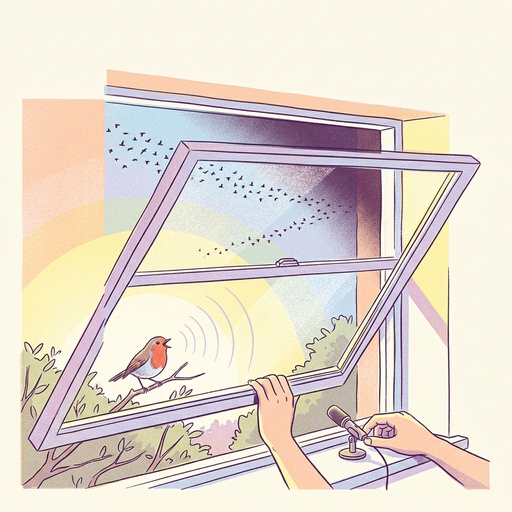
To engage with this living system, start by listening for three distinctive voices outside your door. Focus first on the American robin, with its cheerful, liquid phrases delivered in the quiet moments before sunrise. Next, pick out the clear, ringing whistles of the northern cardinal rising from shrubs and woodland edges. Finally, listen to the black-capped chickadee, distinguishing its whistled two-note fee-bee song from the complex social chatter of its namesake call. Learning to recognize these three patterns transforms background sound into an understandable seasonal narrative.
Two distinct shifts of bird life share our skies: the familiar residents and nesting pairs that announce the morning, and the vast river of nocturnal travelers that passes while we sleep. The sounds outside our windows offer a direct connection to a changing continental ecosystem. Tomorrow morning, before sunrise, open a window, listen into the early light, and begin counting the voices.