Bananas, Bonds, and the Guatemalan Coup: United Fruit and Cold War Intervention
In 1954, Guatemala’s democratic land reform collided with United Fruit’s vast corporate privileges when the government compensated the company for idle land at the low value it had declared for taxes. United Fruit’s lobbying converged with Cold War fears, helping spur a CIA-backed coup that removed President Jacobo Árbenz, reversed reform, and helped set Guatemala on a path toward decades of repression and civil war.
By MyAudioBooks.ai ·
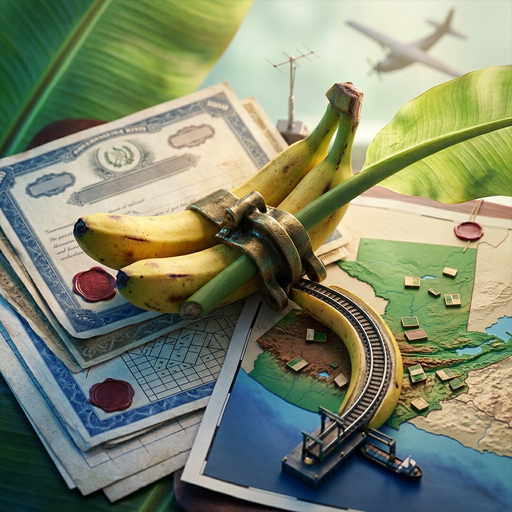
Listen free: Bananas, Bonds, and the Guatemalan Coup: United Fruit and Cold War Intervention
The phrase banana republic began as literary satire before hardening into an economic slur. By the early nineteen fifties, that label concealed an urgent question: how much of a country could one foreign corporation actually control, and what happened when a sovereign, elected government challenged its privileges?
The collision turned on an extraordinary contradiction over the financial value of the exact same soil. For decades, the United Fruit Company minimized its local property taxes by declaring artificially low land assessments to the Guatemalan treasury. When an elected democratic government expropriated those idle acres to distribute them to landless peasant families, it offered financial compensation based strictly on the company's own official tax returns. United Fruit instantly rejected its own declared valuation, demanded nearly twenty times that figure, and took its grievance straight to Washington.
What followed was not simply a dispute over corporate balance sheets, but a covert campaign that transformed Central American history. To understand how a disagreement over banana acreage escalated into a United States covert intervention, we must examine the legal concessions, monopolies, and intelligence operations that reshaped an entire nation.
At My Audio Books dot A I, you can create your own audiobooks from prompts, turn your documents into audio, all with one subscription, and store your items in your own personal library.
United Fruit incorporated in eighteen ninety-nine through the consolidation of the Boston Fruit Company and Minor Keith's tropical railroad network. Its power grew through comprehensive vertical integration.
Rather than operating merely as an agricultural producer, the company controlled the entire transit corridor. It owned the plantations, the local light rail lines, and the deepwater ocean docks. It also managed telegraph networks, wholesale distribution centers, and the refrigerated steamships known across the Caribbean as the Great White Fleet.
This infrastructure gave United Fruit leverage far beyond the acreage it physically owned. In Guatemala, the company held controlling influence over the International Railways of Central America, commonly known as IRCA. Because IRCA owned the only railway linking the Pacific agricultural interior to the Atlantic coast at Puerto Barrios, United Fruit held an effective chokehold on national commerce.
Guatemala's domestic coffee planters, the backbone of the traditional landed elite, paid steep freight rates determined by foreign executives, while United Fruit transported its own bananas at minimal cost. If domestic competitors attempted to move fruit, freight cars suddenly became unavailable.
Corporate dominance rested on legal concessions rather than outright territorial conquest. Authoritarian leaders, most notably General Jorge Ubico between nineteen thirty-one and nineteen forty-four, granted United Fruit ninety-nine-year leases, total exemptions from import duties, and complete immunity from municipal taxation.
In return, the state used its police power to ban labor unions and enforce vagrancy laws. These laws compelled Indigenous Maya laborers to carry work booklets, obligating them to work on commercial estates for negligible wages. Corporate privilege depended directly on state enforcement.
This leverage took distinct forms across Central America. In Honduras, banana enclaves along the northern coast enabled foreign fruit companies to finance rival politicians and manipulate public debt. Costa Rica developed stronger civic institutions and a resilient smallholder coffee economy that limited corporate leverage. Nicaragua and Panama endured direct United States military protectorates and canal-zone policing. Guatemala paired foreign monopolies with extreme domestic inequality: a small coffee elite and a landless Indigenous majority.
In October nineteen forty-four, that domestic order broke. A popular revolution ousted the Ubico regime, inaugurating a ten-year democratic experiment. The central question shifted from what United Fruit controlled to what an elected government could alter.
The first revolutionary administration, led by President Juan José Arévalo, established a labor code, social security, and union rights. United Fruit faced its first collective bargaining disputes and wage demands, but its landholdings remained untouched.
In nineteen fifty, Jacobo Árbenz Guzmán won the presidency with more than sixty-five percent of the vote. Árbenz, an army colonel from the revolutionary vanguard, pursued a modernizing, nationalist platform. His goal was to transform Guatemala from a semi-feudal economy dependent on foreign concessions into an independent capitalist state.
The primary barrier was land concentration. Two percent of landowners held more than seventy percent of arable land, leaving hundreds of thousands of rural Indigenous families landless.
In June nineteen fifty-two, congress passed Decree Nine Hundred, an agrarian reform law targeting only uncultivated land on estates larger than two hundred twenty-three acres. Cultivated land was protected. Farms where more than two-thirds of the property was actively farmed were completely exempt.
Local agrarian committees, composed of peasant representatives and local officials, identified idle parcels, which the state redistributed as private property or lifetime leases. The law directly targeted United Fruit.
The company held roughly five hundred fifty thousand acres in Guatemala, yet cultivated less than fifteen percent of that territory. United Fruit defended the idle acreage as a commercial reserve against crop diseases and tropical storms. Under Decree Nine Hundred, the government expropriated roughly four hundred thousand acres of uncultivated company land.
Compensation triggered an international crisis. Decree Nine Hundred mandated payment in twenty-five-year government bonds at three percent interest. Crucially, the compensation was tied strictly to the property value declared on municipal tax rolls prior to May nineteen fifty-two.
For decades, United Fruit had declared its Pacific coast holdings at Tiquisate at approximately six hundred thousand dollars to minimize property taxes. The Guatemalan treasury offered that exact amount in bonds. United Fruit refused, claiming the land had a true market value of nearly sixteen million dollars.
The company's historic tax evasion became an immediate liability. United Fruit transformed its domestic balance-sheet dispute into a charge of sovereign theft, appealing directly to the United States government.
United Fruit mobilized a sophisticated public relations and lobbying campaign. Retaining Edward Bernays, the company funded junkets to Guatemala for American journalists. Bernays curated stories that framed agrarian reform not as domestic modernization, but as Soviet penetration.
The company enjoyed extraordinary access to the Eisenhower administration. Secretary of State John Foster Dulles and his former law firm, Sullivan and Cromwell, had represented United Fruit. His brother, CIA Director Allen Dulles, had served on the company's board and owned stock. United States Ambassador to the United Nations Henry Cabot Lodge and Assistant Secretary of State John Moors Cabot held substantial family financial ties to the firm.
Declassified records show, however, that commercial lobbying aligned with an already entrenched anti-communist doctrine. In the aftermath of the Korean War, Washington viewed Central America through the lens of containment.
The Guatemalan communist party, the Partido Guatemalteco del Trabajo, operated legally, holding four seats in a sixty-one-seat congress. Communist organizers led peasant confederations and influenced agrarian agencies.
Internal CIA estimates conceded that Árbenz was an independent nationalist military officer rather than a Soviet agent, and found no evidence of Soviet bases or operational control in Guatemala. Yet American officials concluded that communist political influence in the hemisphere posed an unacceptable strategic threat.
In Washington's Cold War calculus, expropriating American property and legalizing communist organizers signaled a hostile foreign beachhead. Commercial grievances and strategic doctrine merged, turning a private corporate dispute into an interventionist campaign.
In August nineteen fifty-three, President Dwight Eisenhower authorized Operation PBSUCCESS, a covert mission to remove Árbenz, approving an initial budget of approximately two point seven million dollars.
The CIA backed Colonel Carlos Castillo Armas, an exiled Guatemalan officer based in Honduras with fewer than five hundred fighters. Because this small force could not defeat Guatemala's six-thousand-strong regular army in battle, PBSUCCESS relied on psychological warfare and strategic deception.
The agency launched a clandestine radio station, the Voice of Liberation, from Nicaragua. The broadcasts jammed domestic frequencies, spread false reports of army defections, and claimed rebel divisions were converging on the capital. Unmarked P-forty-seven aircraft piloted by American contractors dropped leaflets and small bombs on military installations and fuel depots, manufacturing a sense of military collapse.
Assassination planning formed an explicit part of the operation. Declassified files from the nineteen nineties revealed hit lists of political and military leaders, alongside a CIA manual titled A Study of Assassination. While documents do not show the CIA executed specific figures during the operation, they establish that targeted political killing was fully integrated into operational planning.
Diplomatic isolation sealed the outcome. Washington enforced an arms embargo and secured an anti-communist resolution at the Caracas Conference of the Organization of American States in March nineteen fifty-four. When Árbenz circumvented the embargo by purchasing Czechoslovakian small arms aboard the Swedish freighter Alfhem in May nineteen fifty-four, Washington framed the cargo as proof of Soviet infiltration.
When Castillo Armas crossed the border on June eighteenth, nineteen fifty-four, his force stalled immediately. But the psychological operation broke the military high command. Convinced that United States forces would intervene directly, Guatemalan generals refused Árbenz's order to distribute weapons to civilian peasant militias.
Abandoned by his commanders, Jacobo Árbenz resigned on national radio on June twenty-seventh, nineteen fifty-four, seeking asylum in the Mexican embassy.
Colonel Castillo Armas took power in July nineteen fifty-four, flown to the capital aboard a United States embassy plane. The regime immediately dismantled the decade's reforms.
Castillo Armas repealed Decree Nine Hundred, dissolved agrarian committees, and returned ninety-nine percent of expropriated land to former owners, including United Fruit. More than one hundred thousand peasant families were evicted from their newly farmed plots. The government outlawed trade unions and peasant federations, arresting, exiling, or executing thousands of organizers, teachers, and agrarian reformers.
United Fruit recovered its land, but the victory did not preserve its regional hegemony. Over subsequent decades, antitrust litigation by the United States Department of Justice, rising production costs, crop diseases, and competition from Ecuador eroded the company's monopoly. United Fruit sold off its rail networks and port facilities, eventually reorganizing as Chiquita Brands International.
The declassified record establishes that corporate lobbying did not dictate foreign policy; rather, commercial interests and Cold War containment reinforced one another. Furthermore, the covert campaign succeeded by exploiting real fractures within Guatemala's elite and military officer corps. Counterfactual claims about whether Árbenz might have survived without United States action remain unprovable.
The coup eliminated the possibility of peaceful, institutional land reform. By foreclosing democratic change, the intervention helped trigger a thirty-six-year civil war between nineteen sixty and nineteen ninety-six that cost more than two hundred thousand lives. United Nations truth commissions found that state security forces and allied paramilitaries committed ninety-three percent of documented human rights violations, including acts of genocide against Indigenous Maya communities.
United Fruit did not own Central America as a sovereign state. It owned transport chokeholds, enjoyed statutory immunities, and leveraged immense political power. When a democratic government applied standard legal mechanisms—tax valuations and eminent domain—corporate grievance and imperial doctrine converged to overturn that democracy.
If this investigation changed how you examine corporate power and covert statecraft, sit with the enduring question of where private commercial interests end and national security policy begins. The declassified archives remain open, offering documented evidence for anyone willing to trace the record.