America’s Underground Command Centers: Why Three Mountain Sites Still Matter
The United States built command centers inside mountains during the Cold War to keep warning systems, military leadership, and civilian government functioning if a nuclear strike destroyed their surface headquarters. Cheyenne Mountain, Raven Rock, and Mount Weather still serve distinct roles in a wider network of backups, even where daily operations have moved elsewhere. They preserve the ability to assess a crisis and coordinate a response—not immunity from catastrophe.
By MyAudioBooks.ai ·
Listen free: America’s Underground Command Centers: Why Three Mountain Sites Still Matter
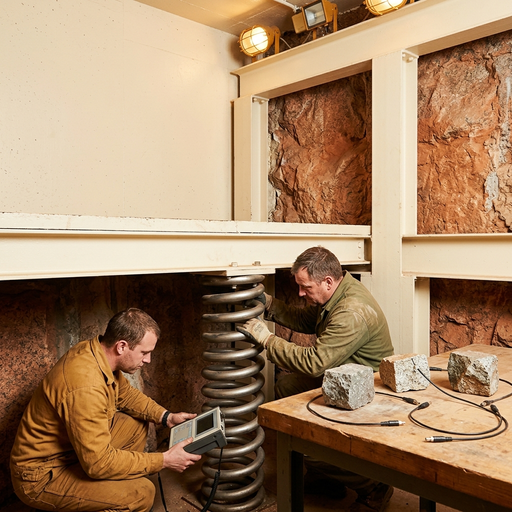
Two thousand feet beneath solid granite in the Colorado Rockies sits one of the most heavily fortified installations ever engineered. During the early nineteen sixties, military planners hollowed out the interior of Cheyenne Mountain to protect the nerve center of North American aerospace defense. Engineers mounted fifteen three-story steel buildings on massive industrial springs to absorb the ground shock of a nuclear blast. Today, the primary daily command floor for the North American Aerospace Defense Command operates out in the open at Peterson Space Force Base, several miles away. Yet the mountain facility was never decommissioned, and it was never abandoned. Crews report for duty inside that granite chamber every single day. That reality presents an intriguing puzzle: why did the United States tunnel deep into mountain ridges to safeguard command infrastructure, and what purpose do those subterranean redoubts serve today?
At My Audio Books dot A I, you can create your own audiobooks from prompts, turn your documents into audio, all with one subscription, and store your items in your own personal library.
The strategic logic behind tunneling into bedrock originated in the rapid compression of warning time during the early Cold War. When long-range bombers represented the primary threat, defensive networks had hours to detect incoming aircraft, alert leadership, and scramble interceptors.
The arrival of intercontinental ballistic missiles reduced that window to roughly thirty minutes. Submarine-launched ballistic missiles patrolling off the coastlines narrowed the margin even further. National authorities were left with as little as ten or fifteen minutes to evaluate radar returns, confirm an attack, and issue orders.
That compressed timeline created the severe danger of a decapitation strike. Strategic planners recognized that a surprise attack could destroy the capital, sever national communications switches, and obliterate military headquarters before anyone could verify what was happening.
If the political and military leadership died in the opening salvo, the entire national defense apparatus would be paralyzed. The same paralysis would occur if the transmission lines connecting them to retaliatory forces were severed. Retaliation would fail not from a lack of weapons, but from an inability to authenticate and transmit authorized commands.
Survival, however, required far more than placing a political leader inside a reinforced shelter. An intact room underground is functionally useless if the officials inside cannot communicate with the outside world, assess damage across the country, or verify who remains alive.
Government planners realized that post-attack survival required four distinct, specialized responsibilities that could not be bundled into a single building. Bundling them together would risk catastrophic failure and confuse civilian leadership with tactical combat direction.
The first responsibility is continuity of government. This function preserves constitutional order, statutory succession, and the legal authority of the executive, legislative, and judicial branches. It ensures that legitimate governing power survives mass disruption, preventing legal collapse.
The second responsibility is continuity of operations. Under Federal Emergency Management Agency guidelines, this focus maintains the ability of individual federal agencies and cabinet departments to execute their essential statutory duties. These duties range from managing public health emergencies to disbursing emergency funding, even after primary headquarters are destroyed.
The third responsibility is military command continuity. This preserves strategic command, control, tactical warning, and threat assessment. It guarantees that the President and the Secretary of Defense, functioning as the National Command Authority, retain an unbroken link to early warning radar, infrared satellites, and operational military forces worldwide.
The fourth responsibility is civilian emergency management. This discipline focuses on domestic incident coordination, crisis logistics, resource allocation, and civil defense. It provides the operational hub through which federal agencies assist state, local, tribal, and territorial authorities during natural catastrophes, technological disasters, or armed conflict.
Because each of these missions demands different expertise, technical networks, and institutional relationships, the United States developed three dedicated mountain installations rather than a single, all-purpose redoubt. Each facility addresses a different facet of national survival: aerospace warning and assessment in the Colorado Rockies, defense command and control in the hills of southern Pennsylvania, and civilian executive coordination in the Blue Ridge Mountains of Virginia.
The earliest and most structurally dramatic of these redoubts is the Cheyenne Mountain Complex, situated just outside Colorado Springs. Excavated during the early nineteen sixties, the underground fortress sits beneath more than two thousand feet of solid granite.
Government Accountability Office records describe the installation as engineered to withstand the blast overpressure of a multimegaton nuclear weapon. The design incorporated heavy blast valves that slam shut in milliseconds, along with advanced biological and chemical filtration systems.
Inside a four-and-a-half-acre network of excavated chambers, engineers erected fifteen interconnected steel structures. These buildings do not touch the surrounding rock. Instead, they rest on more than one thousand three hundred massive steel springs, each weighing approximately one thousand pounds.
If a nuclear detonation shakes the mountain, the shockwaves travel through the granite while the buildings oscillate freely on their suspensions. This mechanical damping shields delicate electronics, computer mainframes, and personnel from lethal ground acceleration. Millions of gallons of water were carved into subterranean reservoirs to cool generators and sustain life in complete isolation.
Cheyenne Mountain was designed to gather, evaluate, and correlate threat data. Government Accountability Office reviews identify five core mission centers that operated within the complex: the Command Center, the Air Warning Center, the Missile Correlation Center, the Operations Intelligence Watch, and the Space Control Center.
Technicians inside monitored radar stations across the Arctic, surveillance satellites orbiting the planet, and air-traffic feeds over North America. Their task was to distinguish between a false alarm, a lost commercial airliner, an atmospheric reentry, and an actual incoming strike.
That mission evolved across decades of geopolitical shifts. The Soviet launch of Sputnik in nineteen fifty-seven alerted defense leaders to the strategic importance of orbit, embedding space surveillance into the mountain from its earliest days.
During the nineteen ninety-one Persian Gulf War, the complex adapted to track regional theater ballistic missiles fired at coalition forces. Following the terrorist attacks of September eleventh, two thousand one, the facility expanded its focus to monitor domestic airspace for internal aviation threats.
Today, the complex supports the North American Aerospace Defense Command, the United States Northern Command, and the United States Strategic Command. It also maintains command-and-control capabilities for ground-based midcourse missile defense interceptors.
Roughly fifteen hundred miles east, buried beneath the Appalachian hills of southern Pennsylvania near the Maryland border, sits the Raven Rock Mountain Complex, widely known as Site R. While Cheyenne Mountain focused on sensory perception and warning, Raven Rock was built to preserve decision-making authority.
Constructed in the early nineteen fifties, Raven Rock serves as the primary alternate headquarters for the Department of Defense. Public military-construction budget records document its ongoing role as a hardened, survivable strategic battle-command platform.
If a catastrophic strike or sudden crisis disables the Pentagon, Raven Rock provides a blast-hardened environment where the Joint Staff, service leaders, and defense officials can assemble. From within the mountain, commanders can monitor global force posture, process classified intelligence, and direct military operations.
Department of Defense budget authorizations confirm continuous investments in the complex, ensuring resilient communications, data processing, and independent electrical generation. Raven Rock does not duplicate Cheyenne Mountain's tactical warning mission. Instead, it provides an alternate seat of operational military command.
Sixty miles west of Washington, in the Blue Ridge Mountains of Virginia, the Federal Emergency Management Agency operates the Mount Weather Emergency Operations Center. Encompassing five hundred sixty-four acres, the facility is divided by federal infrastructure records into an unclassified above-ground campus and a classified underground complex.
Mount Weather anchors civilian continuity across the federal executive branch. Managed by the Office of National Continuity Programs, the installation maintains redundant administrative, telecommunications, and computer systems supporting multiple cabinet departments and civilian agencies.
During a national crisis or catastrophic regional disaster, designated civilian officials can operate from Mount Weather to sustain constitutional governance, maintain federal administrative functions, and coordinate disaster response. Mount Weather ensures the survival of the civilian government that military command authorities are sworn to defend.
Understanding how these facilities function today requires resolving the paradox of Cheyenne Mountain: why did military officials shift daily watch-floor operations to an open military base if the mountain remains vital?
In two thousand six and two thousand seven, defense authorities realigned primary command activities. They relocated the main round-the-clock watch floors for the North American Aerospace Defense Command and Northern Command to the Eberhart-Findley Building at Peterson Air Force Base, now known as Peterson Space Force Base.
Congressional oversight reports from the Government Accountability Office examined this transition in detail. Defense planners sought to lower routine maintenance costs, streamline communications with civilian agencies, and place daily watch standers in a modern, collaborative workplace. The watchdog agency noted, however, that full lifecycle costs and security implications required sustained scrutiny.
Relocating the primary day-to-day command floor is not the same as shutting down an underground fortress. In the vocabulary of modern military readiness, an operational installation does not have to serve as the most visible daily desk job.
Operational status describes a broad spectrum. It includes maintaining energized communication links, keeping diesel generators and air scrubbers in immediate readiness, and running continuous system simulations. It also means hosting live exercise scenarios and maintaining warm-standby stations that can absorb an influx of personnel on minimal notice.
Cheyenne Mountain transitioned into an alternate command center, a continuity-of-operations relocation site, and a high-readiness training center. If geopolitical tensions spike, or if intelligence suggests an emerging threat to surface facilities, personnel can transition from Peterson back behind the heavy steel blast doors within hours.
In addition, certain classified communications, data analysis, and missile-defense support functions continue to operate from within the mountain on a permanent basis. The facility remains an active, integrated component of aerospace warning rather than a relic of the past.
This operational model reflects a broader strategic shift from single-point survival to distributed resilience. During the early Cold War, defense doctrine relied heavily on constructing a monolithic shelter capable of withstanding the worst possible blast.
As weapons technology advanced, developing precision-guided warheads, deep earth-penetrating munitions, and high-altitude electromagnetic pulse weapons, military strategists recognized that relying on a single fixed point invited disaster. Even if a bunker survived a direct detonation, its external communications towers, utility conduits, and access roads could be obliterated, leaving the occupants trapped and isolated.
Modern resilience distributes essential capabilities across multiple geographic nodes. It relies on primary surface headquarters for daily coordination, hardened underground redoubts for survivable backup, airborne command posts for mobile command in flight, and dispersed digital networks that synchronize data across disparate locations. Cheyenne Mountain, Raven Rock, and Mount Weather survive because they serve as fortified anchors within this broader, distributed web.
Hardened underground facilities provide distinct advantages, but they also carry severe, unavoidable vulnerabilities. Physical survival inside a granite vault does not guarantee operational utility.
An underground installation requires continuous interaction with the surface world. It depends on external early warning radars, orbiting surveillance platforms, high-frequency radio masts, and fiber-optic cables to receive information and transmit orders.
If an adversary severs those surface sensors and antenna fields, a mountain command center becomes an impenetrable isolation chamber. Subterranean systems also depend on delicate life-support equipment. These include industrial air-intake valves that must seal against blast waves, exhaust shafts that must vent heat without revealing subterranean locations, deep water wells, and diesel generators requiring steady fuel resupply.
Protecting these installations against high-altitude electromagnetic pulses requires specialized engineering. Electromagnetic pulses generated by a high-altitude nuclear detonation can induce massive voltage spikes in electrical wiring, destroying unshielded circuitry.
Engineers counter this threat by building nested Faraday cages, installing heavy surge arrestors, and using optical isolation links. Maintaining these defenses requires rigorous, ongoing testing, as a single compromised seal or unshielded cable can conduct destructive electrical currents directly into sensitive command servers.
The financial cost of maintaining this infrastructure is immense. Decades-old rock excavations require continuous structural reinforcement to prevent rockbursts and roof collapses caused by tectonic pressure.
Subterranean humidity accelerates the corrosion of electrical equipment and mechanical ductwork. Upgrading network switches and server arrays inside blast-hardened chambers requires retrofitting modern technology into low-ceilinged steel buildings designed in the nineteen sixties.
Beyond structural and financial constraints lie unanswered questions regarding national governance. Public records illuminate the institutional purposes of these facilities, but emergency staffing rosters, activation timelines, and relocation thresholds remain heavily classified.
If an emergency occurs, public information does not document which specific officials are designated to evacuate, or how rapidly they could reach these sites through disrupted transportation corridors.
Nor can a blast-hardened bunker resolve fundamental legal questions following a cataclysmic attack. Preserving a secure conference room does not explain how legislative quorums could be reconstituted after the destruction of the Capitol. It does not clarify how conflicting claims of presidential succession would be adjudicated, or how civilian leadership would enforce authority across a shattered nation.
Most importantly, these facilities offer protection for specific command mechanisms, not the society around them. An intact bunker cannot shield surrounding populations, restore severed electrical grids, or undo the humanitarian catastrophe of a major war. Their sole function is to preserve an organized capacity to assess what happened, communicate with surviving assets, and prevent an adversary from achieving total paralyzing victory through surprise attack.
The United States constructed these subterranean complexes because modern warfare threatened decision-making itself. Cheyenne Mountain stands to evaluate the skies and space, Raven Rock to preserve military command, and Mount Weather to sustain civilian governance.
These mountains preserve options for command, communications, and coordination, not immunity from catastrophe. They demonstrate that being operational does not require serving as the primary daily workplace. When you encounter claims about secret underground shelters, consider three grounding questions: which specific installation is involved, which institutional mission does it support, and what does the verified public record actually establish?