America’s Reserve Ships: Sealift Readiness and the Cost of Aging Hulls
The United States keeps aging ships in reserve because some provide vital transport capacity in wars and disasters—but a hull at anchor is only useful if its machinery works and a qualified crew can sail it. As vessels deteriorate, obsolete ships bring mounting costs and environmental risks, making timely maintenance, replacement, and safe disposal as important to preparedness as the ships themselves.
By MyAudioBooks.ai ·
Listen free: America’s Reserve Ships: Sealift Readiness and the Cost of Aging Hulls
In a quiet bend of the James River in Virginia, along a bayou in Beaumont, Texas, and across the brackish shallows of Suisun Bay in California, dozens of gray ships sit motionless at anchor. Their hulls carry years of faded paint, their decks are deserted, and from a highway bridge or a passing boat, they look like a forgotten ghost fleet left behind by history. Some of these vessels are maintained on short notice to carry tanks, helicopters, and ammunition across oceans in a sudden national crisis. Others are obsolete steel hulks that have not turned a propeller under their own power in forty years, waiting for an opening at a scrap yard. The challenge is that from the shoreline, a ship ready to deploy looks almost identical to a ship waiting to be torn apart. In the minutes ahead, we will trace the operational record of this reserve fleet and see what happens to massive steel structures left in salt and mud for decades. We will calculate the true cost of keeping aging ships on standby versus letting them go.
At My Audio Books dot A I, you can create your own audiobooks from prompts, turn your documents into audio, all with one subscription, and store your items in your own personal library.
The reserve fleet emerged directly from the industrial surplus of the Second World War. By nineteen forty-five, the United States had built thousands more merchant vessels and naval auxiliaries than commercial ocean trade or peacetime defense could possibly employ. Selling every hull risked collapsing the global shipping market, while scrapping brand-new freighters meant destroying manufacturing capacity that might be required in a future conflict. The solution was the National Defense Reserve Fleet, established under the Maritime Administration to keep commercial-type vessels in quiet storage until a strategic mobilization demanded their return.
Over the decades, the size and composition of that inventory shifted dramatically. By December two thousand twenty-five, the Maritime Administration's official inventory listed ninety-three vessels across the entire National Defense Reserve Fleet. That total, however, can be deeply misleading if you interpret it as a tally of ready military power. The inventory divides those hulls into distinct legal and practical categories. Some are retention vessels kept for emergency logistics. Others are obsolete non-retention ships that have been formally surveyed, deemed unusable, and placed in custody simply to await environmental remediation and disposal. Still others are held in reimbursable custody for other government agencies, using reserve anchorages as parking lots for surplus property.
The operational core inside this system is known as the Ready Reserve Force. Created in nineteen seventy-seven with an initial group of six ships, this subset belongs to the Maritime Administration. It integrates directly into the military sealift planning of the Department of Defense. By July two thousand twenty-six, the formal program description for the Ready Reserve Force accounted for forty-three active reserve vessels. This forty-three-ship count represents a specific, mission-ready operational echelon, rather than a conflict with the ninety-three-hull custodial inventory.
The bulk of that operational echelon consists of roll-on, roll-off vessels, thirty-seven of them in that July program count. The remainder includes four specialized crane ships designed to unload cargo in damaged ports, and two dedicated aviation-maintenance support vessels. Sealift is the physical movement of combat equipment, fuel, and sustaining supplies across oceans. Roll-on, roll-off ships are the backbone of that mission because modern military forces move on wheels and tracks. Instead of hoisting armored vehicles into a cargo hold with winches, drivers can steer equipment directly up massive stern and side ramps. This allows crews to fill multiple internal decks in hours.
To keep these assets available, the government relies on three primary anchorages. These are the James River fleet off Fort Eustis in Virginia, the Beaumont fleet in Texas, and the Suisun Bay fleet near Benicia, California. Many Ready Reserve Force ships, however, do not sit at these anchorages. They are outstationed at commercial berths and military terminals along the Atlantic, Gulf, and Pacific coasts, kept under civilian contract management near designated loading ports. The river anchorages function as long-term custody sites rather than operational shipyards. A hull can float safely in fresh water for years, but keeping steel afloat is a world apart from being ready to sail into combat.
The popular belief that these anchorages are filled with phantom ships waiting for an emergency that never arrives collapses under the historical record. When major conflicts erupt, sealift demand spikes instantly and severely. During the nineteen ninety-one Persian Gulf conflict, and again throughout operations in Iraq and Afghanistan, military planners faced an immediate logistical reality. Standard commercial container ships carry civilian consumer goods efficiently, but they cannot easily swallow self-propelled artillery, bridge-laying vehicles, or helicopters. The global spot charter market cannot provide dozens of specialized heavy-ramp roll-on, roll-off vessels on three days of notice without paralyzing private maritime trade.
During these mobilizations, Ready Reserve Force vessels were brought out of reduced operating status, boarded by crews, fueled, loaded, and dispatched across the Atlantic and Pacific. They carried the heavy initial equipment for combat divisions and sustained those forces for months. Beyond war fighting, reserve vessels have anchored offshore to provide electrical power, clean water, berthing, and heavy relief equipment following catastrophic hurricanes in the Gulf of Mexico and devastating earthquakes in the Caribbean.
Yet measuring the success of the reserve fleet requires looking past dramatic activation headlines and examining the difference between having a ship on paper and getting cargo to an overseas pier. In maritime logistics, an activation is merely the start of a timeline. Contracts typically mandate that a reserve ship fire its boilers or start its diesels, embark a full crew, complete sea trials, and report ready to load cargo within five to ten days.
An activation notice is not a completed mission. An operational exercise designed to test readiness without loading combat gear is not a wartime deployment. Over the decades, activations have exposed recurring friction. Ships that have sat idle for months can suffer sudden boiler tube leaks, auxiliary generator failures, or frozen steering gear when pushed to maximum operating pressure. When an activated reserve vessel fails its initial sea trials or misses its departure window, military planners are forced to scramble for commercial charter substitutions at premium spot-market rates.
The most persistent constraint on reserve sealift is not always the machinery; it is the human element. An intact hull sitting at an anchorage is an inert metal box. Transforming that box into operational capacity requires qualified civilian mariners holding active United States Coast Guard licenses and certifications. These crews do not live aboard reserve ships at anchor; they work in the commercial merchant marine and must be mobilized through maritime labor unions when activation orders arrive. Without enough licensed marine engineers, deck officers, and qualified crew members, a structurally sound ship is tethered to its berth. True reserve capacity is a complete operational system: trained crews, functioning steam and diesel propulsion, regulatory safety certifications, fuel bunkering, harbor tugs, and river pilots. When any link in that chain fails, the ship remains just another gray silhouette in the river.
While planners rely on reserve ships for future emergencies, the physics of maritime storage works against them every single day. Steel exposed to oxygen, humidity, and water corrodes continuously. In river anchorages, fresh or brackish water slows aggressive barnacle growth and hull pitting. Above the waterline, however, atmospheric moisture and driving rain attack the superstructure relentlessly.
To preserve these ships, crews install dynamic dehumidification systems, running ducts through the engine rooms and cargo holds to circulate dried air and protect sensitive electrical switchboards and reduction gears. Submerged hulls are protected with cathodic protection systems, which run low electrical currents through the water or use sacrificial metal anodes to draw corrosion away from the hull plates. Yet preservation can only decelerate aging; it never stops it.
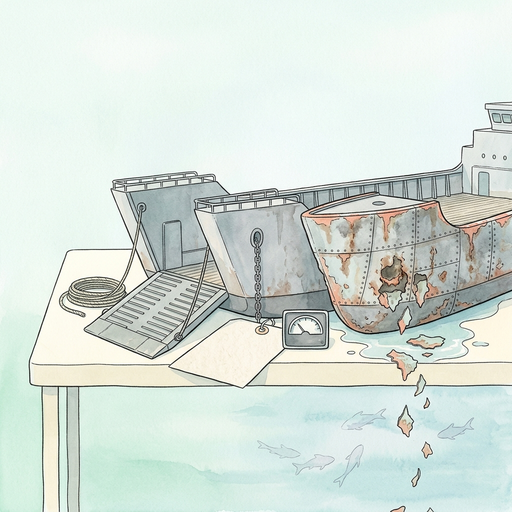
The older vessels held in these fleets reflect the industrial chemistry of the mid-twentieth century. Their bulkheads and boiler casings are insulated with thick blankets of thermal asbestos. Their transformers, gaskets, electrical cables, and hydraulic systems frequently contain polychlorinated biphenyls, toxic synthetic compounds prized for fire resistance before being banned in modern manufacturing. Inside their fuel bunkers and double-bottom tanks sit heavy residual oils, settled sludges, and oily bilge water accumulated over decades of operations. Above the waterline, their topsides are coated in layer upon layer of vintage lead-based primers and heavy-metal marine paints.
Over decades of storage, that chemistry turns into an environmental management challenge. As sun, wind, and rain degrade exterior coatings, lead-laden paint dries, blisters, and exfoliates, shedding heavy paint chips directly into the surrounding water. Corroding internal piping and thinning steel bulkheads can compromise the containment of residual bunker fuels. Meanwhile, rainwater pooling on open decks washes accumulated heavy metals and grease directly into river sediment.
Establishing the difference between potential contamination and documented environmental injury requires careful analysis. The presence of asbestos insulation inside a sealed boiler room or intact lead paint on a bulkhead does not automatically create an immediate health crisis for communities miles downstream. In undisturbed storage, those materials remain sequestered within the structure of the ship.
The hazard profile shifts dramatically the moment containment fails or physical intervention begins. When high winds sweep deteriorating paint chips into an estuary, or when marine organisms ingest contaminated bottom sediment, toxic compounds enter the aquatic food chain. The risk escalates even more sharply when an obsolete vessel is cleared for the scrap yard. The very materials that rested quietly inside an anchored hull—asbestos fireproofing, lead coatings, and chemical-laden lubricants—become immediate exposure hazards the second industrial cutting torches slice into the steel.
The environmental consequences of prolonged reserve storage reached a legal and political turning point in Suisun Bay. This shallow estuary serves as an ecologically critical gateway connecting California’s Central Valley river system to San Francisco Bay. Over decades, dozens of obsolete Second World War and Cold War-era vessels had accumulated in long, tiered rows near Benicia. Many had been stripped of parts, formally designated as non-retention hulls, and left to swing on their anchor chains as budget allocations for vessel recycling repeatedly fell short.
By the early two thousands, the physical decay of the Suisun Bay fleet was impossible to overlook. Thick sheets of lead-based paint were peeling from the superstructures of dozens of ships. Those paint flakes dropped directly into waters that serve as critical nursery habitat for endangered native fish, including the delta smelt and Chinook salmon. In two thousand five, the Government Accountability Office published an extensive review of the national disposal backlog. The agency had accumulated a nationwide backlog of one hundred fifteen obsolete vessels awaiting disposal. Forty of those ships were categorized as high-priority environmental concerns due to advanced structural deterioration.
That same report detailed how limited the disposal pipeline had become. In the programmatic window under review, the agency had scrapped seventeen vessels and transferred one obsolete hull to be cleaned and sunk as an artificial reef. Deep-water ocean sinking and donations to maritime museum organizations, two methods historically used to clear retired tonnage, had accounted for zero disposals during that period.
Clearing these ships from an estuary like Suisun Bay is not as simple as attaching a towline and steaming toward a dismantling yard. A Government Accountability Office procurement decision regarding disposal operations at Suisun Bay revealed the elaborate environmental precautions required before an ocean transit could even be permitted. Because these vessels had sat undisturbed for years, their underwater hulls were encrusted with thick carpets of invasive marine organisms, while their above-water hulls shed loose, exfoliating lead paint.
Federal regulators recognized that towing those hulls through open ocean waters risked spreading non-native species and scattering tons of toxic paint along coastal corridors. Contractors were required to place the deteriorating ships into regional dry docks first. In those dry docks, workers scraped away and contained tons of marine growth. They power-washed the exfoliating lead coatings inside a sealed basin before the vessel was certified safe for an ocean tow to recycling facilities along the Gulf Coast. Moving an obsolete ship turned into an extensive industrial and environmental project of its own.
Once an obsolete vessel reaches a recycling facility, the hazard simply relocates to dry land. Shipbreaking is inherently dangerous industrial work. It involves the progressive dismantling of massive, compartmentalized steel structures using heavy cutting torches, mobile cranes, and manual labor. Inside the dark, confined spaces of a dismantled hull, workers face fall hazards and explosive vapor pockets. Cutting torches generate toxic fumes as they burn through decades of heavy lead paint and zinc-coated steel. The recovery of scrap steel eliminates public storage liabilities. Even so, it demands continuous oversight, specialized waste containment, and rigorous safety protections to keep shipbreaking yards from turning into contaminated industrial sites.
When federal managers assess an aging ship in the reserve fleet, they face four fundamental choices: continued long-term storage, deep modernization, controlled recycling, or complete replacement with a modern vessel. Each choice preserves a different balance of capability and cash, and each demands an accounting of costs that extends over decades.
The first option, continued storage, carries low upfront costs. Keeping an older ship anchored in a river allows the government to defer the immediate multimillion-dollar price tag of dry-dock abatement and shipbreaking. It also preserves the theoretical ability to reactivate the hull in an existential crisis. The hidden cost is compounding liability. Storing a dead ship requires continuous outlays for security, custodial moorings, cathodic electrical power, periodic hull integrity inspections, and emergency response plans. If the vessel has lost its military utility, storage does not preserve strategic capacity; it merely postpones an inevitable environmental and fiscal cleanup bill.
The second option is maintenance and service-life extension. Naval architects can send a thirty-year-old roll-on, roll-off ship into a dry dock to replace thinned hull plating and overhaul propulsion machinery. This preserves specialized military features like reinforced vehicle decks and heavy-lift cranes. When executed properly, this approach avoids the massive capital cost of buying a new ship. Yet life extensions carry high technical risk. Once contractors open the machinery of an aging auxiliary ship, they frequently discover hidden corrosion and obsolete electrical systems with no commercial spare parts. Remediating widespread asbestos insulation can drive final overhaul costs far beyond initial estimates.
The third option is controlled recycling. Sending an obsolete vessel to a qualified shipbreaking facility terminates recurring custodial expenses. It recovers thousands of tons of high-grade scrap steel while permanently eliminating the risk of accidental fuel leaks in an estuary. The trade-off is immediate expenditure. Preparing an old hull, cleaning its bottom, towing it safely across oceans, and abating hazardous waste under strict occupational standards is expensive. The value of the scrap steel rarely covers the comprehensive cost of safe, modern environmental dismantling.
The fourth option is procuring replacement vessels. The government can construct purpose-built sealift ships in domestic shipyards, or purchase commercial roll-on, roll-off vessels on the global market and convert them for defense needs. New construction delivers highly reliable propulsion, automated engine rooms, compliant modern environmental designs, and compatibility with modern military hardware. The barrier is capital expense and manufacturing capacity. Domestic shipyards operate under tight industrial constraints with long delivery timelines, while buying foreign-built hulls requires legislative authorization and substantial modifications.
Waterfront geography sharpens these trade-offs. The Beaumont reserve fleet sits along the Gulf Coast, positioned directly in the path of Atlantic hurricane tracks. Storing dozens of unmanned, dead-ship hulls in a region subject to violent storm surges, tropical heat, and extreme humidity creates severe operational vulnerabilities. A single Category Four hurricane striking an anchorage can part heavy mooring lines and break hulls away from their berths. Drifting vessels can ground in sensitive coastal marshes or collide, puncturing aging fuel tanks. Environmental risk cannot be evaluated by inspecting hull steel in isolation; it must be measured against changing weather severity, tidal swings, and sea-level rise across all three anchorages.
When is an aging ship a prudent strategic reserve, and when is it a fiscal and ecological liability? The answer depends entirely on capability and condition. A structurally sound ship that provides a scarce military capability, maintained with working machinery and supported by a qualified pool of mariners, represents genuine national security insurance. Its value is measured not by commercial profitability, but by the strategic cost of not having transport capacity when a major deployment begins. Conversely, keeping an obsolete, mechanically broken hull afloat simply because disposal funding has been delayed preserves no readiness whatsoever. It turns a sovereign anchorage into an uninsured parking lot for hazardous waste.
When you hear about reserve fleets or debates over domestic sealift, remember that real preparedness is never measured by counting hulls on a map. True capacity lives in operational machinery, trained civilian mariners, and the discipline to fund timely disposal instead of deferring maintenance.
If this exploration changed how you view those gray silhouettes in the river, consider a broader question. What other critical capabilities do we assume will be ready in an emergency, while quietly paying only the bare minimum to keep them tied to the pier?