Akashi Kaikyo Bridge: Engineering a Crossing Through Wind, Water, and Earthquake
The Akashi Kaikyo Bridge was built to carry traffic across a deep, storm-swept shipping channel without obstructing the ships below. When a 1995 earthquake shifted the ground beneath its unfinished towers, engineers recalculated the cables and redesigned the remaining roadway to fit a main span that had grown by about eighty centimeters. Its completion—and the maintenance it still requires—shows that resilience depends not on resisting all movement, but on understanding and accommodating it.
By MyAudioBooks.ai ·
Listen free: Akashi Kaikyo Bridge: Engineering a Crossing Through Wind, Water, and Earthquake
On January seventeenth, nineteen ninety-five, a violent earthquake ruptured the seabed beneath Japan's Akashi Strait. Out in the open water, construction crews were halfway through building what was destined to become the longest suspension bridge on Earth. When surveying teams returned to inspect the site with precision instruments, they uncovered an astonishing reality: the two colossal steel towers had been pushed apart. The underlying tectonic plates had shifted, permanently increasing the distance between them.
When the crossing officially opened to traffic three years later, in nineteen ninety-eight, its central span stretched across approximately one thousand nine hundred ninety-one meters of open ocean. The survival of the Akashi Kaikyo Bridge is often celebrated as a triumph of brute strength, or reduced to the popular myth that an earthquake simply stretched a completed highway by nearly a meter. But the true engineering achievement reveals something far more demanding. Carrying a six-lane expressway across two kilometers of deep, storm-swept, seismically violent water requires a structure engineered to accommodate motion, and a design process flexible enough to adapt when the earth changes the blueprint mid-stride.
At My Audio Books dot A I, you can create your own audiobooks from prompts, turn your documents into audio, all with one subscription, and store your items in your own personal library.
To understand why this crossing was built, one must look at the geography of Japan's Seto Inland Sea. The Akashi Strait separates the major port city of Kobe, on the main island of Honshu, from Awaji Island to the south. Awaji Island, in turn, connects across a second strait toward the island of Shikoku. For generations, maritime ferries provided the only link across this channel. But the Akashi Strait is notoriously treacherous. It spans roughly four kilometers of open water, plunges to depths of more than one hundred meters, and is swept by tidal currents moving at up to four point five meters per second. Ferries had to contend with dense international shipping traffic, blinding seasonal fog, and violent typhoons. A permanent overland crossing was a major economic priority, planned as a vital artery within the Honshu-Shikoku Bridge Project to unite the islands into a contiguous transport network.
Building a fixed crossing across the strait meant resolving an immediate physical conflict. The Akashi Strait serves as an international shipping corridor traversed by more than one thousand four hundred commercial vessels every single day. Planting multiple intermediate concrete piers across the channel would have created unacceptable collision hazards for container ships and oil tankers. To keep the maritime lanes completely clear, engineers had to leap the deep navigation channel in a single, continuous bound.
That operational requirement dictated the choice of structure: a suspension bridge. The total crossing measures approximately three thousand nine hundred eleven meters from anchorage to anchorage. It is divided into three distinct segments: two side spans measuring approximately nine hundred sixty meters each, and a central main span of approximately one thousand nine hundred ninety-one meters.
When evaluating bridge scales, structural engineers distinguish between total length and main-span length. Total length simply measures the overall distance between approach abutments, a figure that can easily be achieved by stringing multiple short piers across shallow water. The main span, by contrast, measures the unsupported distance hanging between the two primary towers. When the Akashi Kaikyo Bridge opened in nineteen ninety-eight, that central expanse made it the record holder among suspension bridges worldwide.
The way a suspension bridge carries weight across such an expanse relies on a clear, unbroken mechanical chain. When heavy freight trucks and passenger vehicles drive onto the roadway, their downward gravitational load presses into the deck. Vertical steel wire ropes, known as suspenders, hang down at regular intervals to support this roadway. The suspenders take that downward load and transfer it straight upward into the sweeping catenary curve of the two main suspension cables overhead.
Those main cables carry the entire accumulated weight of the suspended bridge through pure tension, which is a pulling force. The cables sweep upward, rest atop the massive steel towers, and dive back down to the shorelines at either end. At the shoreline, the cables are locked deep inside colossal concrete blocks called anchorages. The anchorages pull directly against the mass of the earth, countering the horizontal tension of the cables. Meanwhile, the towers experience staggering compression, a downward squeezing force, funneling hundreds of millions of kilograms of vertical weight directly into the seabed. Through this balance of tension in the cables and compression in the towers, the bridge avoids the need for intermediate supports across the deep channel.
Transforming that mechanical equilibrium into physical reality required confronting an unforgiving marine environment. The load path must ultimately terminate in the ground, and for the Akashi Kaikyo Bridge, that meant anchoring the two principal towers directly into the ocean floor.
At the tower locations, water depths reach approximately sixty meters. Traditional land-based excavation methods or driven piles were impossible in such deep, fast-flowing water. Instead, engineers constructed massive double-walled cylindrical steel structures known as caissons. The largest caisson measured eighty meters in diameter and sixty-five meters in height, weighing roughly fifteen thousand metric tons. Specialized tugboats towed these giant steel cylinders into the strait, where marine crews faced the challenge of positioning them with millimeter accuracy amidst currents running four point five meters per second. Once precisely located, the caissons were flooded with seawater, settled into pre-dredged trenches in the seabed, and filled with thousands of cubic meters of specialized underwater concrete designed to displace water without washing away. These foundations do not merely rest on the sea bottom; they transfer the crushing compressive weight of the towers deep into dense gravel and sedimentary rock layers beneath the strait.
On the shorelines, the anchorages demanded a completely different structural solution. Instead of compression, the anchorages must resist the continuous horizontal pull of the main cables, which try to yank the shoreward ends into the sea. On the Honshu side at Kobe, engineers excavated a deep circular trench into the shoreline, creating a massive underground concrete foundation weighing hundreds of thousands of tons. The dead weight of the concrete and the shear resistance of the surrounding earth act together as a direct mechanical counterweight to the tension of the suspension cables.
Rising from the marine foundations, the two main towers climb two hundred ninety-seven meters above the surface of the water, matching the height of major skyscrapers. Each tower is fabricated from high-strength steel plates formed into hollow, multi-cellular box shafts. Inside each shaft, tuned mass dampers, consisting of heavy control weights on mechanical dampers, were installed to suppress swaying motions caused by wind and earthquakes.
Perched atop the saddles of these towers are the two primary suspension cables. Each cable measures over one meter in diameter and contains thirty-six thousand eight hundred thirty individual galvanized steel wires, each roughly five millimeters thick. Because a steel cable of that dimension is far too heavy and stiff to manufacture in a factory and transport across the sea, it had to be assembled directly on site. Using the aerial spinning method, guide ropes were pulled across the strait, after which spinning wheels traveled back and forth across the four-kilometer expanse, carrying thousands of individual loops of wire. Once all the wires were in place, powerful hydraulic presses compacted them into tight, dense cylinders, which were then wrapped in protective wire to seal out moisture.
Yet load-bearing strength alone cannot ensure the survival of an ultra-long suspension bridge. In an open maritime strait exposed to severe seasonal typhoons, the most relentless dynamic threat is aerodynamic instability. When high-velocity winds strike a flat roadway deck, air separates into swirling vortices above and below the surface. If these vortices shed at a frequency matching the bridge's natural vibration, they can trigger violent, self-reinforcing twisting oscillations known as aerodynamic flutter. This exact aerodynamic phenomenon famously destroyed the original Tacoma Narrows Bridge in nineteen forty.
To prevent flutter, the designers of the Akashi Kaikyo Bridge avoided a solid, closed box girder. Instead, they suspended a massive open steel truss framework measuring fourteen meters deep and thirty-five point five meters wide. The triangular lattice structure allows strong winds to pass straight through the deck rather than generating destructive aerodynamic lift. Furthermore, engineers installed a continuous vertical stabilizing fin along the center of the truss to disrupt vortex formation, alongside open steel grating in the median and walkways. In extensive wind-tunnel simulations, this aerodynamic design proved capable of remaining completely stable under typhoon-force winds of up to two hundred ninety kilometers per hour.
By early nineteen ninety-five, construction was progressing on schedule. The offshore caissons had been successfully sunk, the towers stood tall above the strait, and the labor-intensive process of assembling the two sweeping main cables was recently completed. Thousands of vertical suspender ropes were already manufactured, waiting on site. The roadway's stiffening truss had been designed down to the millimeter, and specialized steel fabrication yards across Japan were beginning to assemble the girder segments.
Then, at five forty-six in the morning on January seventeenth, nineteen ninety-five, the Great Hanshin-Awaji earthquake struck the region. The epicenter lay just four kilometers away from the southern tower, on the northern tip of Awaji Island, registering a magnitude of six point nine. The disaster caused widespread devastation across Kobe and surrounding municipalities, collapsing elevated expressways, destroying port facilities, and claiming thousands of lives.
At the bridge site, the seismic event created two distinct mechanical challenges: dynamic shaking and permanent tectonic displacement. Shaking refers to the violent, rapid accelerations that stress a structure back and forth as energy moves through the earth. Permanent ground displacement, by contrast, occurs when underlying geological faults slip, physically altering the geographic positions of the foundations relative to one another.
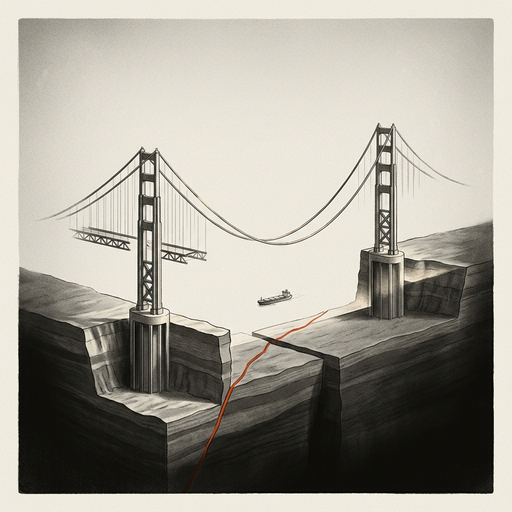
When inspection teams surveyed the bridge site after the disaster, they discovered that the primary steel towers and the newly hung main cables had survived the shaking with virtually no structural damage. The flexible, unfinished suspension system had swayed through the violent accelerations without buckling. But precise satellite and geodetic measurements revealed an astonishing physical change: the Nojima Fault, which ruptured during the quake, had passed directly between the bridge's main foundations. The Awaji-side tower foundation had moved approximately one point three meters westward, while the southern anchorage on Awaji Island had shifted approximately one point four meters westward.
Because the foundations moved at an angle relative to the bridge's centerline, the longitudinal distance between the two main towers had permanently expanded. The central span had lengthened from its planned one thousand nine hundred ninety meters to roughly one thousand nine hundred ninety point eight meters, an increase of approximately eighty centimeters. Simultaneously, the southern side span on the Awaji side had widened by roughly thirty centimeters.
A common myth suggests that the earthquake made the bridge a meter longer by ripping the structure apart, requiring workers to weld a patch into a damaged roadway. The reality was fundamentally different. The roadway deck did not yet exist. At that moment in early nineteen ninety-five, the bridge was essentially two independent vertical steel towers holding up a pair of flexible steel cables.
Crucially, deep-water surveys using side-scan sonar, seabed core sampling, and underwater cameras confirmed that the caisson foundations had not slipped or sheared across the ocean floor. The massive concrete cylinders remained firmly seated on their underlying rock. The foundations had moved because the tectonic crust of the Earth had moved beneath them.
Because the bridge was still under construction, engineers faced an unprecedented design problem: the geometry of the physical crossing no longer matched the blueprints. The increased tower separation pulled the main suspension cables tighter, which slightly flattened their catenary curve and raised their profile. Every single vertical suspender rope, manufactured to fit a specific mathematical curve, was suddenly misaligned with the intended deck height.
The engineering team did not attempt to force the towers back into position. Instead, they adapted the remaining design to fit the new geometry. They recalculated the catenary curve of the lengthened cables, adjusted the lengths and attachment points of the vertical suspenders, and modified the dimensions of the remaining stiffening truss segments before they left the fabrication shops. By recalculating the geometry while the components were still in production, engineers incorporated the eighty-centimeter tectonic expansion directly into the finished design. When the bridge opened to traffic on April fifth, nineteen ninety-eight, its verified central span measured one thousand nine hundred ninety-one meters.
The survival and completion of the Akashi Kaikyo Bridge offers critical insights into modern structural resilience, but it is equally important to recognize the precise limits of what that event proved. The bridge did not survive because it was an immovable, unyielding monolith. It survived because suspension bridges are inherently flexible systems designed to distribute extreme energy along continuous load paths.
Moving with the bearing ground is fundamentally different from sliding across it. If the marine caissons had broken free from their supporting strata, the resulting structural tilt or foundation failure could have brought down the entire crossing. Because the caissons maintained their bond with the underlying earth, the earthquake changed the position of the support points without destroying their capacity to carry load.
Equally important was the specific timing of the disaster. The earthquake occurred at a rare transitional phase of construction. Had the earthquake struck after the roadway's rigid stiffening truss had been fully bolted and riveted into a single, two-kilometer beam, the permanent eighty-centimeter ground displacement would have generated enormous internal shearing stresses along the deck. The fact that the roadway had not yet been installed provided engineers with the flexibility to adapt the remaining elements to the new reality of the site.
Opening the bridge in nineteen ninety-eight marked the completion of construction, but it also initiated an endless regime of inspection and maintenance. A bridge built across a harsh maritime strait faces continuous deterioration from salt spray, atmospheric humidity, and heavy cyclic traffic loads. Steel in a marine environment is vulnerable to corrosion, and repeated dynamic stresses create risk of fatigue, where microscopic cracks can develop and propagate through metal members over time.
The main suspension cables present the most critical maintenance priority. Unlike deck panels, which can be unbolted and replaced, the main cables cannot be swapped out without dismantling the entire bridge. If moisture penetrates the cable wrap and rusts the thirty-six thousand individual wires inside, the bridge's structural capacity degrades irrevocably. To prevent this, the Akashi Kaikyo Bridge employs an innovative dry-air injection system. Dehumidified air is continuously pumped through the interior of both main cables under positive pressure, driving out trapped moisture and maintaining relative humidity below forty percent, halting the corrosion process entirely.
Sensors mounted throughout the structure track wind velocities, ambient temperatures, cable tension, and seismic vibrations in real time. Yet engineering always retains open questions. The nineteen ninety-five earthquake demonstrated how an unloaded cable-and-tower structure responds to near-field fault rupture. It cannot fully predict how the completed, fully loaded bridge, carrying thousands of moving vehicles and facing different seismic wave frequencies, would behave during a future subduction-zone earthquake along the Nankai Trough.
True engineering resilience is not a single, permanent achievement stamped on opening day. It is an ongoing discipline of measurement, vigilance, and physical care. The Akashi Kaikyo Bridge stands as a testament to the fact that when human infrastructure meets dynamic earth systems, success depends on understanding movement, accepting the limits of rigid resistance, and maintaining the structures that keep our world connected.
If this look at how engineering adapts to shifting ground changed how you view major infrastructure, take a moment to reflect on the bridges you cross every day. Consider how much unseen calculation and constant maintenance is quietly working beneath your feet to keep the roadway suspended.